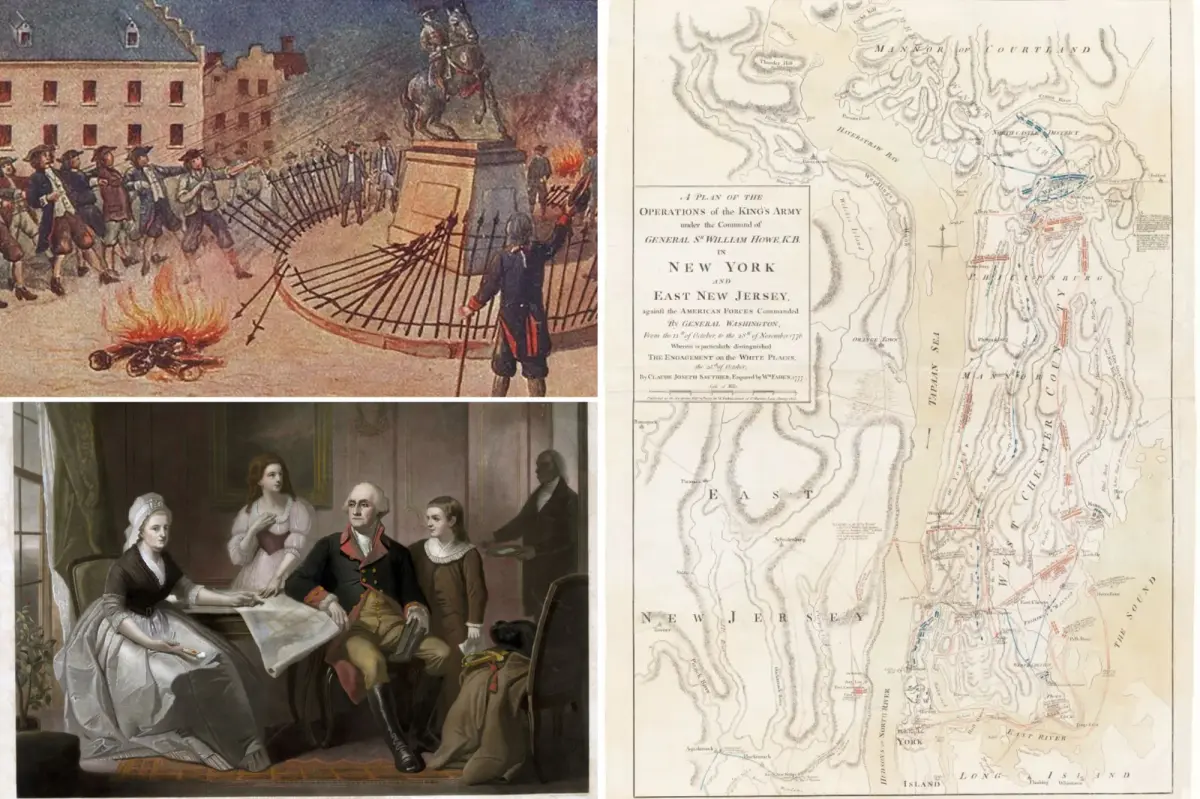

New York has long carried a rebellious streak.
The city played a crucial role in America’s founding, its five boroughs becoming a stage for the turbulent struggle to break away from British rule — a position shaped in part by its strategic place along the Hudson River.
For the revolutionaries seeking independence, however, daily life was harsh, particularly in Manhattan, which stayed in British hands until 1783.
“Everyone who’s living in today’s New York City, in the wider ring around Manhattan, is basically experiencing a constant low-level civil war,” said Peter-Christian Aigner, executive director of the Gotham Center for New York City History and co-curator of its exhibit, The Occupied City, describing the reality faced by residents of that era.
“Those conditions are grim, and they’re grim for everybody.”
Aside from a roughly yearlong stretch when the Continental Army held the city, many American patriots in New York endured British occupation — some as prisoners of war, others operating covertly as spies during the Revolution.
Here is a look at how New York’s rebels lived from day to day:
Clothing
Patriot fighters had no official militia uniform, so most marched into combat wearing their finest suits or everyday work clothes.
At that time, the style for men was slim-fitting three-piece suits, white stockings, low-heeled shoes with buckles and three-cornered hats.
Women wore robes à la française — or long gowns with tight bodices and panniers, or hoops, to give the era’s famously wide silhouette.
Because it was wartime, most rebels wore clothes that were spun from wool and stitched together by their wives or children.
“They’re not particularly well-outfitted,” Aigner said.
Housing
Finding places to sleep was a major issue for both sides during the Revolutionary War, with the British Parliament famously passing the Quartering Acts in 1765 and 1774 that required colonists to provide housing, food and supplies to even British soldiers.
As many as 20 soldiers could be packed in a 21-square-foot room.
There were also makeshift camps throughout Manhattan, where disease ran so rampant that men with carts rode through daily and picked up bodies that were piling up in the streets.
There are forgotten graveyards beneath modern-day City Hall where the remains of more than 20,000 New Yorkers from the era rest.
“We don’t know exactly how many people die, but people are dying like flies,” Aigner said of the times.
READ MORE: Biography of Judge Tony Graf: Age, Spouse, Salary, and Political Affiliation
Food
The cost of basic goods jumped 700% during the war, and there was constant talk of famine.
The rebels lived on meager rations of bread, pork and beef and were forced to “forage” for their meals in the then-plentiful forests and swamps of the five boroughs.
“But it also meant raiding — the word gets used a little bit loosely sometimes. A foraging party might go out into the woods, but you’re more likely to find resources on an established farm,” Aigner said.
Meeting places
Taverns were the prime meeting spot for politics — and New York had more watering holes than any other colony.
Rebels from other colonies would flock to the taverns to share updates on the war.
Fraunces Tavern in Lower Manhattan is perhaps the most famous in the US for hosting the Founding Fathers as they mapped out their plans to revolt.
Rivington’s Coffee House, which stood in Hanover Square in the same area, was also a favorite meeting spot for the George Washington-appointed Culper Spy Ring, which organized a secret network, oversaw the spread of military intelligence and played an important role in intercepting British plans.
“There are spies just riddled across the city. There are a lot of rebels in the city, but they’re incognito,” Aigner said.
Other patriots were stationed in around the outer boroughs, which were mostly farmland, and helped launch frequent incursions against the British.
Getting caught
Paranoia was constant.
Washington had a persistent fear that he had loyalist spies in his ranks, and the Continental Army had consistent desertion.
The future president ultimately ordered the execution of traitors, though other punishments such as flogging were also handed out.
Being captured by the British wrought harrowing punishment, too.
American spies and soldiers were taken as prisoners of war and put on half a dozen ships off the Brooklyn Navy Yard.
They were fed moldy bread, given no place to relieve themselves and had vermin crawling through the boats.
Outcome
The British finally evacuated from New York on Nov. 25, 1783, after the signing of the Treaty of Paris — ending a seven-year military occupation of the city.
“We come out of this harrowing experience a far more united nation,” Aigner said.
“I don’t know how you sugarcoat a war, but there were real gains that came out of that. We gained independence, all of our notions of democracy.”