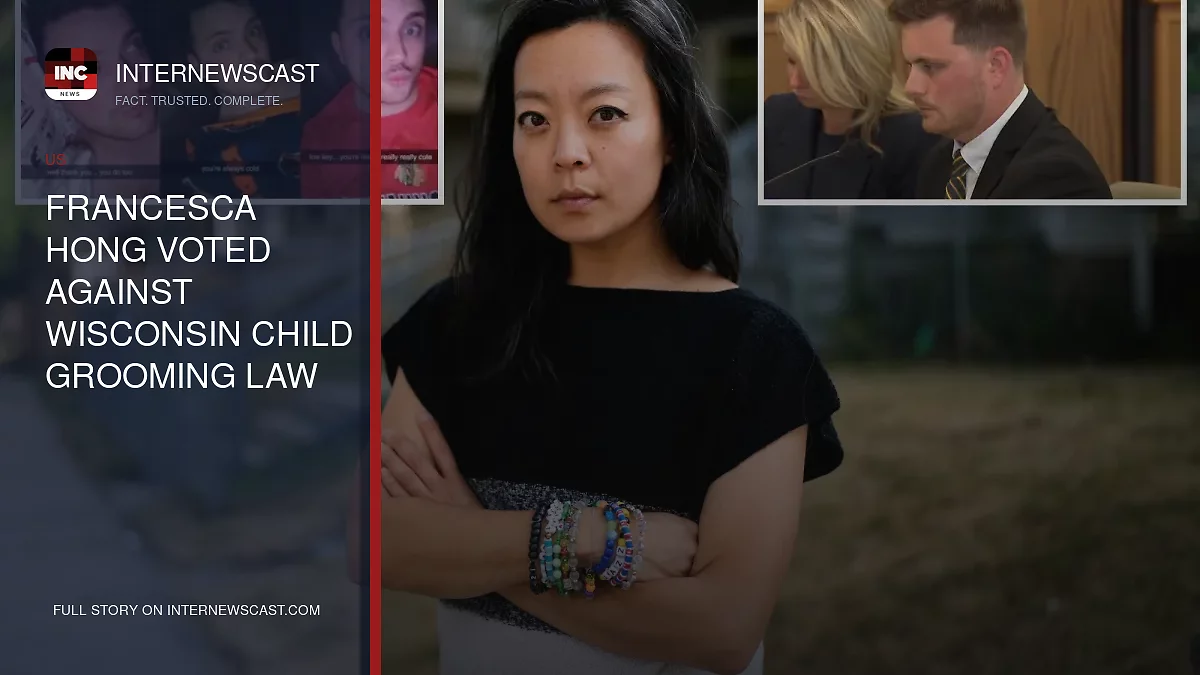

WASHINGTON — Wisconsin state Rep. Francesca Hong, a prominent socialist-aligned Democrat, was among only six lawmakers in the state Legislature who voted against a child grooming bill that was signed into law earlier this year by Democratic Gov. Tony Evers, legislative records show.
The Wisconsin child grooming law makes it illegal for adults to engage in “a course of conduct, pattern of behavior, or series of acts” intended to condition, seduce, solicit, lure or entice a child into sexual activity or pornography. The measure followed the case of former Kenosha teacher Christian Enwright, who was convicted on multiple misdemeanor counts after pursuing a relationship with a 14-year-old student.
“[Enwright] engaged in classic grooming behavior, preying on the vulnerability of at least one female student, under the guise of being a mentor, to foster and further a predatory relationship with her,” a school district investigator wrote in a report cited by the Cap Times in December 2025.
According to the report, Enwright began contacting the minor on Snapchat in June 2023 and exchanged more than 600 messages with her. The communications included sexualized remarks about her appearance as well as photos of himself shirtless in bed.
The Cap Times also reported that at least two staff members had privately raised concerns about Enwright’s conduct around female students. He was additionally known among some at the school for giving “long hugs.”
The case came to a head in February 2024, when the school district’s human resources department received an anonymous tip regarding Enwright’s behavior toward the teenager. He was arrested, charged and fired three months later.
Prosecutors, however, faced legal hurdles. Enwright had not had sexual contact with the girl, and the photos he sent or requested from the teen were not explicit enough under Wisconsin law to support a felony charge.
Enwright ultimately pleaded guilty in April 2025 to 15 misdemeanor counts of disorderly conduct. In July, he was sentenced to 15 months in jail followed by three years of probation.
The subsequent outcry lead to the Wisconsin legislature passing the anti-grooming law, with the Assembly approving it 93-6 and the state Senate passing it by voice vote.
It is unclear why Hong, the leading Democratic gubernatorial candidate ahead of Tuesday’s primary, opposed the bill — though her colleagues who voted against it suggested the measure was redundant in state law.
Hong’s campaign did not immediately respond to requests for comment.
The 37-year-old previously expressed support for both defunding and abolishing the police.
“Police exist to uphold white supremacy. Defund then abolish. Reform can’t be an option,” Hong posted on social media in October 2021, though she has since retreated from that position.
“I was actually trying to become a sports journalist when I first went to college, so I learned you sometimes have bad takes on Twitter,” she recently told reporters in a bid to explain her radicalism.
After Evers signed the anti-grooming bill in March, it was used against 36-year-old Joseph W. Cook of Janesville, who was charged with preying on a cognitively impaired girl.
Prosecutors say the two used the encrypted messaging service Signal to communicate for nearly three years, and the girl alleged to authorities that Cook planned to have her move in with him when she turned 18.
According to the girl, Cook used a Signal setting that would make messages and images vanish after about 30 seconds and would “get mad” when she attempted to change that option.
After police arrested Cook, a search of his home turned up multiple knives and machetes, boxes of ammunition and a Glock handgun with a laser attachment.
Should Hong win the Democratic primary, she will likely face Rep. Tom Tiffany (R-Wis.) in the general election.