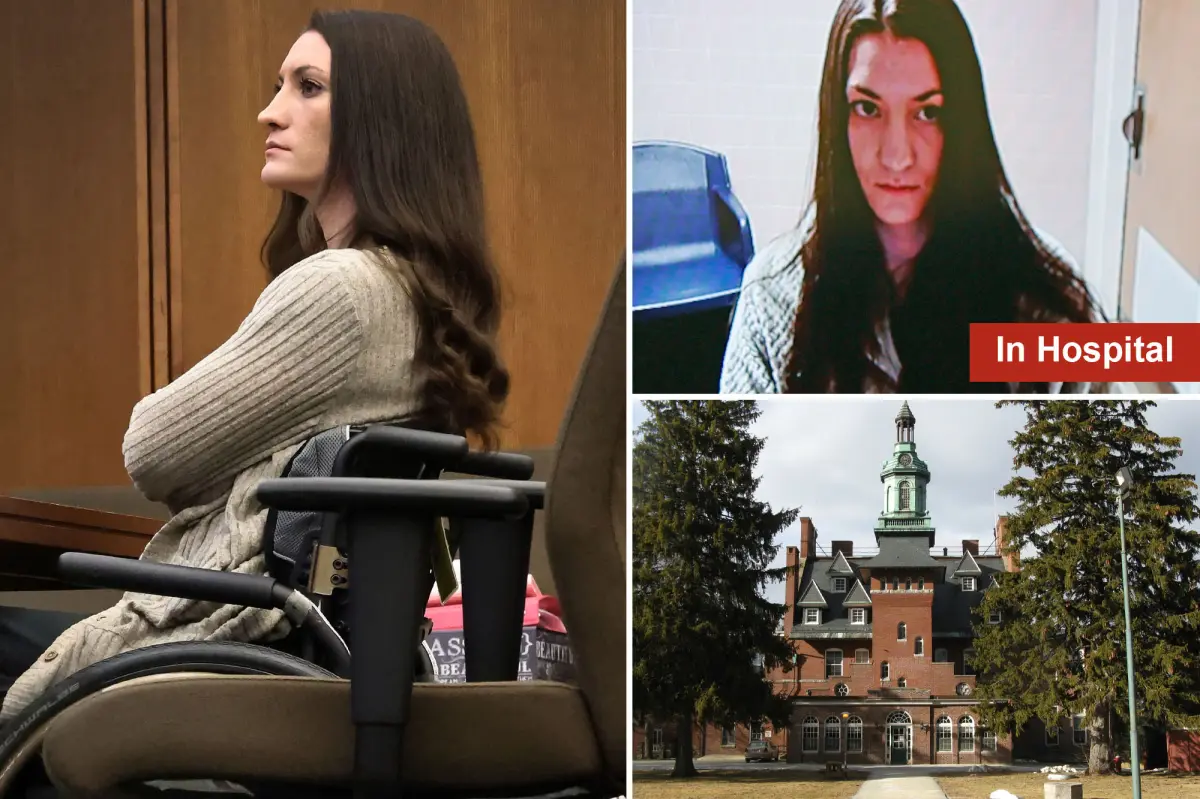

Lindsay Clancy is expected to stay at a Massachusetts psychiatric hospital for now as the high-profile triple-murder case against her remains unresolved following a dramatic mistrial declared Friday.
Clancy, 36, will be sent back to Tewksbury Hospital, the state-operated psychiatric facility where she had been housed earlier, defense attorney Kevin Reddington said Friday after the Massachusetts Supreme Judicial Court rejected his emergency effort to prevent the mistrial.
Jurors could not come to a unanimous verdict, with one male juror reportedly holding out, on the question of whether Clancy was criminally responsible for the deaths of her three children — 5-year-old Cora, 3-year-old Dawson and 8-month-old Callan — who were strangled in the basement of the family’s Duxbury home on Jan. 24, 2023.
Clancy has maintained that she was suffering from postpartum psychosis and had been prescribed an excessive mix of psychiatric medications. After the children were killed, prosecutors have said, she cut her wrists and neck before jumping from a second-story window, an act that left her partially paralyzed.
During testimony on Aug. 21, Dr. Avram Mack, formerly of Nemours Children’s Health in Delaware, offered jurors a glimpse into what he described as Clancy’s isolated day-to-day life inside the Tewksbury psychiatric facility.
“Mostly, she described, she stays in bed or on her own,” Mack told the court, referring to his interviews with Clancy while she was hospitalized.
He said Clancy did not appear to spend much time engaging with other patients, though she had some contact with staff members. “There was a therapist that she described working with,” Mack testified.
Clancy, who now relies on a wheelchair because of injuries from her suicide attempt, also received physical therapy at the hospital, Mack said, though he noted she “wasn’t very interested” in participating in those sessions.
“She wasn’t interested in the food there,” Mack continued.
She described having visitors “on a not infrequent basis, and that sometimes, she was able to eat food or drinks that were brought in by them.”
Clancy also described “that she wasn’t very interested in her own hygiene or grooming,” he added.
“Showering is embarrassing. It requires staff to help her, and that’s one way in which she would rather not,” Mack said. “It may also be that she described a lack of interest … so, it’s both components.”
“She described feeling depressed, which she termed situational depression,” the psychiatrist said. “She described feeling—I’m not sure the exact term she used—but feeling miserable, not wanting to be alive.”
Mack, who got into a fiery exchange with Lindsay Clancy’s lawyer while testifying in the case, resigned from Nemours Children’s Health on the same day he testified.
Clancy will remain at the facility under the same murder charges as prosecutors weigh their next steps on whether or not to try her again with a new jury.
Her attorneys could petition for bail, though it is likely she will remain in Tewksbury Hospital under the same bail conditions while she awaits the fate of a new trial, Brad Bailey, a Boston defense attorney and former prosecutor, told The Post.
Bailey, who is not involved in the case, believes Plymouth County District Attorney Timothy J. Cruz will push to retry Clancy following the mistrial to push for justice in the killings of little Cora, Dawson, and Callan.
“I do anticipate that Tim Cruz will choose to retry the case, not only because, in his opinion, he has to stand up for the three deceased children, but also because the case hasn’t been resolved,” Bailey said.
Prosecutors may offer Clancy a plea deal for a lesser charge, such as second-degree murder or manslaughter rather than first-degree murder, according to Bailey.
“I can’t imagine Kevin Reddington would accept that or take it,” Bailey added of a plea deal.
Bailey said he believes that at a new trial, the prosecution will focus on finding stronger experts, specifically ones that have experience with treating postpartum psychosis.
The defense will also likely try to do a better job helping the jury understand that patients can come in and out of psychosis and have periods of lucidity, the attorney added.
Unless Cruz confidently determines that it is not worth retrying Clancy, given that 11-to-1 jurors are seeking to acquit her, he is unlikely to seek a dismissal.
“If the state decides it doesn’t want to retry, it would do what we call a nolle prosequi in the case, which is a move to dismiss the indictments on their own,” Bailey said.
“I think we’re gonna be looking at a trial down the line, which is gonna be Murder One, and much of the process and proceedings are gonna be the same,” he continued.
“And I would be surprised if he gets any different result, and certainly it’s potentially possible that the defense could get the result they’re looking for.”