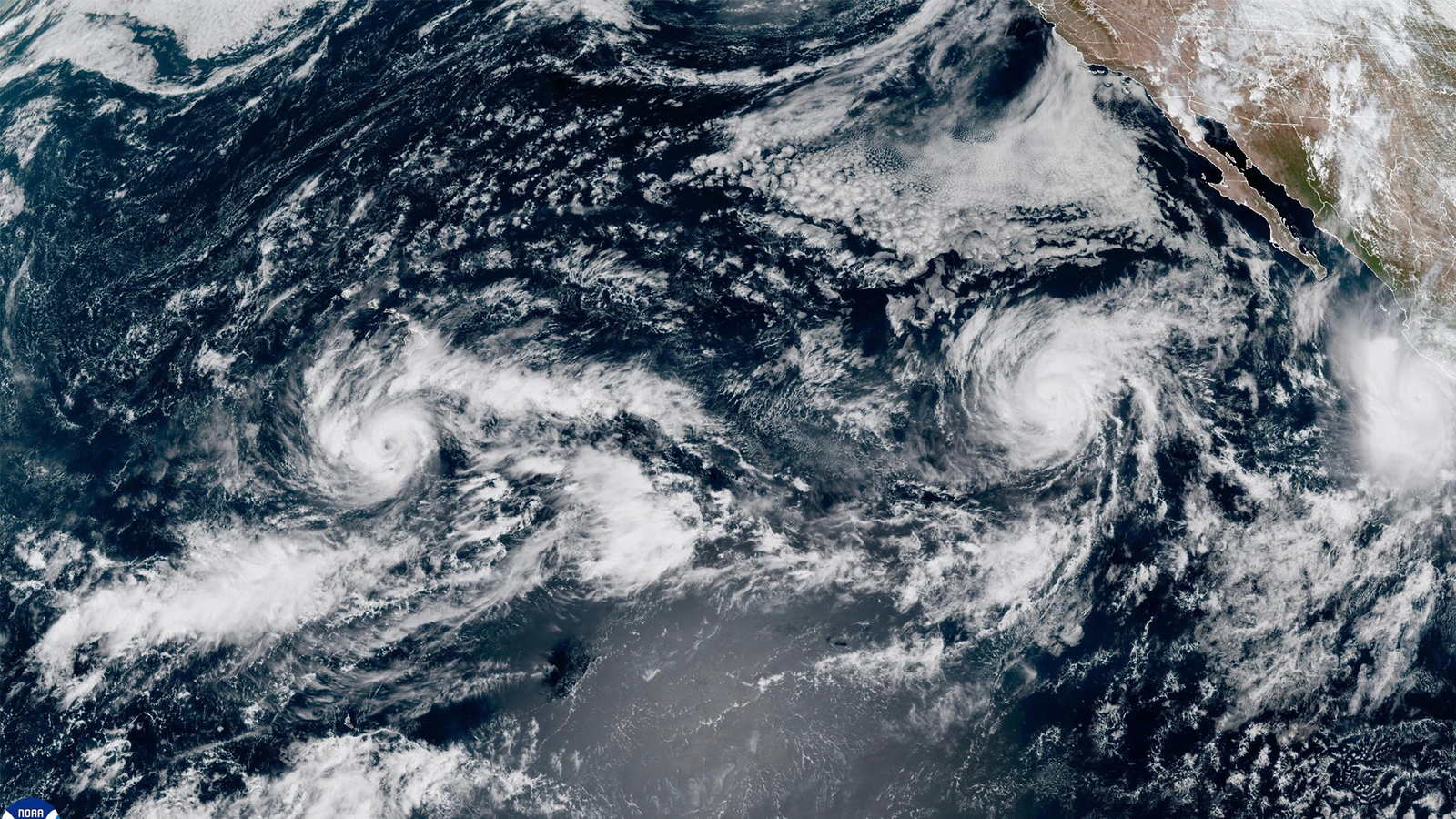

HILO, Hawaii — Residents of Hawaii’s Big Island are bracing for another potentially deadly and destructive storm. Hurricane Nolo is expected to generate flash flooding and dangerous surf as it passes just south of the islands through the weekend.
Nolo was forecast to intensify into a major hurricane Saturday after its maximum sustained winds rose to 105 mph Friday. The storm’s center was approximately 185 miles south of Hawaii’s southernmost point.
Rainfall totals on parts of the Big Island could reach 15 inches, forecasters said, with isolated amounts as high as 25 inches possible. That estimate was lower than an earlier projection of up to 35 inches.
“People are going to want to kind of shelter in place on the Big Island, be in their safe place, certainly by later today, tonight, well into Saturday,” Michael Brennan, director of the National Hurricane Center, said Friday. He urged people not to travel unless necessary, warning of dangerous flooding, powerful winds, downed trees and fallen power lines.
The hurricane center said heavy rain could also affect Hawaii’s other islands. Maui faced the possibility of intense rainfall, life-threatening flooding and mudslides.
On the Big Island, crews worked for hours Friday to construct berms that could redirect runoff and clear large debris before the heaviest rain arrived, said Erika Kapu, Hawaii program manager for the humanitarian nonprofit CORE.
CORE and other nonprofit groups spent the week airlifting supplies from Oahu to the Big Island, including camp stoves and hygiene products. The materials were intended for a community relief hub that has operated since Hurricane Lala struck in August.
Hawaii prepares as northern edge of Nolo is expected to barrel through
State officials urged residents to assemble emergency kits, while Gov. Josh Green issued an emergency proclamation that activated more than 230 Hawaii National Guard members. Schools were closed in some areas.
Hawaii County officials encouraged people living in flood-prone areas of the Big Island to consider moving to designated shelters or other safe locations.
“We encourage everyone to complete their preparations, stay connected to official alerts and weather updates, and secure safe shelter before flooding strikes,” Mayor Kimo Alameda said in a statement.
The heaviest rainfall from Nolo was expected over the Big Island’s southeastern region, the same area affected by Lala. The ground there remains saturated from additional rain. Storm surge of 1 to 3 feet could also produce large, dangerous waves and coastal flooding, the hurricane center said.
Hawaiian Electric, the state’s main utility, said crews assisting with power restoration in Kauai following Hurricane Lowell this month would return to Oahu, Maui and the Big Island to prepare for Nolo.
Residents and visitors across the Big Island turned their attention to storm preparations.
In Hilo, where rain was light Friday, people filled bags with sand and gravel at Francis Wong Stadium. Authorities had established the site as a sand distribution center.
Dean Taise said water had begun flowing from the street into his driveway, prompting him to collect several sandbags in case flooding worsened.
“They say, prepare for the worst, right? Hope for the best,” Taise said.
Gov. Josh Green also requested an emergency disaster declaration covering four Hawaii counties.
YOU MAY ALSO READ: Kaitlan Collins Absent From Her CNN Show Following Trump Ban
Polo is strengthening after returning to Category 5 intensity
In Mexico, meanwhile, Hurricane Polo threatened the Baja California peninsula after bringing storm conditions to the country’s southwestern coast.
The hurricane center said Polo strengthened significantly overnight and into Friday morning, drenching portions of Mexico’s Pacific Coast. No major damage or flooding had been reported along the coast overnight or into Friday.
By midday Friday, attention had shifted toward the peninsula, where Polo was expected to curve back and make an impact between Monday and Tuesday. Local officials prepared shelters, while Mexico’s government announced Friday afternoon that ports in the region would close as dark clouds gathered overhead.
The latest estimated sustained winds were 180 mph.
Residents stacked sandbags to fortify beachfront shops and evacuated their homes in some coastal areas on Thursday. Mexican authorities opened shelters and cleared people from beaches, and 15,000 security personnel were deployed across the coast. Schools were closed.
In the port city of Lázaro Cárdenas in Michoacán, seawater swept through homes and left wooden planks and furniture strewn on the streets. Locals and government officials were clearing debris and shoveling thick mud coating much of the town.
Alicia Contreras said the walls and roof of her restaurant had been severely damaged by 15-foot waves. As officers and family helped pick through the damage, Contreras worried about how she would recover economically.
“This is huge because we have no other source of income. Now we’re just surviving,” Contreras said.
Brennan said some moisture associated with Polo will be pushed into parts of the southwestern U.S. by Monday, possibly producing scattered flash flooding in the Four Corners region, particularly portions of Arizona and New Mexico.
Biologists on Friday relocated eggs from two olive ridley sea turtle nests on Southern California beaches to the Aquarium of the Pacific in Long Beach over concern about high tides and hazardous surf as officials monitor Hurricane Polo.
Powerful storms come during the weather phenomenon El Niño
El Niño is prompting major environmental shifts across the world, fueling drought in some areas and flooding in others. It traditionally dampens the Atlantic hurricane season, while it tends to rev up tropical cyclone activity in the Pacific with moist air and little wind shear.
A third storm in the Pacific, Hurricane Odalys, was at Category 4 status and was still far from land Friday, roughly 955 miles (1,537 kilometers) west-southwest of the southern tip of the Baja California peninsula.
Two other powerful storms were churning in the Atlantic Ocean but were not near land.
In the northern Atlantic, Tropical Storm Fay reformed early Thursday. As of Friday, it was about 1,040 miles west-southwest of the Azores, the hurricane center said. Off Africa’s western coast, Tropical Storm Gonzalo strengthened early Friday as it approached the Cabo Verde Islands.
Associated Press writers Dave Collins in Hartford, Connecticut; Gabriela Aoun Angueira in San Diego; and Kathy McCormack in Concord, New Hampshire, contributed to this report.
Copyright © 2026 by The Associated Press. All Rights Reserved.