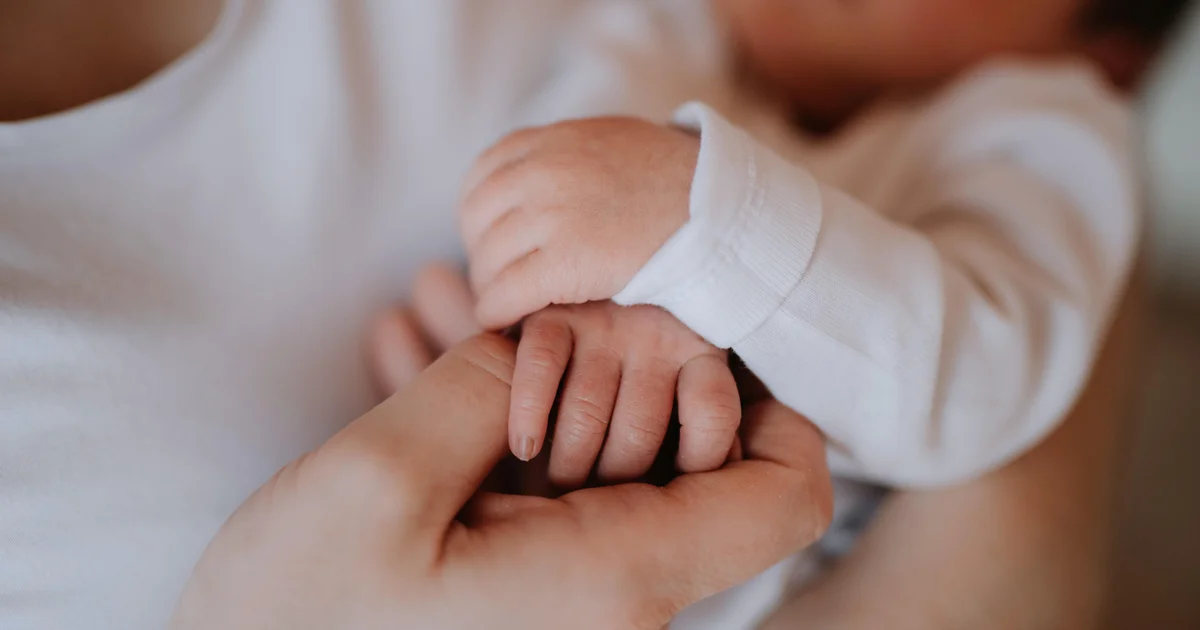
Kasey turns seven weeks old tomorrow, but her world is still much smaller than her family hoped. Her parents have started keeping track of the people she has yet to meet: great-grandparents in the Midwest, relatives in Arizona, loved ones whose health is failing and who may not have time to wait. The barrier between them is measles.
In Utah, the public health message suggests the most dangerous stretch may be over. After temporarily recommending early measles vaccination because of local spread, the state has returned to the standard guidance: the first MMR shot at 12 months. Utah’s weekly case numbers have dropped significantly since peaking in March. Nationally, however, the outbreak is still moving in the wrong direction, with confirmed cases this week surpassing last year’s total and continuing to rise.
For Abby Laskey and Liam Hammons, who live in Mill Creek just outside Salt Lake City, those broader trends do little to change the risk calculation at home. Their daughter is far too young for the MMR vaccine. The earliest possible dose would come at six months, and with Utah back on its usual schedule, she is more likely to wait until her first birthday. Until then, Kasey’s safety rests on herd immunity — the shared protection measles is uniquely good at undermining.
That reality has forced her parents to redraw the boundaries of ordinary life, even as officials describe the local outbreak as easing. They avoid museums, indoor public spaces and air travel. Both parents are vaccinated. Both are cautious. Both are following the rules health systems have long promoted. Still, they cannot bring their newborn to the relatives most eager to hold her. “There’s not a guarantee,” Abby told me, “that by the time she’s fully vaccinated they’ll be able to meet her at all.”
One part of their situation has stayed with me. When explaining their caution to older family members, Abby and Liam found themselves leaning on medical authority to soften the blow. The pediatricians are really cautioning against travel, they would say, invoking the doctor’s office as a shield. But that, too, felt uncomfortable. Liam described it as “offloading blame and caution onto systems that are already … on the ropes … in the public perception.” The predictable pushback is easy to imagine: pediatricians are being too cautious; measles was just something children got. Abby and Liam did not want every pediatrician in Utah to become the reason their baby stayed home.
Vaccination used to spread the cost. Now it doesn’t.
Vaccination once made that kind of protection a shared responsibility. When enough people are immune, infants too young to be vaccinated are protected by the community around them. But that protective wall is weakening. National kindergarten MMR coverage has fallen from 95.2% five years ago to 92.5% last year, slipping below the level epidemiologists generally associate with herd protection. The risk does not vanish when coverage declines. It shifts — onto the immunocompromised, newborns and families suddenly forced to police every interaction during what should be a period of bonding and recovery.
Abby kept returning to something she and Liam struggled to put into words: stories of children who survive measles, only to “die of related things” later. What they were reaching for is known as immune amnesia. Measles does not merely cause an acute illness. It attacks immune cells that store the body’s memory of previous infections, wiping out part of that defense system. In research led by immunologist Dr. Michael Mina, measles was linked to increased deaths from other infections for roughly 28 months afterward. A child may recover from measles and remain more vulnerable for two years. Dr. Paul Offit and New York Times writer David Wallace-Wells have described the societal counterpart as “cultural immune amnesia” — a collective forgetting of how dangerous these diseases once were. Now, both forms appear to be unfolding together.
The official reports only tell part of the story
As of July 21, the United States had recorded 2,295 confirmed measles cases in 2026, according to the Johns Hopkins University measles tracker. That figure has already exceeded the 2,289 cases reported for all of 2025 and represents the highest national total in 35 years, with more than five months remaining in the year. The CDC’s separate weekly tally, released on Fridays, stood at 2,260 as of July 16. The two trackers are following the same outbreak; their reporting weeks simply close on different schedules.
Even short of that line, 2026 is running about 37% ahead of last year’s pace at the same point, and roughly 97% of cases are spreading within U.S. communities. Utah alone has counted 518, spread across 22 of its 29 counties, a share no other state has matched.
Genomic sequencing ties the numbers to one continuous chain: the mutations in Utah’s cases trace back to an outbreak that started in West Texas in January 2025, the same signature now confirmed in at least four other states.
The nation’s measles elimination status is now on the line
The United States’ measles elimination status, held since 2000, requires no continuous domestic transmission for a full year. The Pan American Health Organization is scheduled to make its formal assessment in November, but based on the data, the U.S. has already lost its measles elimination status.
“This didn’t have to be,” Abby said. They’re not that afraid of the virus itself, they told me; they’re angry it’s forcing the question at all. “If we’re losing the plot on this one,” Liam said, “what’s the next thing we lose the plot on?” He told me that “Trust is going to take a long time to build back up … a lot of unnecessary suffering and a lot of unnecessary deaths.”
Kasey’s parents will keep her home. They’ll see family at campgrounds and on beaches, outdoors, at a distance, and skip the flights. Her great-grandparents will keep waiting.
This article was originally published in Dr. Céline Gounder’s “Underlying Conditions” newsletter on Substack. Read more and subscribe here.