
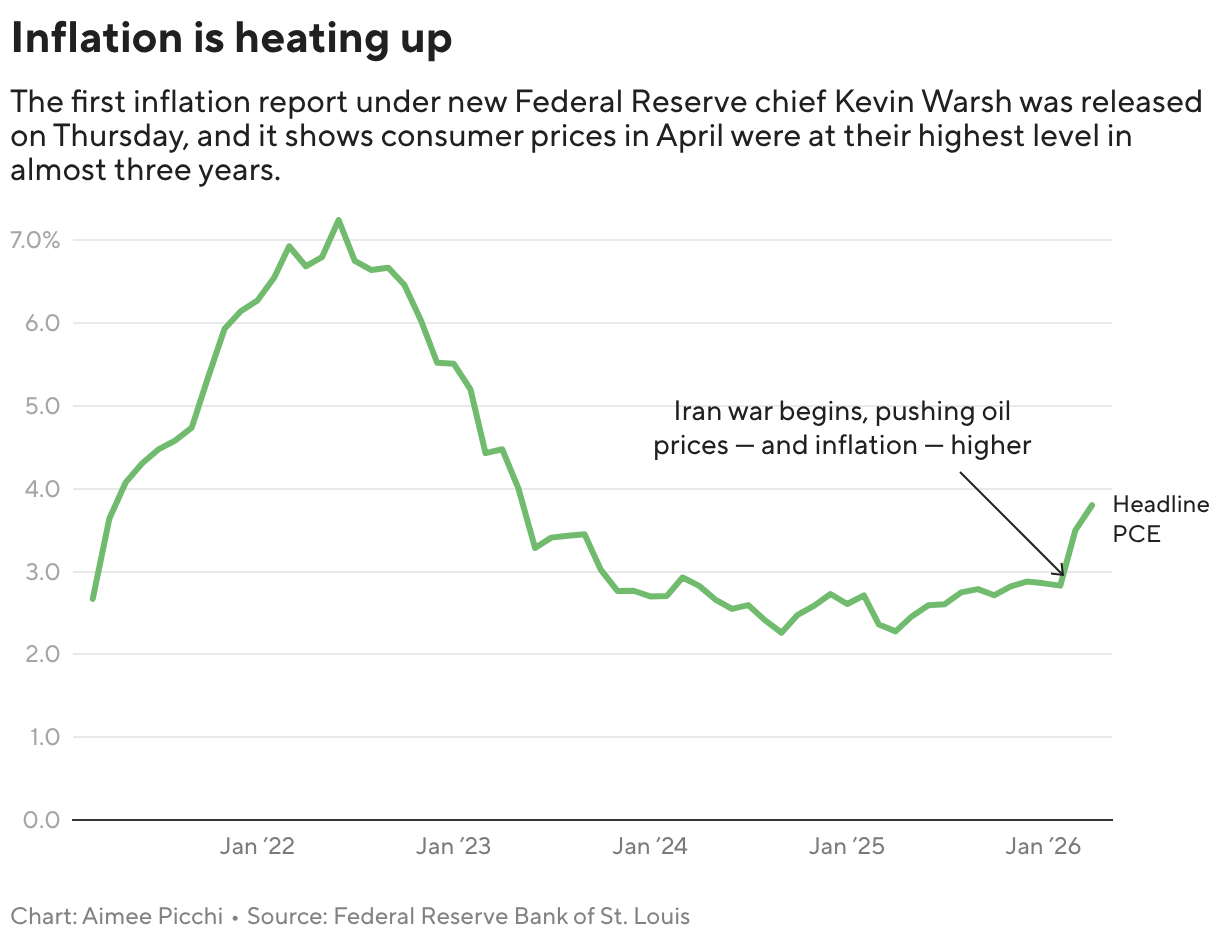
The first inflation report under the leadership of new Federal Reserve Chair Kevin Warsh has been unveiled, revealing a significant rise in consumer prices for April, marking the highest level in nearly three years.
The personal consumption expenditures (PCE) price index, which the Federal Reserve considers its primary gauge for inflation, climbed at an annual rate of 3.8% last month, according to a report released by the Commerce Department. This represents an increase from March’s 3.5% and February’s 2.8%, reaching heights not seen since May 2023.
Economists surveyed by FactSet had anticipated the PCE index to show a 3.9% inflation rate for April, highlighting the close alignment with actual figures.
Excluding the often-volatile sectors of energy and food, the core PCE rose by 3.3% annually in April, aligning with experts’ expectations.
Warsh’s first test
Warsh faces a significant test as he assumes the role of Fed Chair, with inflation pressures intensifying in the wake of the Iran conflict, which has driven up energy costs. Earlier projections by the central bank suggested a potential interest rate cut in 2026, but soaring fuel prices are casting doubt on this outlook.
Adding complexity to Warsh’s task is President Trump’s desire for the Federal Reserve to reduce borrowing costs to stimulate consumer and business spending, thereby fueling economic growth.
While the rise in consumer prices in April was slightly cooler than expected, “that’s little comfort on Main Street, where people are facing the highest inflation in 3 years and having their wage gains wiped out by inflation,” said Heather Long, the chief economist at the Navy Federal Credit Union, in a social media post.
Energy costs saw the biggest increase in April, but prices also rose in other spending categories, according to the Commerce Department figures. The costs of housing and utilities, recreation services and food services also saw large jumps in April, the data shows.
Some economists are now penciling in a possible rate hike later this year. There’s now a 40% probability that the Federal Reserve will hike rates at its December meeting, up from 3% at its June meeting, according to CME FedWatch, which bases its predictions on 30-Day Fed funds futures prices.
Income growth lags inflation
Several other measures in the report highlight the financial struggles facing many U.S. households, helping explain why consumer confidence has plunged to an all-time low.
For instance, the report shows that annual personal income growth slowed to 2.5%, falling below the pace of inflation. That means households are losing purchasing power because their incomes aren’t keeping up with rising prices.
“Inflation is at a three-year high, and personal savings have cratered to one of the lowest levels in the past 20 years,” Long said in an email. “Many Americans are spending more than the income they have coming in. This is not sustainable, especially for lower-income and middle-class households.”
Consumer spending rose 0.5% in April from March, though most of that reflected price increases. Adjusted for inflation, spending rose just 0.1% in April, down from 0.3% the previous month.
The personal savings rate fell to 2.6% last month from 3.6% in March, suggesting that some households are tapping their savings to cope with higher costs, economists said.
“Rising prices are really taking a bite out of consumption, and the decline in the savings rate shows consumers are dipping into savings to make ends meet,” said Ellen Zentner, chief economic strategist for Morgan Stanley Wealth Management, in an email.