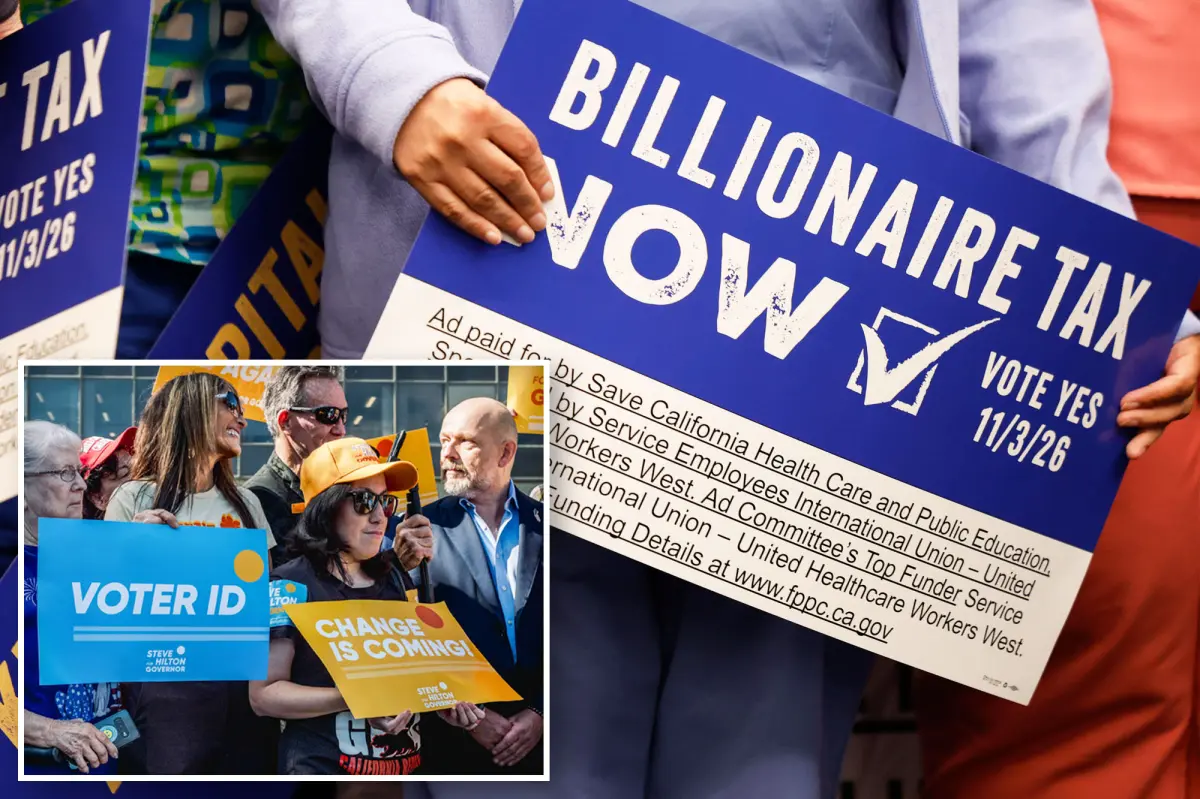

California’s high-stakes battle over a proposed billionaire tax is entering its final stretch, with the measure’s support narrowing just weeks before voters decide whether to impose a one-time 5% charge on the state’s wealthiest residents.
A recent UC Berkeley Institute of Governmental Studies poll, conducted with the Los Angeles Times, shows Proposition 40 holding only a slim lead among likely voters. Forty-five percent support the proposal, compared with 42% who oppose it, while 13% remain undecided — a group that could determine the outcome.
The numbers represent a drop in support from the previous survey six weeks ago, when 48% favored Proposition 40 and 41% rejected it.
The tightening race comes as supporters and opponents wage an expensive advertising battle over one of the most closely watched measures on California’s crowded Nov. 3 ballot.
Proposition 40 would collect a one-time tax equal to 5% of the net worth of billionaires who lived in California on Jan. 1, 2026. The proposal is intended mainly to bolster healthcare funding as federal support is expected to decline, with additional money directed toward education and food assistance programs.
The plan has drawn intense opposition, with its critics spending heavily to persuade voters that a tax on accumulated wealth could damage California’s economy.
Mark DiCamillo, who leads the Berkeley IGS poll, said the results suggest that voters are troubled by economic inequality but hesitant to embrace a tax on assets — an approach that would be different from taxing annual income.
“When you’re going about taxing the billionaires’ assets, I mean that’s something kind of new and different, and it’s risky, and the governor’s against it,” DiCamillo told the Times, describing an electorate that appears to be weighing the proposal cautiously.
One California business executive has also warned that the measure could prompt wealthy residents to reconsider staying in the state.
Eric Schiffer, chairman of family office Patriarch and chief executive of Reputation Management Consultants, told Fox Business that approval of the tax could produce what he called a “giant sucking sound” as entrepreneurs move elsewhere.
CONTINUE READING: Top DOJ Official Warns After 42 Vanish on Smuggling Route
Schiffer, who said he advises billionaire clients, argued that some affluent Californians may conclude the state no longer offers enough value to justify its tax burden.
“Why would anyone stay if they have spent their life building wealth that they were already taxed on?” he told the outlet.
Proposition 40 also faces a potential obstacle from two other ballot initiatives that could undermine its impact or complicate its implementation.
Under Proposition 42, certain types of personal property taxes would be restricted and retroactive taxation would be limited. The Berkeley poll found 43% support for the measure, 34% opposition and approximately 23% undecided.
Proposition 41 remains even less settled, with 37% of likely voters backing it, 33% opposed and 30% still weighing their decision.
Either measure could significantly affect the future of Proposition 40.
At the same time, another proposal affecting high-income Californians appears to be in a stronger position with voters than the proposed billionaire wealth tax.
Proposition 3 would permanently extend an existing income-tax increase on top earners, revenue that currently supports schools and healthcare. Approved in 2012 and set to expire in 2031, the tax applies to individuals making at least $360,000 per year.
The contrast between the two measures underscores the choice facing voters: Proposition 3 would preserve an established income tax, while Proposition 40 would introduce a new levy on billionaire wealth.
The proposed wealth tax has drawn national scrutiny and generated vast campaign spending, while also revealing a split among California Democrats. The California Democratic Party supports Proposition 40, but Gov. Gavin Newsom opposes it, warning that the measure could create long-term problems for the state’s finances.