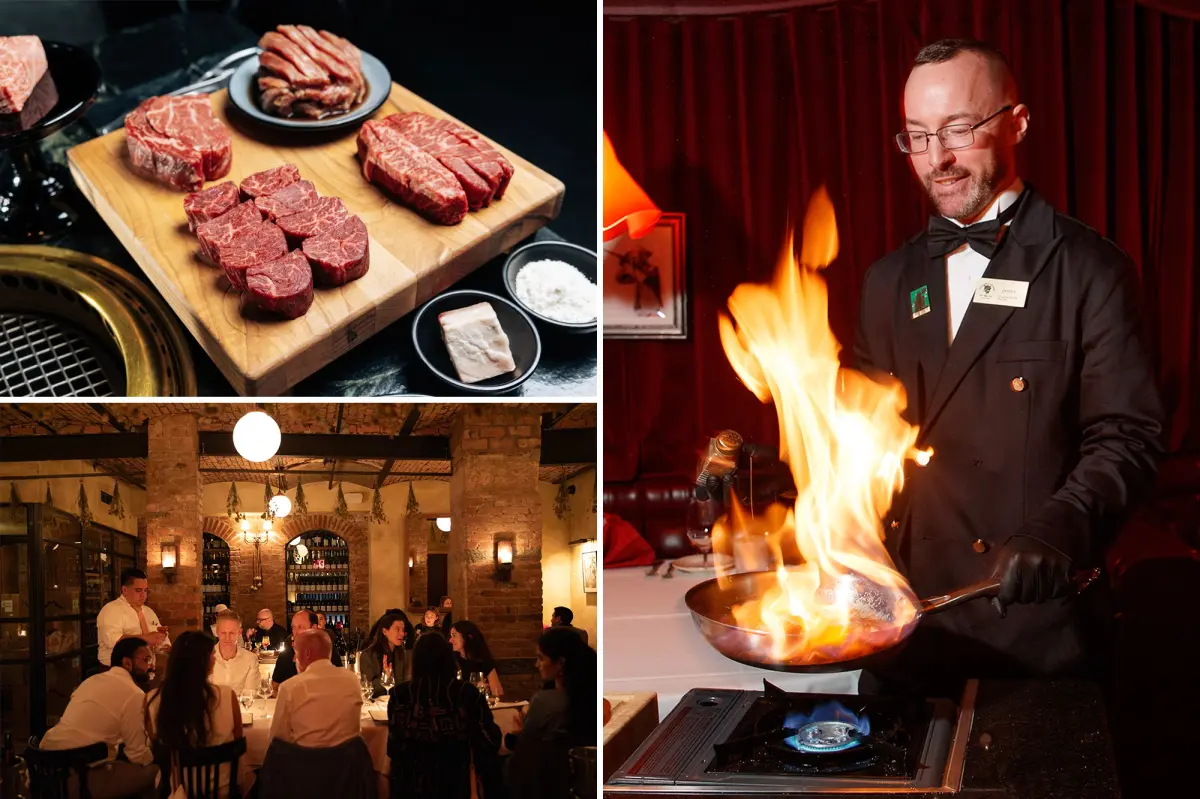

Vegan, shmeygan — in New York, red meat in all its bloody glory remains the undisputed king of the table.
While media coverage often promotes an appetite for plants, seeds, obscure international specialties and tiny 10-seat omakase counters, the spending tells a different story about what New Yorkers actually choose to eat.
So why the gap between popular taste and the politically charged push toward plant-based dining?
“New York never lost its appetite for steak — it’s just that the headlines went somewhere else,” said Max Tucci, a partner at Delmonico’s.
More than 15 steakhouses of various styles have opened across the Big Apple in the past three years, many with seating for more than 200 guests. A substantial number launched between 2019 and 2023.
Nearly all are thriving despite the publicity surrounding supposedly healthier alternatives. Only a small number closed during the same period, most notably Porter House and one of Wolfgang’s five locations.
The latest wave includes an uptown outpost of Korean-style Cote; Las Vegas-inspired Golden Steer and Carver Steak; Monte Carlo-born Beefbar; Argentine-influenced Graciela and Baires Grill; Mexican-style Cuerno; and La Tete D’or, the French restaurant from chef Daniel Boulud.
Elder draws on British-Indian cuisine, while Fogo de Chao brought its Brazilian rodizio style to the World Trade Center. Amasa takes a Latin approach at the Kimpton Era Hotel.
This latest international surge followed the arrival of Salt Bae’s Turkish Nusr-Et, England’s Hawksmoor and the Italian-inspired Carne Mare.
There is little sign of the momentum fading. Last year, Palladino’s opened at Grand Central Terminal and became an immediate success. This year brought the Manhattan debuts of Atlantis Prime, Vinyl Steakhouse and Dynamo Room.
Among next year’s most anticipated openings is Delmonico’s Reserve, planned for Midtown’s Sixth Avenue. Jack D’s and Chicago-based Maple & Ash are also on the way, with Maple & Ash promising to become the first “experiential steakhouse.”
CHECK THIS OUT: Climate Attribution Science Is Advancing at Unprecedented Speed
Meanwhile, old-school beef institutions including Peter Luger, Smith & Wollensky, Sparks, Wolfgang’s, Empire Steak and Knickerbocker Bar & Grill continue to prosper.
Michael Stillman’s Quality Branded operates the original Manhattan Smith & Wollensky, which has recorded a 5% to 10% increase in business over the past two years. “That’s a big number for a 50-year-old place,” Stillman said.
The growing recognition that New Yorkers remain deeply committed to red meat has even prompted several prominent chefs and restaurant owners to change direction.
Eleven Madison Park, once celebrated as a vegan destination, added beef and chicken to its menu for the first time early this year. José Andrés converted his Bazaar at the Ritz-Carlton NoMad into Bazaar Meat, a steakhouse. Simon Oren’s Monterey began as an American brasserie but now proudly describes itself as “a modern steakhouse.”
Mark Bucher, a National Restaurant Association board member and founder of the Medium Rare chain, including its Manhattan location, recalled advice from legendary French chef Paul Bocuse: “Give customers what they want — not what you want.”
For Americans — and most New Yorkers in particular — “meat and potatoes are the center of our diets,” Bucher said, despite the parade of passing exotic food trends.
Today’s New York steakhouses serve much more than beef, with high-quality seafood, pasta and salads also featured prominently. And the meat itself has arguably never been better, ranging from USDA Prime to Japanese Wagyu blends.
Modern steakhouses “are more elevated,” said Sebastien Silvestri, CEO of Daniel Boulud’s Dinex Group.
At Boulud’s elegant La Tete D’or, the most popular cuts include filet mignon, porterhouse, côte de boeuf and New York strip. “Daniel sources the best meat from around the globe and uses French techniques on it,” Silvestri said.
Its success came as no surprise to Silvestri. When he previously worked at several Las Vegas casino hotels, “We had the best chefs in the world, like Daniel, Thomas Keller and Charlie Trotter.
“And out of 40 restaurants the four top-grossing ones were all steakhouses.”