In SAN BERNARDINO, Calif., a significant financial predicament unfolds as taxpayers initially funded a $2.2 billion solar plant, but now electricity consumers bear the financial burden of its continued operation.
The Ivanpah Solar Power Plant, a vast installation near the California-Nevada border, was developed with substantial federal aid during the Obama-era stimulus initiatives. However, it now finds itself caught in a costly bind.
Both the Trump and Biden administrations, along with the utility company buying its power, have pushed for its closure, citing its inefficiency, high electricity costs, and competition from cheaper energy sources. Despite these calls, California regulators have resisted shutting it down, expressing concerns that its closure could jeopardize the stability of the power grid.
This situation has resulted in a financial stalemate, stemming from years of governmental decisions. Closing the plant risks leaving taxpayers accountable for hundreds of millions due to a $1.6 billion federal loan, while keeping it operational leads to increased electricity costs for consumers.
“Keeping this project afloat makes no economic sense, as the market has clearly demonstrated,” stated Daniel Turner, founder of the energy advocacy group, Power The Future, in an interview with Fox News Digital.
Turner criticized the project as a “boondoggle,” akin to many of California’s large-scale ventures, suggesting it persists for political motives with the financial impact ultimately falling on consumers.
“At some point, you have to stop throwing good money after bad,” he added.
The Ivanpah Solar Power Plant in the Mojave Desert uses mirrors to focus sunlight onto three towers to generate electricity. (Jeff Gritchen/MediaNews Group/Orange County Register via Getty Images)
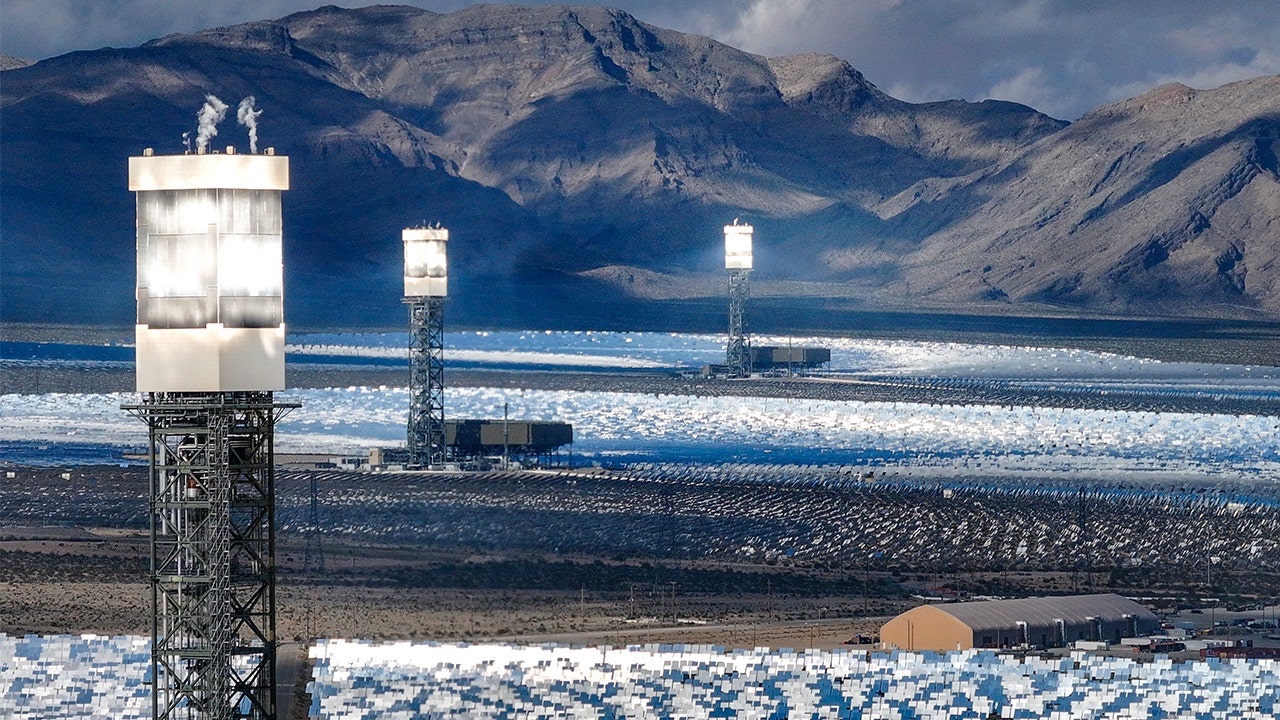
Rising out of the Mojave Desert, the more than 4,000-acre facility still looks like the future. It has roughly 350,000 mirrors — mounted on more than 170,000 heliostats — which stretch for miles and reflect blinding sunlight into three towering structures that glow eerily white against the barren terrain.
But more than a decade after it opened, the technology behind it has been overtaken by cheaper, more efficient solar alternatives — turning what was once a symbol of clean energy progress into a costly problem. The project has also faced scrutiny over its environmental impact, with thousands of birds killed after flying through the plant’s concentrated solar beams — along with the destruction of large areas of desert land and displacement of desert tortoises.
The costly tradeoff
Roughly $730 million to $780 million of the $1.6 billion federally backed loan tied to the project remains outstanding, according to federal data. In addition, the U.S. Department of the Treasury provided a $539 million grant to help build the facility, covering about 30% of construction costs.
At the same time, some analysts estimate the plant’s electricity could cost customers roughly $100 million more per year than power from newer solar alternatives.
That leaves policymakers facing a stark choice: shut it down and risk sticking taxpayers with hundreds of millions in losses tied to the loan, or keep it running and continue passing higher costs on to electricity customers.
Critics argue that without government backing and long-term contracts, the plant would likely struggle to remain economically viable.
Even the federal government and the utility paying for the power have tried to walk away.
Officials under both the Trump and Biden administrations, along with Pacific Gas & Electric (PG&E) — which buys electricity from the plant — have supported shutting it down. PG&E has described the contracts as part of an effort to reduce “uneconomic resources” in its energy portfolio, according to regulatory filings.
California regulators, however, have refused.
The California Public Utilities Commission rejected efforts to terminate the plant’s contracts, citing concerns about grid reliability as electricity demand rises, including increased demand from data centers.
In its decision, regulators warned that shutting down Ivanpah could strand more than $300 million in ratepayer-funded transmission and infrastructure tied to the project, while also creating potential risks for grid reliability — particularly as uncertainty grows around how quickly new energy projects can be built.
PG&E, meanwhile, has argued that terminating the contracts would save customers money compared with continuing to purchase electricity from the facility.
The dispute highlights a broader challenge facing the energy sector — how to balance reliability, cost and past investments as demand rises and technology evolves.
Outdated technology, shifting market
Standing near the site, the scale of the project is unmistakable.
The plant uses a technology known as concentrated solar power, in which computer-controlled mirrors reflect sunlight onto boilers atop nearly 460-foot towers, creating visible beams of concentrated light and causing the structures to glow brightly. The heat is then used to produce steam, which drives turbines to generate electricity.
When it opened in 2014, the technology was considered cutting-edge. However, rapid advances in photovoltaic solar panels and battery storage have since made cheaper, more flexible alternatives widely available.
The project was fast-tracked during the Obama-era stimulus push, prompting concerns about the speed of its environmental review. It was part of a broader federal effort to boost the economy following the 2008 financial crisis and expand renewable energy.
It represented a significant scale-up of relatively new technology, expanding from smaller pilot projects to a nearly 400-megawatt facility — a leap that introduced uncertainties about long-term performance.
But the industry moved on faster than expected.
Cheaper and more efficient photovoltaic solar panels, often paired with battery storage, quickly overtook the concentrated solar technology used at Ivanpah — leaving the plant at a competitive disadvantage.
The Ivanpah Solar Power Plant in the Mojave Desert uses mirrors to focus sunlight onto three towers to generate electricity. (Michael Dorgan/Fox News Digital)
“The technology used at Ivanpah is no longer really competitive with a new solar farm that uses conventional solar panels,” Severin Borenstein, an energy economist at the University of California, Berkeley, told Fox News Digital.
Borenstein said the project reflects the risks of investing in emerging energy technologies at scale.
“When this plant was planned, solar thermal looked like a promising approach,” he said. “But photovoltaic costs fell much faster than anyone anticipated, and that changed the economics entirely.”
Borenstein explained the project was part of a broader wave of experimentation in early clean energy development, noting that while some technologies — including solar panels, batteries and wind power — became dramatically cheaper over time, Ivanpah “fell into the latter category,” with costs failing to drop as expected.
“That doesn’t mean it was a bad idea to build it originally,” he said.
Borenstein added that once those shifts occur, large infrastructure projects can be difficult to unwind.
“These are long-lived assets with long-term contracts,” he said. “Even if they no longer make economic sense, you can’t easily just walk away.”
Mark Jacobson, a Stanford University energy systems expert, contended the technology itself is not inherently flawed but lacks key features used in newer systems.
“There’s no role for a concentrated solar plant without storage,” Jacobson told Fox News Digital, noting that modern systems typically store energy for use at night — something Ivanpah cannot do.
An aerial view shows the Ivanpah Solar Power Plant near the California–Nevada border, where mirrors reflect sunlight onto towers to generate electricity. (Joe Sohm/Visions of America/Universal Images Group via Getty Images)
Jacobson added that while the plant may no longer be competitive with new projects, that does not necessarily mean it should be shut down.
“It’s already built,” he said. “So the question is whether it’s cheaper to keep it running than to replace it.”
In addition to the $1.6 billion federal loan guarantee, the project received a roughly $539 million Treasury grant covering about 30% of construction costs, along with tax credits, accelerated depreciation and other federal incentives.
California’s renewable energy mandates also required utilities to purchase power under long-term contracts, helping ensure demand even as newer technologies emerged.
Ivanpah is not the first federally backed clean energy project to face scrutiny. Solar company Solyndra collapsed in 2011 after receiving $535 million in federal loan guarantees.
The Ivanpah project drew backing from major private investors, including NRG Energy and Google, which invested hundreds of millions of dollars in its development.
But the project’s financing structure spreads risk unevenly. Federal loan guarantees, taxpayer-funded grants and long-term power contracts help stabilize returns for investors, while leaving taxpayers and electricity customers exposed to potential losses and higher costs.
Operational challenges have also been documented. A 2025 audit by California regulators identified recurring forced outages and equipment issues that could affect reliability.
NRG Energy, which operates the facility, told Fox News Digital it remains committed to running the plant under existing agreements and providing renewable energy to California.
Although Ivanpah has a nameplate capacity of nearly 400 megawatts, solar plants typically operate below full capacity because they only generate electricity when the sun is shining. Even so, the facility has underperformed.
In 2023, it operated at roughly a 17% capacity factor, according to data from Lawrence Berkeley National Laboratory — well below the 25% to 30% levels originally expected.
The Ivanpah Solar Power Plant near the California–Nevada border uses mirrors to reflect sunlight onto towers to generate electricity. (Jeff Gritchen/MediaNews Group/Orange County Register via Getty Images)
Real-world impact
While the facility spans thousands of acres in a remote stretch of desert, it feeds electricity into the broader grid rather than a specific community and has drawn relatively limited public attention despite its scale and cost. The town of Baker, for example, is the nearest town to the facility on the California side, but it is about 50 miles away from the plant.
For some residents and business owners in the region, however, rising electricity prices remain a growing concern.
“During the summer it can be anywhere from $10,000 to $12,000 … in the winter anywhere from $6,000 to $8,000,” said Lazarus Dabour, owner of the Mad Greek restaurant in Baker.
“It still restricts your bottom line when your overhead from more electricity goes up. It’s a big factor,” he said.
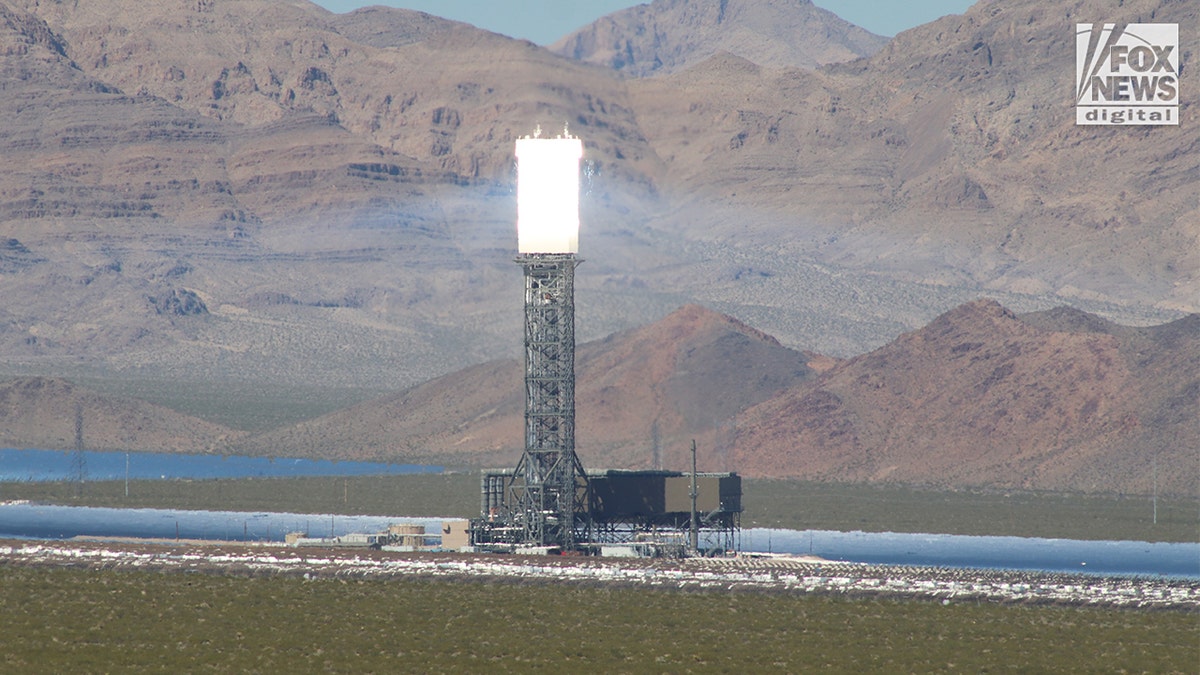
A tower at the Ivanpah Solar Power Plant is illuminated by concentrated sunlight in the Mojave Desert, where mirrors reflect solar energy to generate electricity. (Michael Dorgan/Fox News Digital)
“Our electricity is too high here in Baker,” said Eddie Bravo, a local store worker who said his bills can reach between $650 and $750 in the summer.
He said he notices the plant when he travels to Las Vegas, but “[doesn’t] know much about it.”
Despite the scale of the project, many people passing through the area said they were largely unaware of the facility or the controversy surrounding it.
Some expressed frustration with rising energy costs, while others took a more neutral view.
“It seems like it’s doing its job … it’s definitely working,” said Gregory Simons, a truck driver from Rancho Cucamonga who was stopped at a gas station near the Nevada state line.
Just across the road, newer solar facilities sit quietly on the desert floor, using photovoltaic panels to generate electricity more simply and at lower cost — highlighting how quickly the industry has shifted away from Ivanpah’s technology.
More than a decade after it opened, the plant now stands as a symbol of how quickly energy technology can evolve — and the cost of getting it wrong when a project becomes too expensive to shut down and too costly to justify keeping it running.