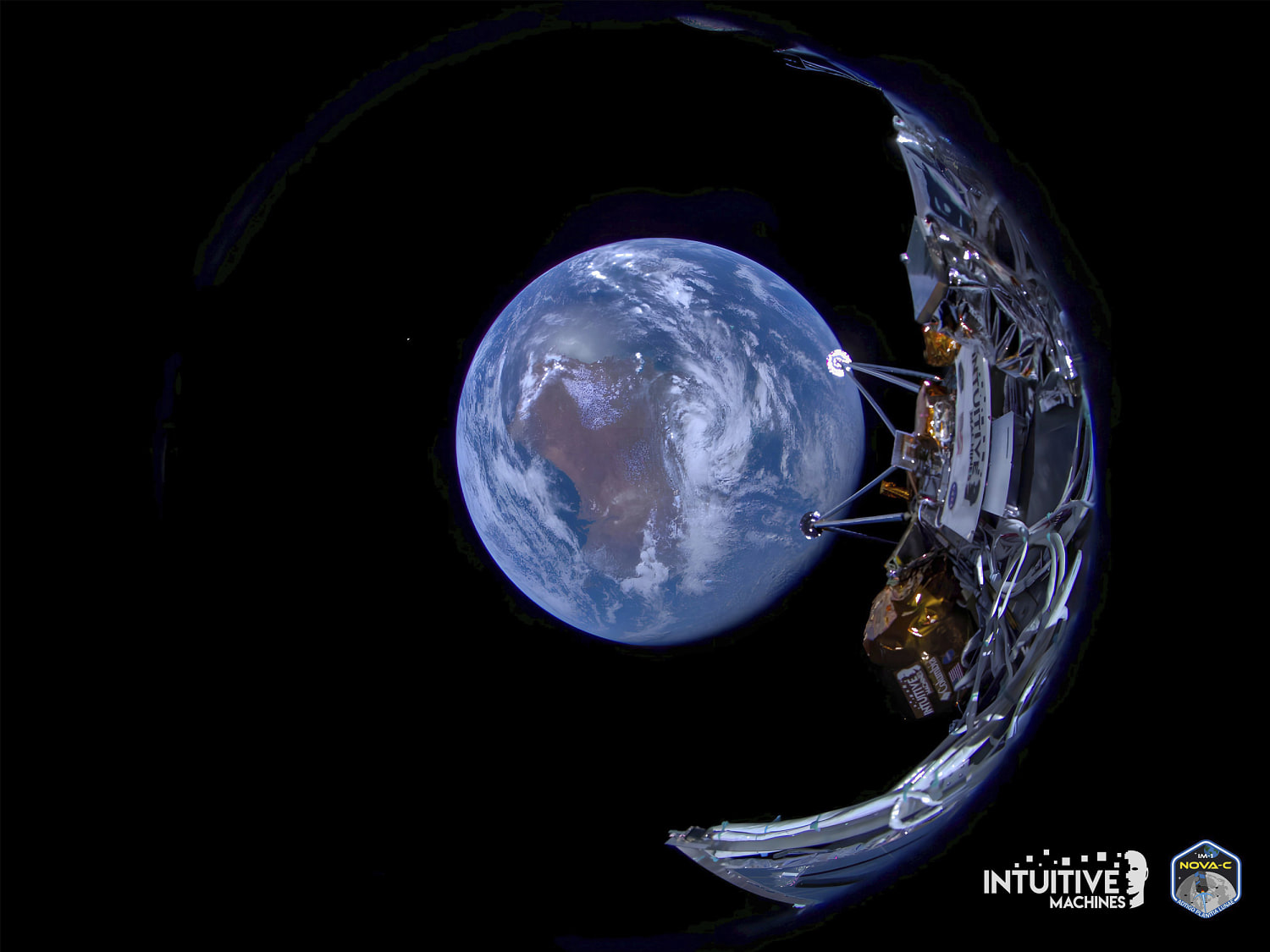
A robotic spacecraft made history Thursday becoming the first privately built craft to touch down on the lunar surface, as well as the first American vehicle to accomplish the feat in more than 50 years.
The lander, built by Intuitive Machines, touched down on the lunar surface at around 6:23 p.m. ET, overcoming a late-stage glitch with its onboard laser instruments. The Nova-C lander, nicknamed Odysseus, is now the first American spacecraft on the moon since the Apollo 17 mission in 1972.
“Houston, Odysseus has found its new home,” the company’s Chief Technology Officer Tim Crain radioed back from mission control, as employees cheered and celebrated.
It took several minutes to confirm the landing. As the spacecraft made its final descent, mission controllers lost contact with the spacecraft, as was expected to occur.
The company said it could detect a faint signal from one of Odysseus’ antennas, but more data will be needed to determine how the spacecraft landed, precisely where it is and if the probe is upright or on its side. The company said it is working to refine the signal and retrieve more information. The spacecraft’s condition was unknown as of Thursday evening.
Intuitive Machines CEO Stephen Altemus called it an “outstanding effort” and praised the entire team. “I know this was a nail biter but we are on the surface and we are transmitting, and welcome to the moon,” Altemus said.
NASA Administrator Bill Nelson also congratulated Intuitive Machines on the landing, calling the milestone a “triumph.”
“Odysseus has taken the moon,” Nelson said in a video message that aired during live coverage of the event. “This feat is a giant leap forward for all of humanity.”
Odysseus launched into space on Feb. 15 atop a SpaceX Falcon 9 rocket. The 14-foot-tall lander then spent six days cruising more than 620,000 miles to reach the moon.
The landing time was adjusted several times Thursday as Intuitive Machines adjusted the spacecraft’s orbit around the moon.
As it descended to the lunar surface, Odysseus targeted a landing site near a crater called Malapert A, close to the moon’s south pole. The moon’s south polar region has long been tantalizing for scientists because water ice is thought to be relatively abundant in the region’s permanently shadowed craters.
Odysseus is carrying a mix of commercial cargo and NASA science instruments on its journey. The lander is expected to spend about a week collecting data on the moon before lunar night sets in and the probe loses power.
Roughly an hour before landing, the company also scrambled to resolve a problem with laser instruments designed to help the spacecraft assess the lunar terrain and find a safe and hazard-free spot to touch down. The laser rangefinders aboard Odysseus were not operable but sensors on one of the NASA science instruments aboard the lander were repurposed instead.
The mission is part of NASA’s Commercial Lunar Payload Services program, which the space agency set up to support development of moon landers by private-sector companies. NASA eventually plans to hire these companies to transport cargo and scientific instruments to the lunar surface as part of the agency’s broader ambitions to return astronauts to the moon.
NASA awarded Intuitive Machines $118 million to carry out the moon landing.
Last month, a separate company tried but failed to send a lander to the moon under the same NASA program. That spacecraft, built by Pittsburgh-based Astrobotic Technology, suffered a crippling malfunction shortly after launch that forced the company to scrap the entire mission.
In addition to being the first commercial spacecraft on the moon, Odysseus also joins an elite club: Only the space agencies of the United States, the former Soviet Union, China, India and Japan have successfully carried out a controlled or “soft” landing on the moon.