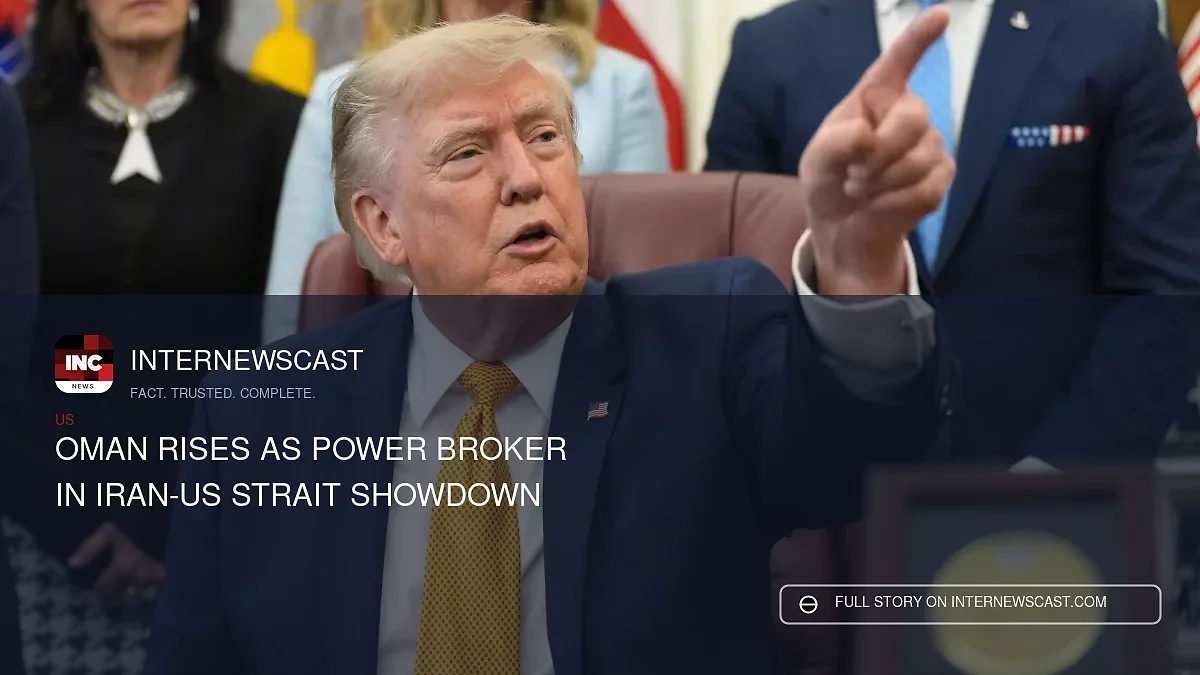

WASHINGTON — Iran insists it is not negotiating with the United States, but Tehran is engaged with another key player that could help deliver one of President Trump’s most significant foreign policy objectives: reopening the Strait of Hormuz.
Iranian officials publicly pushed back on Trump’s Sunday assertion that talks between Washington and Tehran are in progress. At the same time, they acknowledged intensive discussions with neighboring Oman over the fate of the narrow waterway, a critical global shipping route that carries about one-fifth of the world’s oil and has emerged as the central flashpoint in the worsening confrontation.
Should Muscat succeed in brokering an agreement, Trump could see the world’s most vital oil shipping corridor reopened without direct negotiations between the United States and Iran.
Iranian Foreign Ministry spokesman Esmail Baghaei said Monday that Tehran’s talks with Oman are centered on restoring commercial shipping through the Strait of Hormuz.
“To avoid any misunderstanding, it is important to clarify what the current negotiations are about and who they are with. We are not negotiating with the United States at this time,” he said.
“Our negotiations are with Oman and are focused on reaching an understanding on a route that will ensure the safe passage of shipping through the Strait of Hormuz,” he added.
Still, Iranian officials warned that any agreement to reopen the strait would remain temporary unless what Tehran describes as US “aggression” comes to an end.
“As long as the US mischief continues, as long as the Iranian sea siege continues, as long as the US military aggression against Iran and its allies continues, there will be no [permanent] change in … Hormuz,” Baghaei said.
But reaching even a temporary agreement Iran would accept could prove challenging, as Oman has sided repeatedly with the US that the waterway should be open to all.
The Wall Street Journal reported last week that Iranian and Omani negotiators have been working toward an arrangement to restart commercial shipping, although major disagreements remain over transit fees and the rules governing passage. A US official told the paper Washington remains closely engaged with mediators despite the indirect format.
In a July 14 statement, Oman’s Foreign Ministry described its role as “transparent and neutral cooperation with all parties” aimed at restoring freedom of navigation through the Strait while complying with international maritime law.
The latest discussions come after Oman and Iran in June created a joint working group to negotiate navigation, shipping services and the future management of the Strait, pledging to keep the waterway “a secure and open” route for international shipping.
The biggest obstacle now appears to be control of the shipping lanes.
According to Baghaei, Oman has rejected Iran’s preferred proposal to reduce commercial traffic to a single inbound and outbound corridor.
“The [issue] in Hormuz has not been solved due to the disagreement between Iran and Oman,” he said.
“The negotiations were based on the fact that the southern route passes through the waters of Oman, and the northern route passes through the waters of Iran, and it will be transformed into an intermediate route that will provide for the interests of both coastal governments,” he added.
“Therefore, we are now talking about a corridor that will have a return route and not a two or three-way route.”
His remarks came after Trump on Sunday said he had called off planned military strikes after hearing Iran wanted negotiations, telling reporters talks would resume Monday afternoon. Iran flatly rejected that account, saying no US meetings were scheduled.
US officials denied to CBS News on Monday that Washington and Tehran are engaged in a new round of formal talks.
Instead, the same level of back-channel diplomacy — with Iranian negotiators passing messages to Jared Kushner and Special Envoy Steve Witkoff — continues, with hopes formal negotiations could eventually resume, a regional source told The Post.
Representatives for Oman did not immediately respond to a request for comment.


