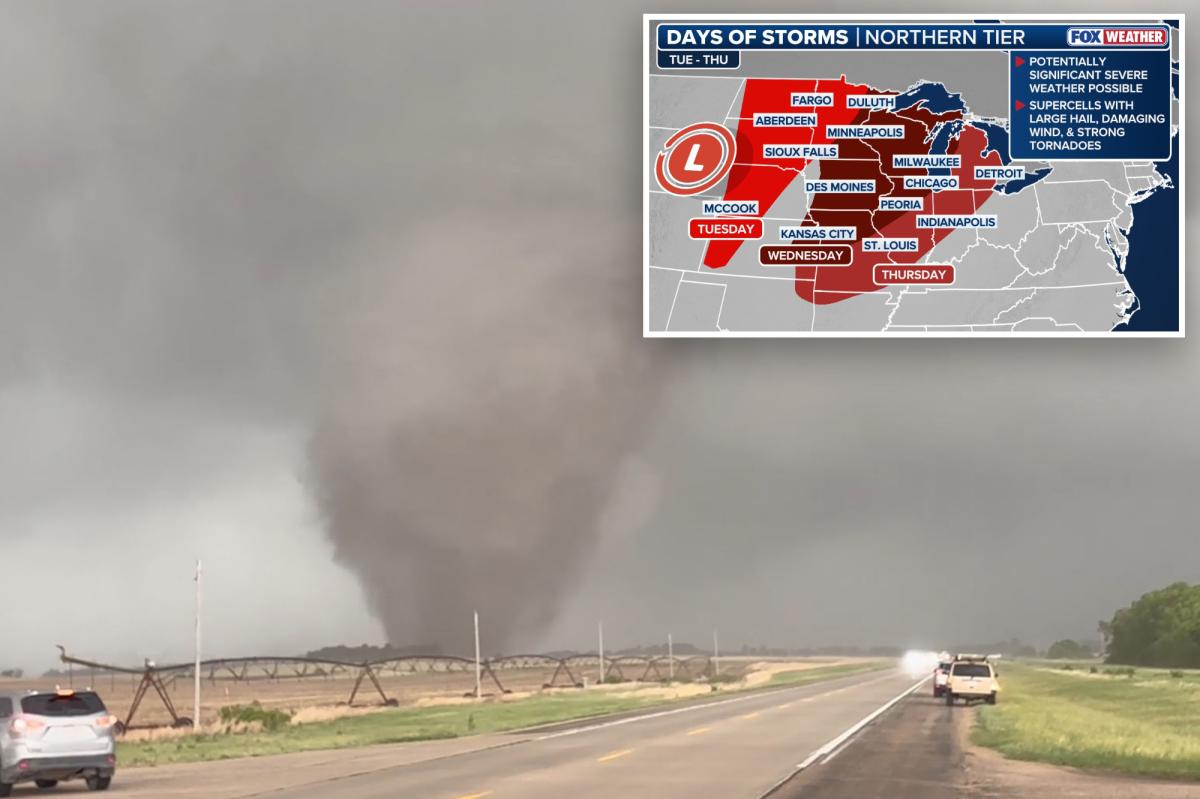


Following the recent bout of intense weather in the Plains, attention is now pivoting to the Upper Midwest, where densely populated areas face an escalating threat that could span several days. The situation is drawing concern, as the FOX Forecast Center alerts the public that these approaching storms may be substantial.
As the week progresses, the area at risk is expected to broaden significantly, potentially impacting over 40 million people. The dangers associated with this weather pattern include the possibility of large hail, destructive winds, and tornadoes.
Furthermore, these storms, laden with moisture, bring the risk of flash flooding, albeit on the lower end. Rainfall throughout the midweek is anticipated to be widespread, with totals ranging from 1 to 2 inches.
Starting on Monday, the central U.S. is under a Level 2 out of 5 severe weather threat. This stretches from the Front Range in Colorado through to central Kansas, indicating the potential for hazardous conditions.
In a particular instance of concern, Newton County, Missouri, which lies adjacent to Kansas, found itself under a Tornado Warning early this morning, lasting until 5 a.m. Central Time.
In fact, Newton County, Missouri — which borders Kansas—was issued a Tornado Warning until 5 a.m. CT this morning.
As the day progresses, afternoon storms could produce large hail over 2 inches in diameter, damaging wind gusts over 70 mph, as well as an isolated tornado.
By Tuesday, a large dip in the jet stream is forecast to take shape across the West Coast.
Ahead of a surface low pushing northward overnight and its associated cold front, very high levels of instability will continue to build.
Dew points in the 50s and low 60s, paired with strong daytime heating, will help fuel storms capable of producing very large hail, damaging winds, and tornadoes.
For this reason, a Level 3 out of 5 severe weather risk is in place, mainly across North Dakota, closest to the area of low pressure.
The FOX Forecast Center said the biggest threats with developing storms Tuesday afternoon and into the evening will be large hail and tornadoes.
Meanwhile, the overnight threat will transition to primarily damaging winds as storms push into the Red River Valley.
On Wednesday, the focus shifts east as the parent area of low pressure moves into Canada, while its trailing cold front will begin moving through the Upper Midwest.
A Level 3 severe weather risk is also in place and includes portions of Minnesota, Wisconsin, and Iowa.
Specifically, Minneapolis appears to be right in the bullseye for what the Storm Prediction Center is calling a “potentially significant severe weather event” on Wednesday afternoon and evening.
Deep-layer shear and instability will set the stage for supercells and bowed lines of storms capable of producing all severe hazards once again.
By Thursday, the threat shifts into the Midwest, with a Level 2 out of 5 severe weather risk that includes more than 26 million Americans and major metro areas such as Chicago, St. Louis, and Milwaukee.
Storms will continue to develop in the afternoon and evening along the cold front as it marches eastward, with all severe weather hazards possible once again.
Additionally, widespread rainfall totals of 1 to 2 inches across Minnesota, Wisconsin, Iowa, and Illinois could bring the potential for flash flooding.
Localized amounts exceeding 2 to 3 inches are possible where storms move more slowly or repeatedly track over the same areas. Due to this, a Level 1 out of 4 flash flood risk is in place across parts of the region on Wednesday.


