

Voter frustration over rising living costs is steering the conversation towards next year’s midterm elections. Key races will likely pivot on issues impacting communities facing soaring electric bills or debates about who should pay for powering Big Tech’s energy-intensive data centers.
This week, electricity expenses emerged as a pivotal issue in the gubernatorial elections in New Jersey and Virginia—particularly in areas known for their data centers—and in Georgia, where Democrats successfully unseated two Republican members of the state’s utility regulatory commission.
Economic concerns topped the list for voters in New Jersey, Virginia, California, and New York City, as both Democrats and Republicans brace for a heated debate over affordability in the forthcoming midterm elections, which will determine control of Congress.
President Donald Trump has already signaled that affordability will be a central theme in his campaign strategy as he and his party aim to retain their narrow congressional majorities. In contrast, Democrats are holding Trump accountable for the escalating costs that households are experiencing.
Electricity bills are likely to take center stage, with many areas experiencing increases that outpace the average U.S. inflation rate, although this trend is not universal.
“Politicians are under tremendous pressure to address affordability, and currently, electricity prices are the most prominent example of this challenge,” remarked Dan Cassino, a politics and government professor and pollster at Fairleigh Dickinson University in New Jersey.
Rising electric costs aren’t expected to ease and many Americans could see an increase on their monthly bills in the middle of next year’s campaigns.
Higher electric bills on the horizon
Gas and electric utilities are seeking or already secured rate increases of more that $34 billion in the first three quarters of 2025, consumer advocacy organization PowerLines reported. That was more than double the same period last year.
With some 80 million Americans struggling to pay their utility bills, “it’s a life or death and ‘eat or heat’ type decision that people have to make,” said Charles Hua, PowerLines’ founder.
In Georgia, proposals to build data centers have roiled communities, while a victorious Democrat, Peter Hubbard, accused Republicans on the commission of “rubber-stamping” rate increases by Georgia Power, a subsidiary of power giant Southern Co.
Monthly Georgia Power bills have risen six times over the past two years, now averaging $175 a month for a typical residential customer.
Hubbard’s message seemed to resonate with voters. Rebecca Mekonnen, who lives in the Atlanta suburb of Stone Mountain, said she voted for the Democratic challengers, and wants to see “more affordable pricing. That’s the main thing. It’s running my pocket right now.”
Now, Georgia Power is proposing to spend $15 billion to expand its power generating capacity, primarily to meet demand from data centers, and Hubbard is questioning whether data centers will pay their fair share — or share it with regular ratepayers.
Midterm battlegrounds in hotspots
Midterm elections will see congressional battlegrounds in states where fast-rising electric bills or data center hotspots — or both — are fomenting community uprisings.
That includes California, Georgia, Michigan, Ohio, Pennsylvania and Texas.
Analysts attribute rising electric bills to a combination of forces.
That includes expensive projects to modernize the grid and harden poles, wires and substations against extreme weather and wildfires.
Also playing a role is explosive demand from data centers, bitcoin miners and a drive to revive domestic manufacturing, as well as rising natural gas prices, analysts say.
“The cost of utility service is the new ‘cost of eggs’ concern for a lot of consumers,” said Jennifer Bosco of the National Consumer Law Center.
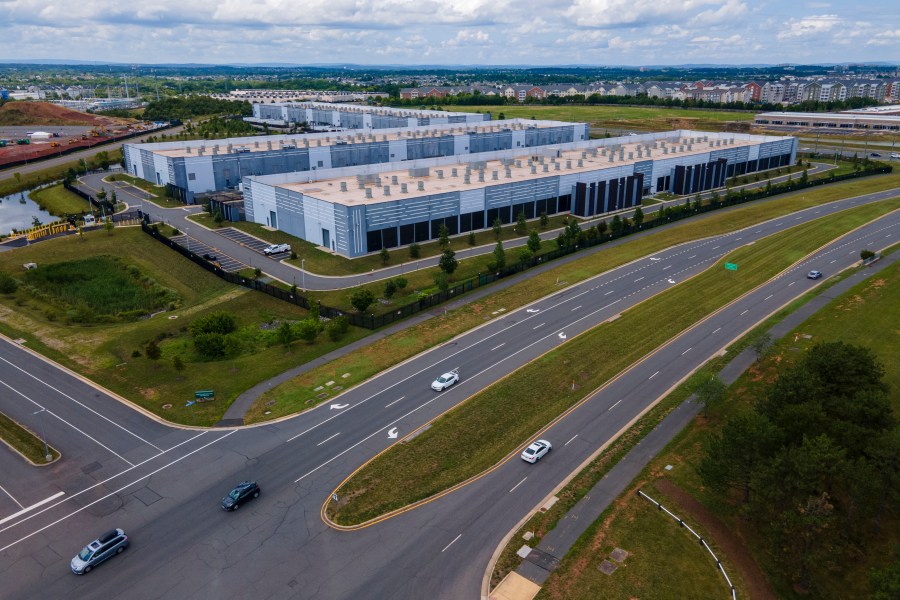
In some places, data centers are driving a big increase in demand, since a typical AI data center uses as much electricity as 100,000 homes, according to the International Energy Agency. Some could require more electricity than cities the size of Pittsburgh, Cleveland or New Orleans.
While many states have sought to attract data centers as an economic boon, legislatures and utility commissions were also flooded with proposals to try to protect regular ratepayers from paying to connect data centers to the grid.
Meanwhile, communities that don’t want to live next to one are pushing back.
It’s on voters’ minds
An Associated Press-NORC Center for Public Affairs Research poll from October found that electricity bills are a “major” source of stress for 36% of U.S. adults.
Now, as falls turns to winter, some states are warning that funding for low-income heating aid is being delayed because of the federal government shutdown.
Still, the impact is still more uneven than other financial stressors like grocery costs, which just over half of U.S. adults said are a “major” source of stress.
And electric rates vary widely by state or utility.
For instance, federal data shows that for-profit utilities have been raising rates far faster than municipally owned utilities or cooperatives.
In the 13-state mid-Atlantic grid from Illinois to New Jersey, analysts say ratepayers are paying billions of dollars for the cost to power data centers — including data centers not even built yet.
Next June, electric bills across that region will absorb billions more dollars in higher wholesale electricity costs designed to lure new power plants to power data centers.
That’s spurred governors from the region — including Pennsylvania’s Josh Shapiro, Illinois’ JB Pritzker and Maryland’s Wes Moore, all Democrats who are running for reelection — to pressure the grid operator PJM Interconnection to contain increases.
Red states vs. blue states
Drew Maloney, the CEO of the Edison Electric Institute, a trade association of for-profit electric utilities, singled out Democratic-leaning states as the drivers of higher electric bills.
“The red states’ electricity rates are not going up at the rate the blue states are,” Maloney said. “But the data centers are largely going to the red states and the rates are still stable.”
Pull out some of those fast-rising rates — like in California, where wildfires are driving grid upgrades, and New England, where natural gas is expensive — and the rest of the country largely follows inflation on electricity rates, Maloney said.
Still, blue states are attracting data centers, too, and some red states are seeing higher electric bills.
In Indiana, a growing data center hotspot, the consumer advocacy group, Citizens Action Coalition, reported this year that residential customers of the state’s for-profit electric utilities were absorbing the most severe rate increases in at least two decades.
Republican Gov. Mike Braun decried the hikes, saying “we can’t take it anymore.”
___
Associated Press reporter Jeff Amy in Atlanta contributed to this report.