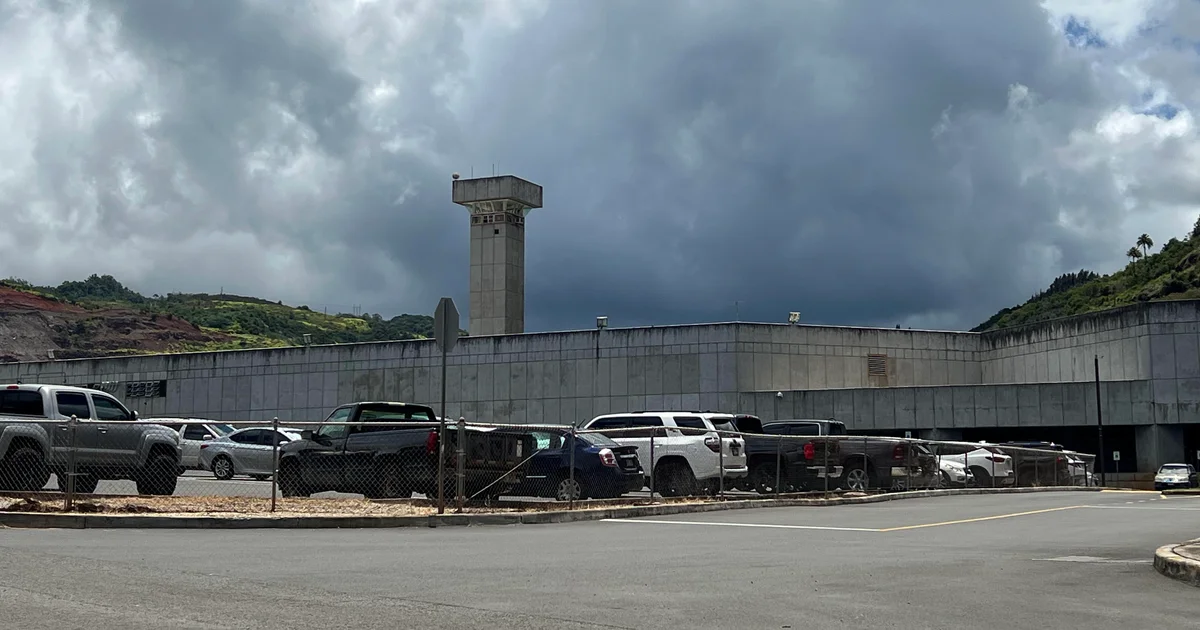

ʻAIEA, Hawai’i — Inside a cell at Halawa Correctional Facility in Honolulu, Christian Alameda braced himself on a cane and slowly lifted his body from the bed. Since suffering a stroke in January, he has been recovering in the prison’s medical infirmary, with the right side of his body left largely paralyzed.
In February, Hawai’i’s parole board approved compassionate release for Alameda, now 52, a form of early probation that permits incarcerated people to seek medical attention for severe conditions.
Yet Alameda remains behind bars because no long-term care facility has agreed to take him.
By June, at least three other prisoners who had been granted release for serious medical needs were also still living indefinitely in the infirmary, according to the state parole authority. Long-term care facilities had refused to accept them, largely because of their criminal histories.
“This is a challenge across the country,” said Molly Crane, an attorney with FAMM, an organization that advocates for fairness in prison policies.
All states allow compassionate release for prisoners, although Hawaiʻi is the only state without a dedicated statute, instead using an internal policy. People who qualify are often unable to care for themselves, are terminally ill, or require placement in an assisted living facility, nursing home, or hospice program.
But across the United States, many long-term care providers decline to admit formerly incarcerated patients, leaving some people in prison for months — and in some cases years — after parole or compassionate release has already been approved.
The problem has surfaced in several states. In Rhode Island, researchers found that nursing home rejection rates climbed sharply once facilities learned a patient was coming from prison. In Colorado, medically fragile prisoners remained incarcerated for an average of 200 days after being granted parole because long-term care centers denied them admission. And in New York, prisoners who had been approved for parole sued the state after they could not secure nursing home placements.
President Donald Trump’s signature One Big Beautiful Bill Act further strains long-term care providers’ ability to take people from incarceration. Prisoners don’t qualify for Medicaid, so parolees often need to apply after they’re granted the release. The law, enacted last summer, reduces the window in which facilities can get reimbursed retroactively for new Medicaid patients from three months to as little as 30 days before they apply. That means facilities risk not getting paid for new Medicaid patients whose applications are not submitted within the reduced timeframe.
The Centers for Medicare & Medicaid Services “encourages providers and beneficiaries to prioritize timely application submission to maximize coverage,” CMS spokesperson Timothy Foster said.
“Risk is just too high”
Most nursing homes nationwide already have a waiting list for new residents, according to a 2024 report by the American Health Care Association and the National Center for Assisted Living. Those waitlists are another hurdle to getting prisoners placed, said Bob Merce, a former attorney who advocates for prisoners’ compassionate release.
“We tell the nursing homes that most of the people who we are talking about cannot hurt somebody,” Merce said.
Some of the prisoners staying at the Halawa infirmary in June couldn’t walk or dress themselves. One man couldn’t recall what his illness was. Another with brain cancer couldn’t coherently respond to questions.
Ashley Mizuo/KFF Health News
Sean Sanada, the Oʻahu Region CEO with the Hawaiʻi Health Systems Corp., oversees the region’s two state-funded long-term care facilities, Leahi Hospital and Maluhia. Sanada said that the health system has reviewed dozens of compassionate release referrals but has never accepted any of them.
Sanada said the facilities don’t discriminate based on where the resident comes from. His main concerns, he said, were his staff’s safety and the lack of resources to adequately care for the patient.
“The risk is just too high in most of those instances,” Sanada said.
Violent incidents in long-term care facilities have been well documented. A 2024 study observing 14 assisted living facilities found that in just one month, 15% of residents experienced resident-to-resident aggression.
When long-term care facilities refuse to accept prisoners who have been granted compassionate release, it leaves state taxpayers footing a larger bill. The annual cost to incarcerate an individual in Hawai’i with complex needs is up to eight times the $112,505 average of housing one person in prison, according to FAMM. In comparison, the average Medicaid reimbursement for long-term care patients at a Hawaiʻi Health Systems Corp. facility is about $135,000 a year.
RELATED: Democratic Lawmaker Claims Constitution Barred Police Stop After Alleged 100 MPH Speeding
Four states — Connecticut, Georgia, Massachusetts, and Vermont — contract with nursing facilities to take prisoners who are granted compassionate release, according to FAMM.
The iCare Health Network’s MissionCare Health, which operates nursing homes for people coming out of prison, secured contracts in three of those states. David Skoczulek, iCare’s vice president of business development and communication, estimated that its rates are $100 to $350 a day more per patient than the average nursing home rates in the states where they operate.
In Hawaiʻi, the correctional department determines recommendations to send to the parole board, which decides whether to grant the release. Prisoners who are granted the early probation can be released to family members who commit to caring for them or to a long-term care facility.
Corey Reincke, head of the Hawaiʻi Paroling Authority, said that in his 24-year career he couldn’t recall getting anyone placed into a long-term care facility without family intervening, for instance by contacting facilities themselves.
“Parole has to find a facility that can meet their medical needs and is also willing to take them,” Reincke said. “That’s where we’re hitting the roadblocks.”
For one parolee, Reincke called more than 100 care homes, he said, but they all declined to accept the patient, over safety concerns. According to a 2024 state report, while Hawaiʻi’s long-term care facilities use about 80% of their bed capacity, workforce strains make it difficult to maintain even those levels.
Hawaiʻi prisoners’ refuge: family
Last year, 69-year-old Paul Kupihea died at a hospital five days after the state granted him compassionate release to his family. He died before he could get on a flight to his home island.
In July 2025, Lahela Kruse, the mother of Kupihea’s child, received a call from a Honolulu hospital informing her that his condition had become severe. By then he had been diagnosed with an incurable form of cancer and had been in and out of the hospital while still in custody.
Kruse and their daughter flew to Oʻahu to see him and were shocked when they saw how sick he was. Their daughter agreed to take him into her home in Hilo, on Hawaiʻi Island, despite not having a relationship with him for most of her life.
“She knew he was sick,” Kruse said. “I told her that, but she didn’t know the severity of it. I didn’t truly know.”
Her daughter’s willingness to take him prompted his compassionate release. But Kruse said the notification about Kupihea’s illness came too late.
FAMM’s Crane has been working on expanding compassionate release laws in states to allow for more prisoners to qualify and strengthen transparency in the process. Hawaiʻi lawmakers have tried for years to pass bills on compassionate release, but none has succeeded.
Crane said without a law that outlines a formal process and who qualifies, even family support isn’t enough. Prisoners can still face life-threatening delays, she said.
“The absence of a compassionate release statute means that people who need compassionate release languish and even die in prison,” Crane said.
In Alameda’s cell, two beds stood about 3 feet apart, with a seatless metal toilet in the corner and a window looking out on a concrete wall. The smell of bleach permeated the room. Alameda said he hoped to see his daughter soon. She recently turned 5.
“I made some mistakes in my life,” said Alameda, who has been incarcerated since 2024 for drug possession, driving a stolen vehicle, and jumping bail. “I tried when my daughter was born, but I know I’ll change, because she needs me out of here.”
Merce, the former attorney, is still trying to find a place for Alameda, who committed no violent crimes. Merce became aware of prisoners’ struggles through his work as a trial lawyer. He said he has helped about 15 prisoners leave Hawaiʻi correctional facilities for medical treatment.
He said he’s seen cases in which people have waited years to get out.
“The ones that stick with me, though,” Merce said, “are the ones that I never found placements for.”
KFF Health News is a national newsroom that produces in-depth journalism about health issues and is one of the core operating programs at KFF — the independent source for health policy research, polling, and journalism.