
The Supreme Court on Friday rejected an effort to put a new Missouri congressional map backed by President Donald Trump into effect, ending a prolonged legal fight as absentee voting gets underway in the midterm elections.
The justices blocked a federal appeals court ruling that would have restored the Republican-favored map for the November election, which will help determine control of Congress. The court issued its decision without noting any dissents.
Instead, the Supreme Court allowed a ruling from the Missouri Supreme Court to remain in force. That decision found that a citizen petition bars use of the new districts unless voters approve them in a November referendum. As a result, Missouri will hold this year’s congressional election using the same district boundaries in place for the 2022 and 2024 elections.
“At this late date, ordering reversion to the 2025 map in the midst of an ongoing election would usher in electoral chaos,” the high court said in an unsigned opinion. “The District Court and Court of Appeals should not enjoin or otherwise prohibit the use of the 2022 map in the 2026 congressional election in Missouri.”
Republicans had viewed the new House map, which was already used in Missouri’s August primaries, as a potential path to gaining an additional seat. The effort was part of a nationwide redistricting campaign promoted by Trump to improve the party’s position in the midterms.
On Monday, a panel of the 8th U.S. Circuit Court of Appeals ruled that using one set of districts for the primary and another for the general election would violate the U.S. Constitution. The panel ordered a district judge to prohibit Missouri from using any map other than the new one, but delayed the order until the following Monday to give the state time to appeal to the Supreme Court.
The Republican-backed map had already been used in Missouri’s August primaries and was expected to give the party a chance to capture an additional House seat. Its adoption formed part of Trump’s broader national redistricting effort aimed at strengthening Republican prospects in the midterm elections.
The 8th Circuit panel said Monday that changing congressional boundaries after the primary would be unconstitutional. It instructed a district judge to block use of any map except the revised districts, while postponing enforcement until the next Monday so the dispute could reach the Supreme Court.
Cleaver faced no opposition in the Democratic primary, while Republican state Sen. Rick Brattin prevailed in a six-candidate Republican primary conducted under the revised districts. Both remain their parties’ nominees for the general election, even though the boundaries have returned to their previous lines.
YOU MIGHT ALSO LIKE: Behind-the-Scenes Tensions Rise Among The View Co-Hosts
Brattin, along with Republican Rep. Bob Onder and two other voters, was a plaintiff in the federal lawsuit that produced the 8th Circuit ruling and prompted the two most recent appeals to the Supreme Court.
Missouri’s redistricting prompted a big legal fight
At least 16 lawsuits have been filed in state and federal courts over Missouri’s congressional redistricting. The dispute has become the longest and most complicated among roughly a dozen states that attempted to redraw their U.S. House districts during the past year.
The new map prevailed in most of those cases, including challenges arguing that redrawing districts in the middle of the decade violated Missouri’s constitution or produced districts that were not sufficiently compact. In one proceeding, the Missouri Supreme Court permitted the new boundaries to be used while election officials verified signatures on a petition seeking to put the map before voters statewide.
Republican Secretary of State Denny Hoskins waited until the Aug. 4 legal deadline — the same day the new districts were used in the primary — to reject the petition. Hoskins argued that referendum petitions cannot be used for congressional redistricting.
On Sept. 3, the Missouri Supreme Court ruled that the referendum petition was valid. It directed Hoskins to stop using the new map and return to the districts adopted in 2022 after the latest census. The U.S. Supreme Court allowed that ruling to stand on Sept. 8, but minutes later U.S. District Judge Stephen Clark issued a conflicting order favoring the revised map.
The U.S. Supreme Court blocked Clark’s order from taking effect on Sept. 10. That same day, the Missouri Supreme Court temporarily held Hoskins in contempt after he instructed local election authorities to use the new map despite the state court’s ruling and the Supreme Court’s action.
The litigation continued when the 8th Circuit considered an appeal of Clark’s blocked order and ruled Monday in favor of the Trump-backed map. That decision set the stage for the Supreme Court’s latest ruling.
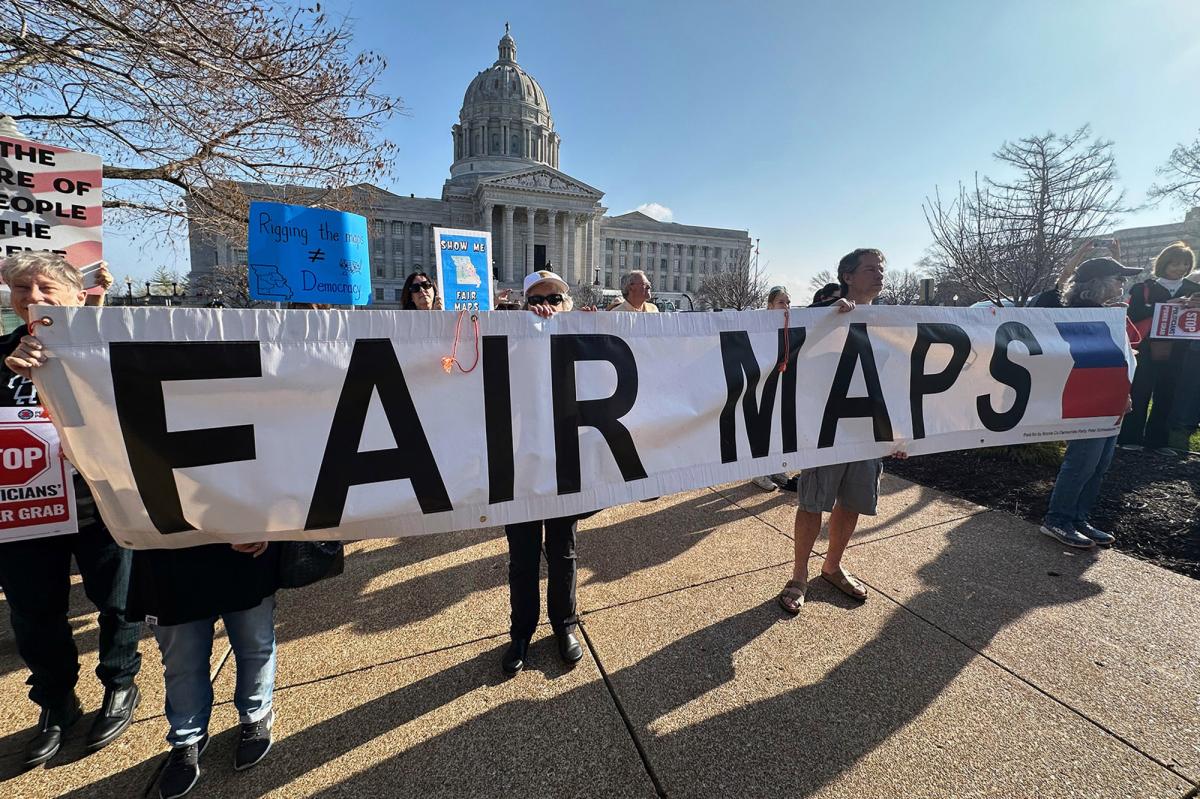
Richard von Glahn, executive director of People Not Politicians Missouri, said the group would continue campaigning for voters to permanently reject the new map in the November referendum.
“We have said from the beginning, people, not politicians will be the final deciders on this DC power grab,” he said in a statement.