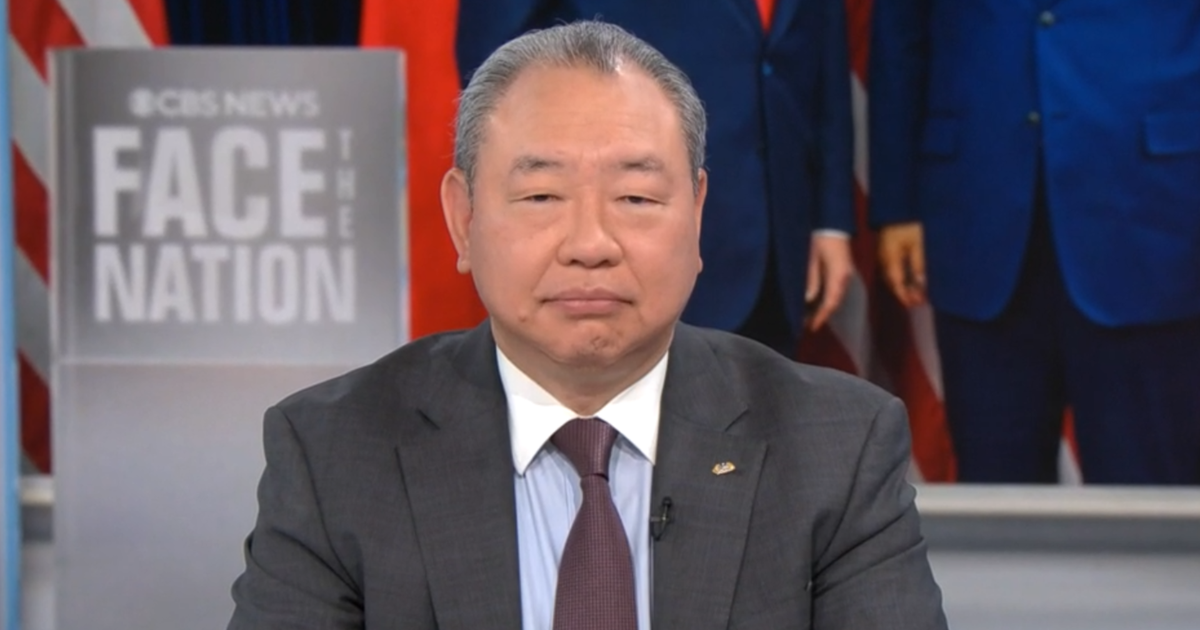

Washington — On Sunday, Taiwan’s envoy to the United States, Alexander Yui, emphasized the nation’s desire for “peace and stability” amid heightened attention on Taiwan during last week’s pivotal discussions between President Trump and Chinese President Xi Jinping.
“We wish to live our lives without disruption. Yet, we are not the ones instigating these issues,” Yui stated during an appearance on “Face the Nation with Margaret Brennan.”
After completing a two-day summit in Beijing, Mr. Trump returned to the U.S. on Friday. Taiwan remains a critical focal point for China, which has not discounted the possibility of using force to reclaim it. Historically, the U.S. has pledged to support Taiwan’s defense, but concerns are rising about potential shifts in this stance under Mr. Trump’s administration.
President Trump mentioned to reporters on Air Force One that Taiwan was a significant topic of conversation with Xi. Reports from Chinese state media indicate that Xi cautioned Trump about potential “clashes and even conflicts” if the Taiwan issue is not “managed appropriately.”
Yui expressed on Sunday that although President Trump was informed “extensively about Taiwan” during the talks, it was primarily from the “Chinese perspective.” He added, “We would appreciate the opportunity to share our narrative, the Taiwan story, which is one of resilience and standing firm against Chinese hostility.”
The ambassador said Taiwan would “love to tell our side of the story, the Taiwan story, which is one of resiliency, of staying up against the Chinese aggression.”
“This has been going on for 77 years. This is not something that just happened when the DPP, the current ruling party of Taiwan, came to power,” Yui said. “This has been going on for 77 years, since the inception of 1949 when they became a People’s Republic. So this is not a recent thing.”
Yui expressed appreciation for the U.S.’ approach in the Beijing summit, saying Mr. Trump and Secretary of State Marco Rubio were “very categorical with their visit to Beijing, publicly stating that there’s no change in the United States’ longstanding position in Taiwan.”
While China wants the U.S. to stop weapons sales to Taiwan, Mr. Trump said he made “no commitment either way” and will “make a determination over the next fairly short period.” He told Fox News after meeting with Xi that he views the pending weapons sale as a “very good negotiating chip.”
“Taiwan would be very smart to cool it a little bit,” Mr. Trump said. “China would be very smart to cool it a little bit.
“I think that’s a statement of saying he wants status quo,” Yui said, when asked about the statements. “That he wants no change in the Taiwan Straits, neither through economic or military coercion, and that the peace and stability of the Taiwan Straits is good for all parties concerned.”
Asked whether Taiwan has an intention of declaring independence formally from China, Yui said what is meant by an emphasis on Taiwan independence is that “Taiwan is independent from the Chinese aggression.”
“That we’re not subordinate to the People’s Republic of China in any way at all,” he said. “And that’s maintaining our sovereignty, our way of life, our democracy, our vibrant economy, our high-tech production. That is what is meant by independence. We are sovereign, independent, away from the People’s Republic of China’s attempt to swallow us as one of their own.”
Yui stressed that Taiwan doesn’t “want a war.”
“It’s like, our house, there’s intruders trying to get into our house,” he said. “We’re trying to beef up our security system, and then they complain, the intruder complains, that because we’re trying to improve our security system, it’s making his job harder.”