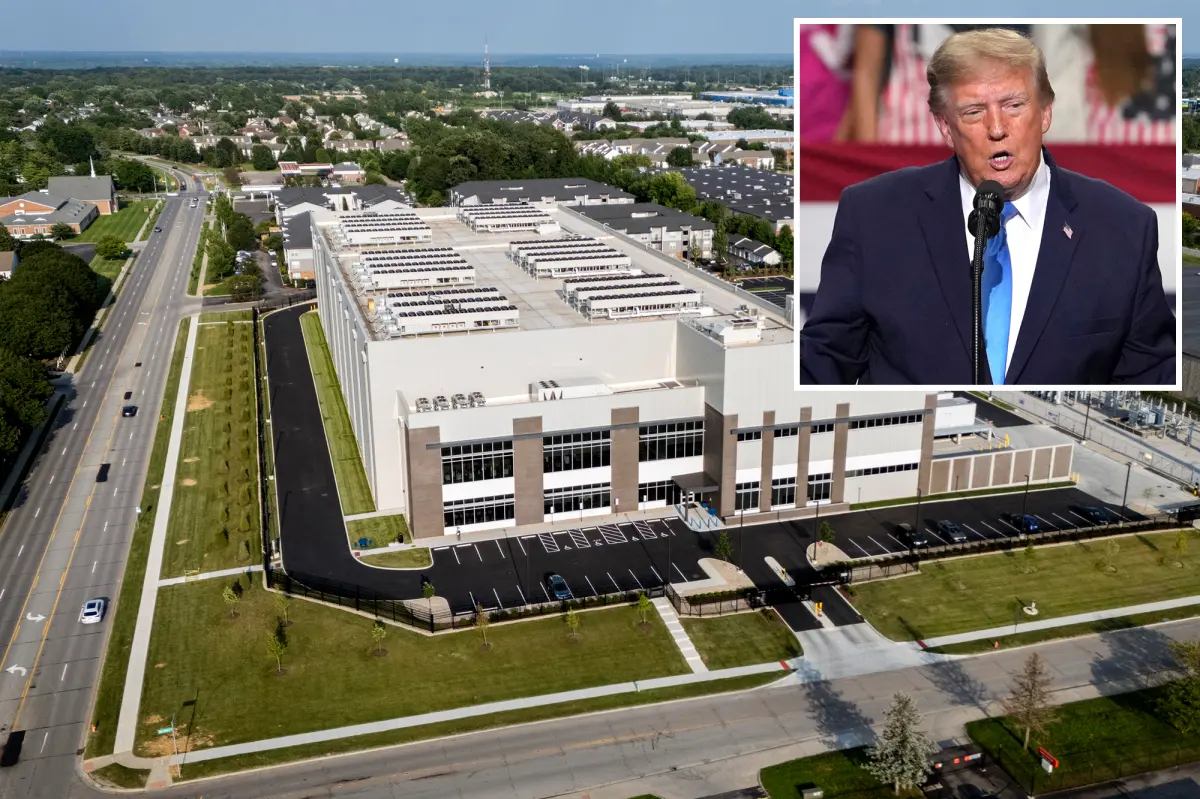

President Trump on Saturday defended the swift expansion of massive data centers, telling supporters in Ohio that stopping the projects could give China an edge. He made the argument while urging voters to support Republican candidates in next month’s midterm elections.
“There’s so much money to be made for Ohio. You can’t just turn them off. They’ll go to China,” Trump said at a rally outside Dayton. He encouraged voters to back Republican Sen. Jon Husted and gubernatorial candidate Vivek Ramaswamy.
Speaking in the battleground state, Trump repeatedly asked the crowd to approach the November 3 election as if his own name were on the ballot.
“Please pretend that I’m on the ballot, and you need to turn out for a midterm victory,” he said.
Trump said his administration was pursuing “historic action” to ensure the large technology companies building data centers contribute to the communities around them.
He linked the rapid growth of the data center industry to the international competition over artificial intelligence, asserting that the United States is ahead of China in what he repeatedly described as “superintelligence.”
Trump said China “doesn’t want to see us” succeed and declared, “We’re beating China,” as he argued that the United States should continue welcoming data center development.
At the same time, Trump endorsed legislation backed by Husted that he said would prevent data centers from driving up electricity bills and require the facilities to cover the costs they impose on the power grid.
Trump claimed that nearly every Senate Democrat had voted several days earlier against the proposal.
DON’T MISS: Super Bowl-Winning Coach Jon Gruden Makes Surprise Appearance at Trump Rally
He promised to sign the Ratepayer Protection Act “into law immediately within 24 hours” if Republicans won the election.
The nationwide data center boom has sparked bipartisan opposition as communities confront the vast quantities of electricity, water and land needed to operate the facilities.
A central dispute is who should pay for the infrastructure required to support these large-scale technology projects.
Utilities could be forced to add power plants, substations and transmission lines to handle the facilities’ enormous demand. That has raised fears that families and other businesses could face higher utility bills if the expenses are distributed across the broader customer base.
Residents have also raised concerns about heavy water consumption, constant noise and the sprawling size of the campuses, particularly when projects are built near neighborhoods or in regions already dealing with limited water supplies.
Opponents are additionally challenging the state and local tax incentives offered to attract data centers, noting that the facilities can cost billions to construct while creating relatively few permanent jobs after the building phase ends.
The growing political backlash has led officials in several states to reconsider the tax breaks and expedited approvals once used to compete for data center investments.
Some states have suspended incentives or permitting processes, while others have introduced specialized utility rates and rules designed to make developers pay more of the expense associated with serving their projects.
Trump’s Ohio appearance followed stops in Texas, Oklahoma and Alabama earlier in the week. He has described the campaign schedule as a 32-day tour leading into the midterm elections.
— With Post wires