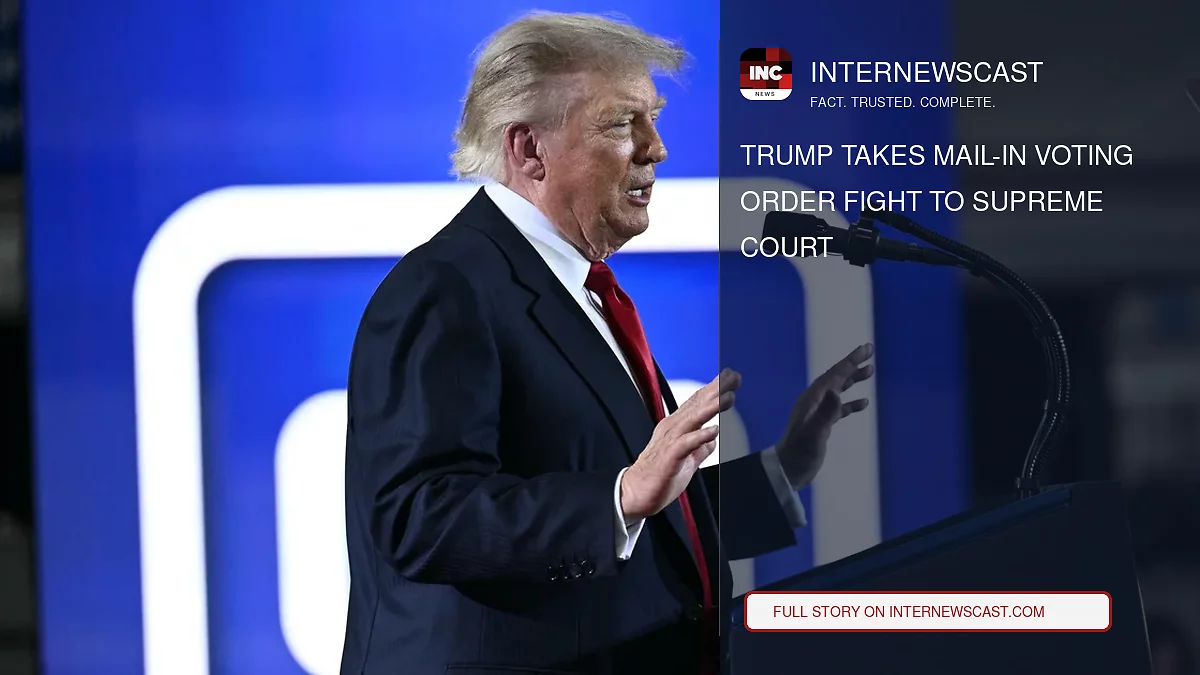

Washington — The Trump administration asked the Supreme Court on Monday to step into a legal fight brought by 23 states over President Trump’s executive order seeking new limits on mail-in ballots and directing the Department of Homeland Security to assemble lists of eligible voters.
The emergency request arrived one day after a federal appeals court allowed a lower-court ruling to remain in effect, blocking major parts of the order in nearly half the country as the November midterm elections approach.
Solicitor General D. John Sauer told the justices that the district court’s injunction is “extraordinary,” arguing that it stops federal agencies from taking steps to carry out Mr. Trump’s directive. Sauer said the order “merely sets forth general policy guidance” and is intended to strengthen election integrity.
“The Executive Order functions only to direct the President’s subordinates to take appropriate and lawful action to implement the President’s policy objectives,” he wrote. “By stopping the relevant agencies and officials from implementing that Order with respect to the November 2026 federal election, the injunction operates as ‘an improper intrusion by a federal court into the workings of a coordinate branch of the Government.'”
Mr. Trump signed the executive order at the center of the case in March. It instructs the Homeland Security secretary to create and provide each state with a “state citizenship list” identifying U.S. citizens eligible to vote. The order also directs the U.S. Postal Service to draft new rules governing mail ballots, including a requirement that ballots be marked in a specific envelope and a provision allowing mail ballots to be sent to voters appearing on their state’s list.
Within days of the president issuing the directive, 23 states and the District of Columbia sued, contending that the executive order is illegal.
U.S. District Judge Indira Talwani of the federal court in Massachusetts ruled for the states in June, preventing the Trump administration from enforcing the provisions tied to mail ballots and state citizenship lists for the Nov. 3 federal elections in the 23 states that brought the challenge.
The U.S. Court of Appeals for the 1st Circuit later declined to let the Trump administration proceed with the executive order while the litigation continues.
Sauer argued that Talwani’s injunction was “premature,” since federal agencies are only working to put together plans to put the president’s executive order in place.
He said the states’ challenge is to “hypothetical” agency action, and the president is allowed under the law to direct his subordinates to consider “appropriate” action.
“The harms to voter integrity in that election if the government’s policy is not in place cannot be undone even if the government later prevails on the merits of its appeal,” Sauer wrote.