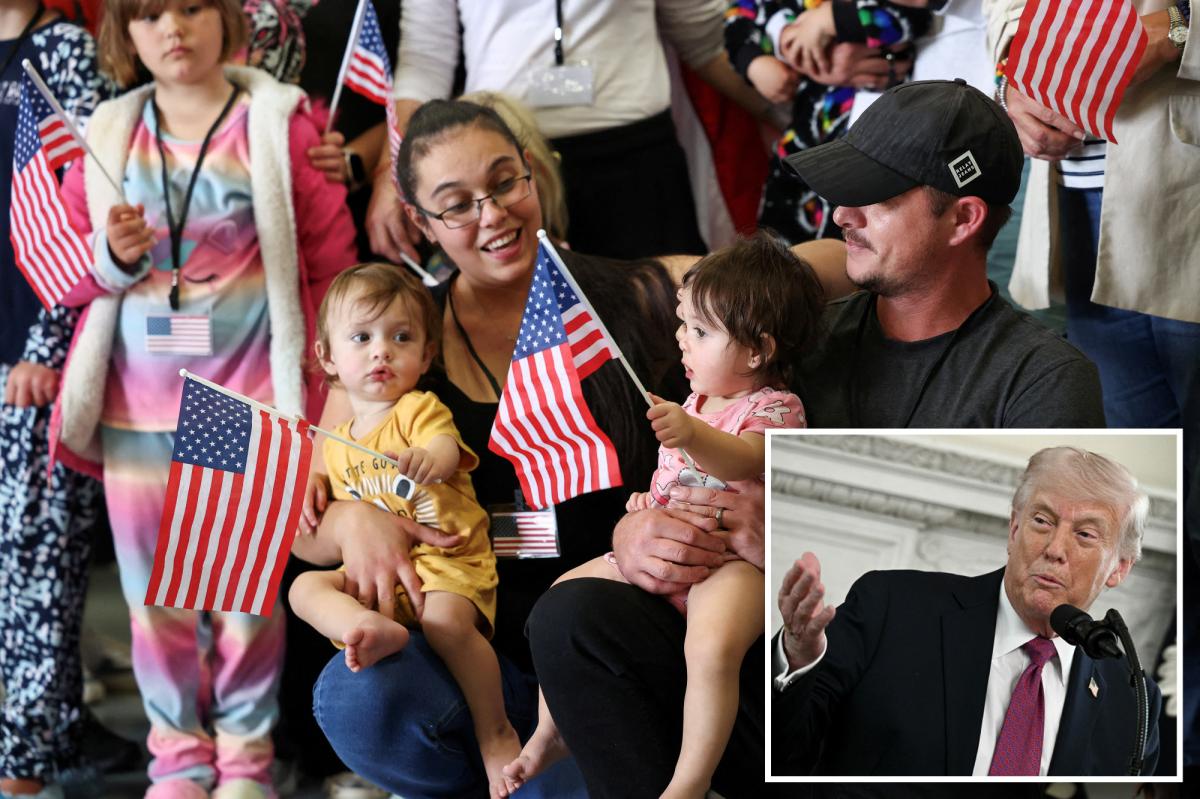


WASHINGTON, April 23 — The Trump administration is weighing a significant increase in the annual refugee cap, aiming to facilitate the entry of more white South Africans into the United States, as revealed by three individuals familiar with the discussions.
Since assuming office in January 2025, President Trump, a member of the Republican Party, halted refugee admissions across the globe.
Shortly after, he enacted an executive order that gave priority to resettling European-descended Afrikaners, citing allegations of racial persecution against them in predominantly Black South Africa.
The South African government strongly refutes such claims.
Established in 1980, the US Refugee Admissions Program was initially launched in response to the mass exodus from war-torn Vietnam and Cambodia.
Over time, the program has evolved to offer sanctuary to individuals facing persecution worldwide.
Trump has used it almost exclusively to bring white South Africans into the US, part of a broader upending of norms around humanitarian protection.
In recent weeks, US officials have discussed expanding the 7,500-person refugee cap by 10,000 to allow more South Africans of Afrikaner ethnicity to obtain refugee status, said people familiar with internal planning, who spoke on the condition of anonymity to share non-public government discussions.
The White House referred questions to the US State Department.
A State Department spokesperson did not confirm or deny the discussions around expanding the refugee admissions ceiling.
“If the president decides to raise the FY 2026 refugee admissions cap, he will do so at the appropriate time, and any numbers discussed at this point are only speculation,” the spokesperson said.
During the apartheid era, which ended with the first democratic elections in 1994, South Africa maintained a racially segregated society with separate schools, neighborhoods and public facilities for people classified as Black, colored, white or Asian.
Blacks make up 81% of South Africa’s population, according to 2022 census data. Afrikaners and other white South Africans constitute 7% of the population.
The US admitted about 4,500 South Africans as refugees through the first six months of the fiscal year, State Department figures show, on pace to exceed Trump’s existing limits for the program.
The only refugees other than white South Africans to enter this fiscal year were three Afghans, according to State Department statistics.
Trump set the record-low refugee ceiling of 7,500 for fiscal year 2026, which began October 1, 2025, down from a ceiling of 125,000 a year under former President Joe Biden.
The Trump administration is also discussing bringing in refugees of other nationalities, one of the people familiar with planning said.
US officials are weighing whether religious minorities from Iran and countries that used to be part of the Soviet Union could be included under what’s known as the “Lautenberg” program, the person said.
The program stems from a 1989 budget amendment introduced by then-US Senator Frank Lautenberg that aimed to make it easier for Jewish refugees to resettle in the US.
Some South Africans in the US decide to go back home
Even as Trump looks to further ramp up the entry of South Africans, an internal US government email reviewed by Reuters showed that at least four refugees already in the US have returned to South Africa.
One South African who arrived in Minneapolis in late January departed the US less than a month later, the email showed. Case notes said that plans for his daughter and grandchildren to join him “fell through,” so he returned to his home country.
A pair of South Africans who arrived in Twin Falls, Idaho, in late January via the refugee program turned around a week later, saying a parent was ill in South Africa, the email showed.
Another South African resettled in Moline, Illinois, in mid-March returned home weeks later, the email said.
“Resettlement occurred quickly, she had not thoroughly thought through the process, and her family in South Africa has decided not to continue their own resettlement process,” case notes said.
“Additionally, the client’s age (66) and ability to provide for herself is a concern.”
Trump has portrayed South Africa as dangerous and oppressive for whites, yet thousands of white South Africans abroad have returned to the country in recent years, Reuters reported in March.
US government contracting documents reported by Reuters in February said the US aimed to process 4,500 white South Africans per month through the refugee program.
The documents also said the State Department paid to install more than a dozen trailers on embassy property in Pretoria to conduct interviews.