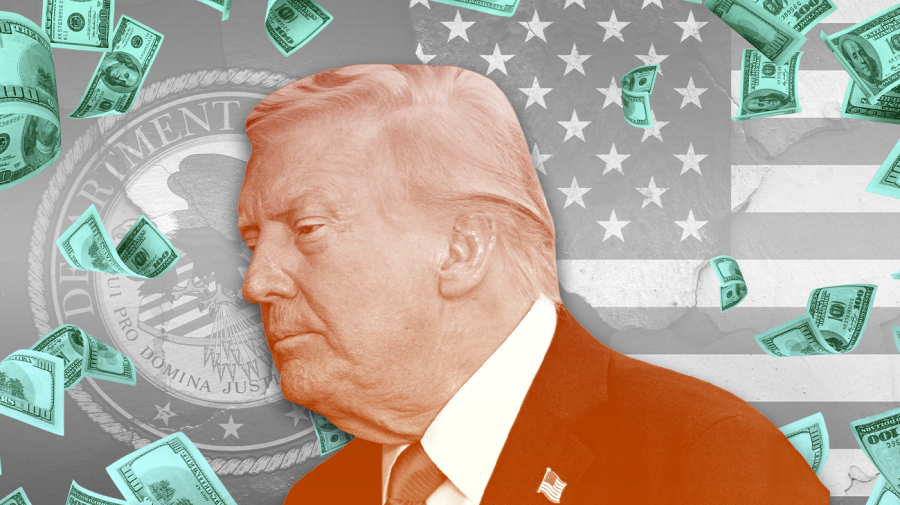


Former President Donald Trump is pursuing a substantial compensation claim, potentially amounting to $230 million, from the Department of Justice, citing the various federal investigations conducted into his activities. If successful, his request could face minimal legal challenges.
Trump revealed on Tuesday that his personal legal team is actively negotiating a settlement. Interestingly, the decision to approve such a payout would fall to individuals who were once appointed by Trump himself, including some of his former defense attorneys.
This unusual situation has sparked significant criticism from Democratic leaders, labeling the pursuit as “blatantly illegal and unconstitutional.”
However, legal experts suggest that there may be limited legal options to counter a DOJ settlement decision, in stark contrast to the typical American’s experience in similar claims.
The New York Times initially broke the story about the potential settlements, a topic Trump later touched upon during his remarks in the Oval Office.
According to the Times, Trump has lodged two separate claims for damages. The first, submitted in late 2023, alleges that his rights were violated during the FBI’s and special counsel’s investigation into alleged Russian connections with his 2016 campaign. The second claim, filed in the summer of 2024, accuses the FBI of breaching his privacy during the search of Mar-a-Lago for classified documents and criticizes what he sees as the Justice Department’s malicious prosecution.
The claims are required to kickstart the process of suing the federal government under the Federal Tort Claims Act (FTCA), the law Trump invoked, which allows damages lawsuits against the U.S. for government employees’ negligent acts. After six months of waiting, a claimant may sue.
Rupa Bhattacharyya, former director of the Justice Department’s Torts Branch-Civil Division, told The Hill that FTCA claims are brought every day and that it is one of the most active areas of litigation against the government.
She explained that the typical claim that settles during the administrative claim process is something like a traffic accident or medical malpractice, where it’s “pretty clear somebody did something wrong.” Such settlements aren’t rare, but they’re “certainly not used in cases like this,” she said.
“I honestly cannot imagine a circumstance in which a career Justice Department person looking at that settlement would approve it,” Bhattacharyya said.
For everyday people seeking compensation from the government, getting a pay-out over an administrative claim like Trump’s alone is unlikely.
Neama Rahmani, a former federal prosecutor and co-founder of West Coast Employment Lawyers, which represents plaintiffs in personal injury and civil litigation, said he has handled “hundreds and hundreds” of such claims and never had one be accepted.
“They are denied every single time,” Rahmani said.
“So, you make your claim, it is denied and you file your lawsuit,” he added, saying it would be “shocking” if Trump’s settlement was approved.
Nonetheless, Trump seems poised to be paid without taking the government to court.
The president told reporters Tuesday that he hadn’t discussed specifics with his attorneys but was owed “a lot of money.” He vowed to give it to charity.
“It’s awfully strange to make a decision where I am paying myself,” Trump said.
The decision would not belong to Trump himself, but instead, his subordinates at the Justice Department.
While lower-level career employees can make settlement decisions under certain dollar amounts, a high-sum compensation like the $230 million Trump is seeking would be decided by either the deputy attorney general or associate attorney general.
Deputy Attorney General Todd Blanche was Trump’s former defense attorney, and Associate Attorney General Stanley Woodward represented Trump’s co-defendant, Walt Nauta, in the classified documents case.
Stephen Gillers, a legal ethics scholar at NYU School of Law, said in an email that government officials who serve at the president’s discretion should not decide whether the legal fees Trump incurred while defending himself can be reimbursed.
“Their interest in keeping their jobs conflicts with their obligation to their client, the United States, to make a disinterested decision,” he said.
Earlier this week, Justice Department spokesperson Chad Gilmartin said officials would “follow the guidance of career ethics officials.” Attorney General Pam Bondi fired the department’s top ethics adviser in July.
On Thursday, the top Democrats on the House Judiciary and Oversight and Government Reform committees announced an investigation into the settlement bid.
Reps. Jamie Raskin (D-Md.) and Robert Garcia (D-Calif.), ranking members of the House Judiciary and Oversight and Government Reform committees, respectively, suggested Trump could have taken his claims to court if he believed they had merit, but instead, “waited” until he was president to “secretly order” his subordinates to approve the settlement.
They called the move “a blatantly illegal and unconstitutional effort to steal $230 million from the American people,” contending it violates a provision barring the president from taking payment from the federal or state governments beyond their salary.
Paul Figley, a former deputy director of the DOJ’s FTCA Staff in the Civil Division, suggested looking at the situation with changed facts: Imagine a helicopter flew to pick up the president at his home, and the helicopter crashed and burned the house down.
“You would have the same ethical issues that you’ve got here. Who’s going to approve the settlement?” said Figley, a professor emeritus at American University and visiting professor at Villanova University.
“We can all see that there’s liability and that this is something that would be within the waiver of sovereign immunity,” he continued, “and it would not be illegal or unconstitutional for the president to file an administrative claim and then take the money.”
That the decision lies with the Justice Department is ultimately Congress’s fault, Figley suggested.
Before 1948, Americans seeking compensation from the government would have to go to Congress for a special bill, he said. However, Congress “hated that process,” because their constituents were never satisfied, and there was “no good way” to determine whether money should be paid.
When Congress passed the FTCA, it turned that power over to the executive branch, which pays any settlements out of the Judgment Fund — a pot of indefinitely appropriated funds to pay court judgments and settlements in suits against the government.
“Because Congress has given the power over to the executive branch, it is an executive branch decision,” Figley said.
Rahmani agreed there’s “no legal recourse whatsoever” to challenge any decision to settle with Trump.
“They can be heard politically, but legally, there is no process whatsoever for a taxpayer or a representative in Congress to challenge a bona fide settlement,” Rahmani said.
And Bhattacharyya, while declining to rule it out entirely, said mounting a legal challenge to a possible settlement would be “difficult,” primarily because it would be hard to find a third-party plaintiff with legal standing to bring the case.
The right person could file suit claiming the Justice Department made an “arbitrary and capricious” settlement decision or could potentially contend under the False Claims Act that Trump submitted false claims to DOJ and was paid.
But without standing, which requires a concrete and personal stake in a lawsuit’s outcome, the challenge would likely fail.
“I haven’t come up with a great theory yet,” Bhattacharyya said of whom that person might be. “But I’m still thinking about it.”