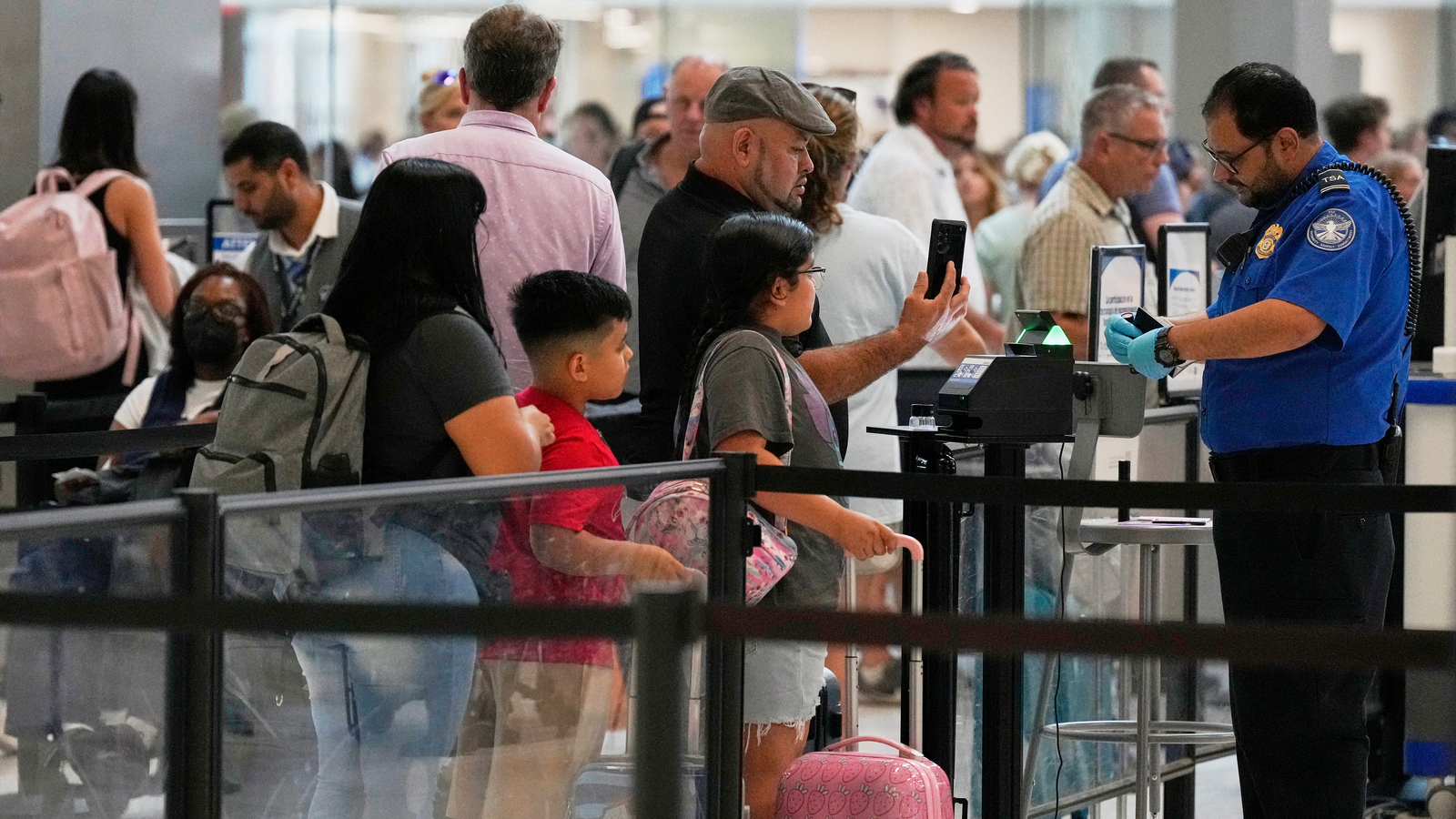

When liquid restrictions were introduced at TSA checkpoints nationwide in 2006, containers filled with water, toothpaste, and shaving cream quickly piled up. Almost twenty years later, travelers have become more familiar with the “3-1-1” rule that dictates the size of liquids allowed during flights. Nevertheless, it’s still a common sight to see passengers hurriedly drinking a beverage before getting their bags scanned.
That’s why recent comments by Homeland Security Secretary Kristi Noem suggested to many travelers that changes could be on the way regarding the TSA’s liquid restrictions.
“The liquids, I’m questioning. So that may be the next big announcement, is what size your liquids need to be,” Noem told a conference in Washington.
Will larger bottles or multiple 1-quart bags of liquids be allowed? Specifics have not been disclosed yet. However, following Noem’s earlier statement this month allowing travelers to keep their shoes on at TSA checkpoints, it appears that air travel security might soon look different for American passengers.
9/11 and its aftermath changed much
Airline travel changed dramatically after the Sept. 11, 2001 attacks. Before that, airlines were responsible for security and would often contract it out to private firms, said Henry Harteveldt, an airline industry analyst with Atmosphere Research Group. Travelers often didn’t need to show their ID at security checkpoints – and people without boarding passes, such as family members or friends, could go to the gate in some locations.
“It was much more casual. And clearly it was ineffective, because 9/11 occurred,” Hartevelt said.
That’s when the Department of Homeland Security and the Transportation Security Administration were born, with the mandate of preventing more terrorist attacks.
The liquid limits, however, didn’t kick in until 2006, after authorities foiled a plot that used liquid explosives smuggled aboard carry-on luggage. The TSA then very briefly banned all liquids in carry-on luggage. That ban lasted about six weeks, but strained airlines’ baggage systems as more and more travelers turned to checked bags to pack toiletries.
At the time the 3.4-ounce limit was implemented, the FBI and other laboratories had found that tiny amounts of substances small enough to fit into a quart-size bag couldn’t blow up an airliner.
When the ban was eventually lifted in September 2006, consumers and businesses alike had to learn how to adapt to the 3-1-1 rule – leading to more demand for smaller, travel size bottles of anything from shampoo to toothpaste, as well as clear, “TSA approved” toiletry bags that are still seen on store shelves today.
The rule was also adopted in many countries around the world starting later that year.
Keith Jeffries, a former TSA director at Los Angeles International Airport and now vice president of K2 Security Screening Group, says whatever comes next needs to be clear for passengers. And he knows whereof he speaks.
Jeffries was working for TSA in Albuquerque, New Mexico, when the liquids rules came down overnight. Signage had to be changed to let passengers know of the new regulations. Barrels overflowing with toothpaste, shaving cream and shampoo had to be emptied every half hour. Jeffries remembers seeing a pair of shoes sitting in one of the barrels.
When he asked why, a TSA staffer said there was gel in the soles. “I said, ‘Please tell me I don’t have a passenger back there walking in the sterile area barefoot. And he says, ‘No, sir, they still have their socks on,'” he said. “That’s how chaotic it was.”
It’s about more than convenience
Any move to simplify the screening process and cut down on the time it takes for passengers to navigate checkpoints would be a welcome change for everyone, Harteveldt says. Because it isn’t just about convenience; those lines before the security checkpoints are the most at risk to a potential threat.
The fact that the TSA felt confident enough to change its shoe policy earlier this month may not save too much time from an individual traveler’s perspective, Harteveldt notes – but marks a “big step forward” toward cutting down the average length of the security process when you think about the number of people going through U.S. airports each day. Relaxing current liquid restrictions could aid that effort.
Still, questions remain. “What we don’t know is what the secretary is going to announce about liquids,” Harteveldt said. “Will they remove the liquid ban altogether – and can we go back to bringing full-sized of toiletries and other items with us? Will they allow people to bring more than one bag of toiletries and liquids? And importantly, will they relax the limit on (the) quart-size bag itself?'”
It’s also possible that the changes the TSA makes, whatever they are, only start at a handful of airports that have the technology to do so. Over the years, airports worldwide have adopted some aspects of security screenings faster or differently than others.
But travelers could be confused if they’re able to bring a full-size bottle of shampoo or lotion when flying out of one airport, for example, but not on their return trip home.
“The devil is going to be in the details,” Harteveldt said. “That’s why the rollout plan will be absolutely critical.”
Harveldt says a more streamlined process could make travelers less stressed, but others – including flight attendants and pilots who are in the skies more frequently – may object and question whether airport security is being compromised. Still, Harveldt says he doesn’t believe the TSA would make this change if the agency “didn’t feel it was authentically, truly safe.”
What of expedited security lines?
If shoe regulations disappear and liquid restrictions are eased, the effects could ripple into the TSA PreCheck program, in which passengers submit information like their fingerprints and the agency prescreens them for any red flags. By giving the agency this information, the traveler then gets some benefits not available to other travelers – a special line to go through and the ability to keep their computers in their bags and their shoes on, for example.
But if those benefits become more widely available to all passengers, will fewer people sign up for PreCheck?
“What is the impact on now both shoes and liquids going to have on TSA PreCheck enrollment? That is the million-dollar question,” Jeffries said. “And if I was still with TSA, I would be watching that closely over the next 12 to 18 months.”
While the prospect of increasing the current liquid limit could be a welcome change for many U.S. travelers, some experts say that the tech isn’t available in enough airports yet. Current X-ray machines used at most airports today have a difficult time distinguishing between different types of liquids, says Jeffrey Price, a professor of aviation at Metropolitan State University of Denver.
That’s key, he explains, in determining whether something is harmless or potentially explosive.
While newer computed tomography scanners are better and have begun making their way to airports, Price said in commentary published last week that it could take “another decade or more” before the newer machines are deployed at all U.S. airports.
“This is an issue that needs to be studied much more carefully than the policy to leave your shoes on,” he said in an email Thursday.
Copyright © 2025 by The Associated Press. All Rights Reserved.