
ORLANDO, Fla. (AP) — No place is more vulnerable to hurricanes in the 50 U.S. states than the Florida Keys.
The string of islands, celebrated in Jimmy Buffett’s songs for their tropical allure, extends 120 miles southwest from Florida’s mainland to Key West, flanked by the Gulf of Mexico and the Atlantic Ocean.
The archipelago has long attracted eccentric and independent-minded residents who enjoy a hedonistic, artistic, and outdoor lifestyle. Recently, it has also become a retreat for affluent individuals.
Ensuring the safety of the more than 80,000 residents of the Conch Republic — a playful moniker for the islands that humorously declared secession from the United States in the early 1980s — is Shannon Weiner, the director of emergency management for Monroe County, Florida.
The Atlantic hurricane season starts June 1, and the county has some new weapons this season, including a brand-new emergency operations center and a new seawater desalination water treatment plant. The county also relies on surveillance flights from hurricane-hunting aircraft from the National Oceanic and Atmospheric Administration (NOAA) for information about how to prepare.
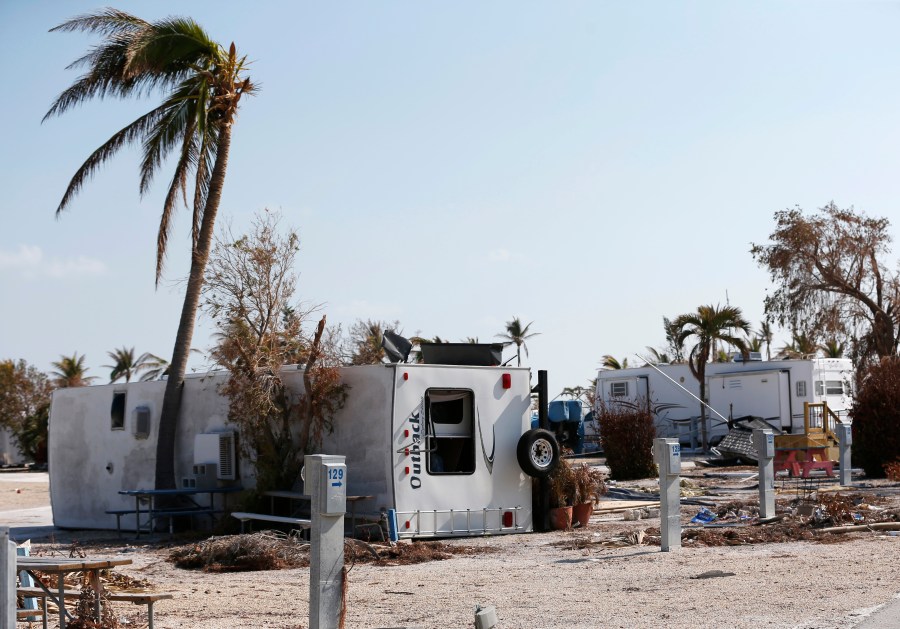
But, the potential for a catastrophic storm like Hurricane Irma in 2017 is always at the back of residents’ minds. The Category 4 storm made landfall in the Florida Keys with winds up to 132 mph (209.2 kph), destroying around 1,180 homes and seriously damaging another 3,000.
Weiner recently talked to the Associated Press about the upcoming hurricane season. This interview has been edited for length and clarity.
___
AP: Why is Monroe County perhaps the most vulnerable place in the 50 U.S. states for hurricanes?
Weiner: Our entire island chain is surrounded by water. We have more water than we do land mass. Being uniquely situated between the two large bodies of water makes us very vulnerable. We see storms early, sometimes in their formation — storms that come across the Atlantic and then storms that develop in the south, in the Caribbean Sea. We tend to be in their path, and so we get a lot of storm practice here in Monroe County.
AP: Given your dependence on the National Weather Service and NOAA for hurricane predictions, how concerned are you about recent job cuts and budget cuts to the federal government?
Weiner: The weather service is a good partner, and the field offices, from what they were telling us and what they’re hearing here, everyone is secure. They are not expecting or anticipating any cuts to the (Florida Keys) field offices. So, of course, going into hurricane season, we’re really happy to hear that.
AP: Can we talk about Hurricane Irma? The Keys have always been vulnerable, but Irma was a shock to the system, right?
Weiner: The Keys had not had a storm of that magnitude or size since the early 20th century. People tend to get complacent. It’s human nature, right? They’re not as worried. They’re not as prepared. We were very fortunate with Irma in that we had plenty of days’ notice to evacuate. But when we came home and saw the devastation, it was an eye-opener. Being an island chain, we had unique challenges bringing logistics in to help us recover.
AP: Do residents typically evacuate when they are asked to?
Weiner: Usually, they tend to heed that advice. We are constantly reminding people to be prepared and how important it is in our county to evacuate because the Florida Keys, the entirety of the island chain, is a storm surge zone. People here tend to be pretty savvy when it comes to storms, and throughout the entire Keys, the bigger concern is storm surge rather than wind. We say, “Hide from the wind and run from the water.”
AP: We are close to the start of the Atlantic hurricane season. What is keeping you up at night?
Weiner: The city of Key West is an incredibly resilient community. There’s a lot of history there. But there is also a lot of older architecture there. There’s a lot of wooden homes, and for them to receive a storm, a direct impact of a major magnitude, that would be devastating for them. That is what keeps me up at night – a Category 4 or 5 storm hitting Key West.
AP: Given the Keys’ vulnerability, why do you think people choose to stay and live there?
Weiner: Because it’s beautiful here. It really is an island paradise. Being surrounded by a national marine sanctuary is amazing. I think everyone that lives here, we all live here for that reason. Because we appreciate the environment and the marine life and love the water. And so it’s worth it. You make sure that you’re prepared, and you have a plan if you need to go. And you go somewhere safe, and you come back, and you just put it back together.
___
Follow Mike Schneider on the social platform Bluesky: @mikeysid.bsky.social.