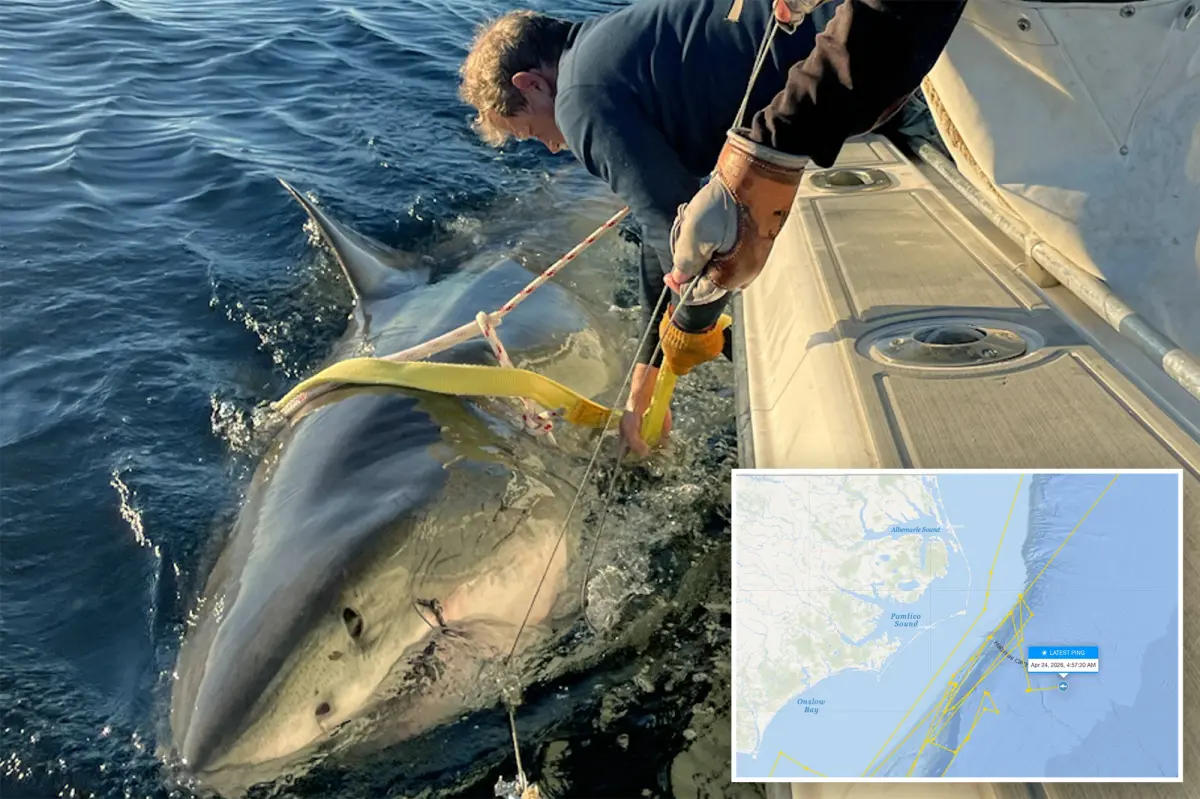

Contender, the biggest male great white shark ever documented in the Atlantic, is traveling once more after his most recent location signal placed him near the Outer Banks in April.
At nearly 14 feet long and weighing close to 1,700 pounds, the massive shark generated his latest Z-ping on Thursday, June 25, according to OCEARCH’s global shark tracker.
Since being tagged in January 2025 off the Florida-Georgia coastline, Contender has continued to send valuable real-time information that aids migration studies and supports broader ocean conservation work.
OCEARCH says its tracking process begins with attaching a SPOT satellite tag to a shark’s dorsal fin.
That tag works through two copper contacts, which create a closed electrical circuit while the device remains underwater.
MORE STORY: Unmasking the Church: Hugh Jackman's Faith and Emily Watson's Chilling Accusations
Once the shark surfaces, the circuit opens, activating the tag and allowing it to transmit a location signal.
“If the shark stays at the surface for 10, 20, 30 seconds, we’ll get a good fix on where the shark is,” OCEARCH Chief Scientist Dr. Robert Hueter said.
But when the signal is brief and fleeting, OCEARCH classifies that transmission as a Z-ping.
This tells researchers that the shark surfaced, but the signal was too brief to calculate its coordinates.
“It’s really a miracle of science,” Hueter said.
Contender and other sharks and sea animals like him can be tracked in real-time using the free OCEARCH Global Shark Tracker app.