
Downtown Los Angeles has been named one of the least vibrant urban centers in the world in a blunt new global survey, intensifying concerns about the city’s uneven recovery and the long-term outlook for its struggling core.
The assessment comes from Gensler’s 2026 City Pulse report, which examined how residents view the energy, activity and overall appeal of downtown districts. In the study, Los Angeles fell near the bottom of the list for vibrancy, underscoring how far it trails many of its global peers.
Among 75 major cities surveyed worldwide, only about 65 percent of Los Angeles residents described downtown as vibrant. That placed the city well behind places such as New York, Chicago, Sydney and Shanghai, where more than 80 percent of residents gave their downtowns high marks for vitality.
The results add to a growing sense of unease around downtown Los Angeles, which has spent years trying to regain momentum after the disruptions of the pandemic. City leaders and business interests have worked to draw back office workers, shoppers and visitors, but the latest findings suggest those efforts have yet to fully restore confidence in the area’s appeal.
Gensler’s report was based on responses from roughly 35,000 residents around the world, who were asked to rate different aspects of city life.
Gensler surveyed roughly 35,000 residents around the world, asking them to evaluate various aspects of city life.
Los Angeles ranked as the 20th-lowest city globally for vibrancy and the 11th-lowest among the 34 American cities included in the study.
Urban planners say the results reflect a downtown still struggling to recover from years of office departures, retail vacancies and lingering concerns about safety.
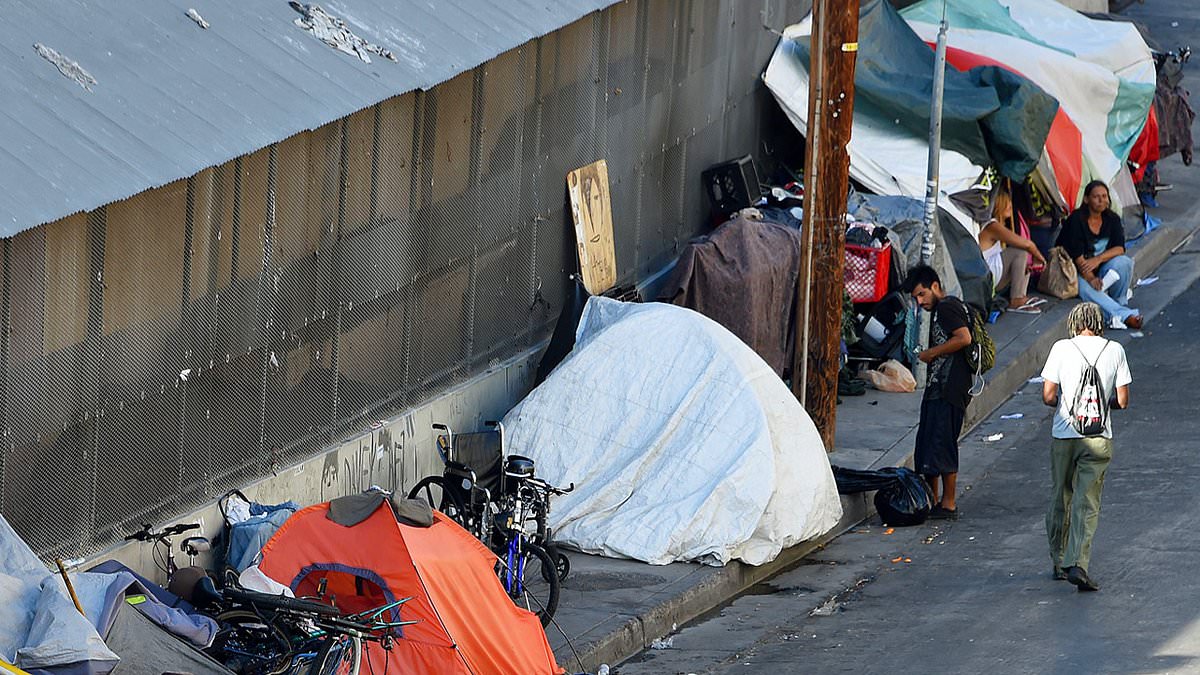
Downtown Los Angeles ranked among the least vibrant urban centers surveyed globally, with only 65 percent of residents describing the district as vibrant
A homeless man stands outside a tent in the Skid Row area of downtown Los Angeles earlier this week
A homeless man sits on a mattress in downtown Los Angeles
The report comes after years of high-profile corporate departures from California, with companies citing taxes, regulation, crime concerns, housing costs and remote-work trends as reasons for relocating operations elsewhere.
Major firms including Chevron, Oracle and Tesla have shifted headquarters or significant operations out of California in recent years.
Downtown LA has been particularly vulnerable to the post-pandemic office slump, with large employers reducing office footprints and leaving behind millions of square feet of vacant workspace.
City data shows the number of businesses reporting departures from downtown Los Angeles has risen sharply over the past two years, adding to concerns about the district’s long-term economic health.
Empty office towers and shuttered storefronts have become increasingly common sights across parts of downtown, fueling concerns that investment and foot traffic are flowing elsewhere.
Kelly Farrell, managing director of Gensler’s Los Angeles office, said the city’s biggest challenge is getting businesses and workers back into the downtown district.
‘LA’s kind of central problem is that businesses have left LA. We need them to bring the offices back in,’ Farrell said.
‘Bring the people back in so they’re staying after work and interacting with those businesses that are in the area.’
California Governor Gavin Newsom and Los Angeles Mayor Karen Bass are seen enjoying themselves at Friday’s World Cup game in at the Los Angeles Stadium
Images from the city center show tents lining sidewalks and public spaces as Los Angeles continues to grapple with a visible homelessness crisis
Several photographs depict makeshift encampments clustered along downtown streets despite ongoing efforts to address homelessness
Shopping carts filled with belongings stand near a homeless encampment in the Panorama City neighborhood of Los Angeles, California
Images of the drug crisis among the homeless population on the streets of Downtown Los Angeles where a group of men are seen using drugs right next to the ‘Skid Row’ LAPD
Drug use is rampant across the city and culminates in the bedlam that is downtown LA
While some neighborhoods within downtown continue to attract visitors and investment, the broader district faces a perception problem that experts say has become increasingly difficult to shake.
The report identified several ingredients that successful downtowns tend to share, including a mix of residential housing, office space, retail stores, walkability and strong cultural attractions.
Los Angeles possesses many of those assets on paper. Downtown remains home to government offices, financial institutions, sports venues, museums and entertainment destinations.
Yet many of those advantages have been overshadowed by a steady exodus of office tenants and businesses in recent years.
Data from the Los Angeles Office of Finance showed an increase in companies leaving the downtown area over the past two years after a temporary slowdown following the pandemic.
The vacancy problem has become particularly visible in the city’s Financial District.
Commercial real estate firm CBRE reported that nearly 40 percent of office space in the area is effectively empty, while roughly 30 percent of retail space sits vacant.
The report found that the key to a thriving downtown is not simply attracting visitors but encouraging them to remain there.
Scenes of open-air drug use in MacArthur Park, Westlake, Los Angeles. The park is a ten-minute drive from Downtown
Tents and belongings in homeless encampments block the sidewalk in Skid Row in LA
Graffiti-covered walls, discarded belongings and litter-strewn sidewalks have become common sights in parts of the downtown core
Graffiti lines the walls in many parts of downtown Los Angeles
Researchers concluded that the amount of time people spend downtown is a more meaningful measure of vitality than raw visitor numbers alone.
That remains a significant challenge for Los Angeles, which has struggled for years to convince residents to spend more time in the city center.
Concerns about crime and public safety continue to weigh heavily on public perception.
Business owners have frequently pointed to vandalism, robberies and assaults as reasons for relocating elsewhere, while some residents remain reluctant to visit due to fears about safety and a perceived lack of police visibility.
At the same time, law enforcement officials argue conditions are improving.
Los Angeles Police Department Captain Kelly Muniz said in April that crime in the area had fallen by 10 percent compared with the previous year.
Homelessness even started improving recently in LA County, with the number of unhoused people dropping in 2024 and 2025, according to the point-in-time count. As of last year, there were an estimated 72,000 unhoused people in the county.
Even so, the Trump administration has been attempting to overhaul the way LA and other places across California address homelessness.
The administration wants to move funds from permanent housing into temporary shelters and prioritize housing programs that require sobriety.
Roughly 30 percent of retail space in the Financial District sits empty, highlighting the scale of downtown’s economic challenges
Business owners have cited vandalism, robberies, open-air drug use and public safety concerns as factors contributing to downtown’s struggles
Photos show rows of tents and temporary shelters stretching along sidewalks in areas that were once busy commercial corridors
Concerns about drug use, homelessness and public safety have frequently been cited by residents and business owners as obstacles to downtown’s recovery

Los Angeles has struggled for years with overlapping issues including homelessness, mental illness and substance abuse, problems that have become increasingly visible on some streets
Farrell believes a stronger downtown population could further accelerate that trend.
‘One of the best things we can do for safety is have an abundance of population,’ she said.
‘You will see right now that we have a lot of great ground-floor retail that’s empty. As that gets fuller, we typically see that crime starts to go down with it.’
Despite the gloomy ranking, Farrell stressed that fortunes can change quickly.
She noted that perceptions of vibrancy often fluctuate significantly from one survey year to the next and expressed confidence that a return of offices and workers could dramatically improve downtown’s standing.
The Daily Mail has contacted Governor Gavin Newsom and Mayor Karen Bass for additional comment.