
Share this @internewscast.com

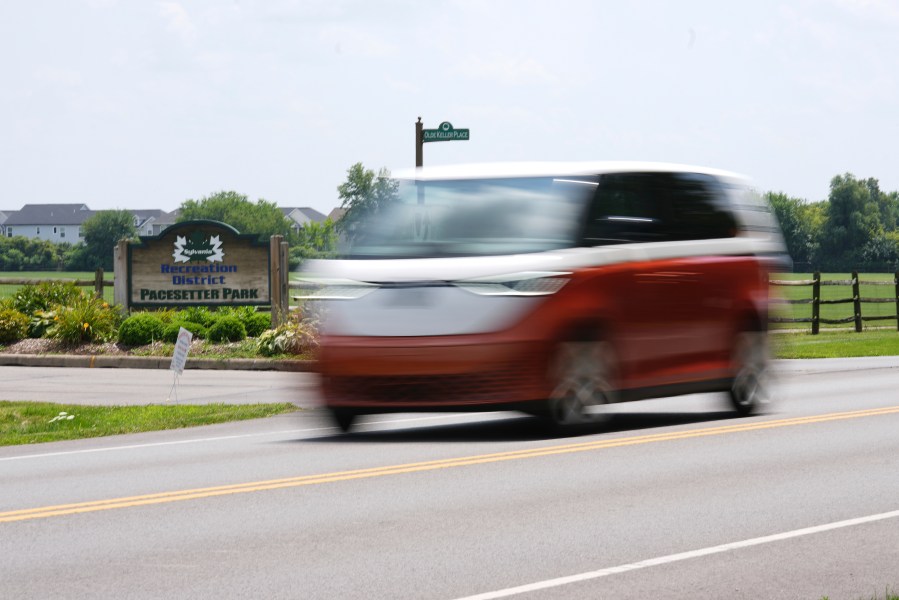
For years, Rose Hammond advocated for a reduced speed limit on the two-lane road near her assisted living facility. This road also passes a church, two schools, and a bustling park frequently visited by youth sports teams.
The 85-year-old resident pressed officials in northwest Ohio, questioning if they were waiting for a tragic accident to happen, as she expressed frustration over the motorcycles that sped by nearly every day.
Under increasing public pressure, Sylvania Township requested a speed analysis from county engineers in March to determine if Mitchaw Road’s speed limit was appropriate. Surprisingly, the findings suggested that the speed limit was actually 5 mph lower than it should be.
This calculation is rooted in decades-old studies from the 1930s and 1940s on rural roads, which continue to heavily influence speed limit settings throughout the United States, including urban areas.
The research introduced the widely recognized 85% rule. This principle proposes that a road’s speed limit should correspond to the speed of the 15th-fastest vehicle out of every 100 in free-flow traffic, rounded to the nearest 5 mph.
However, after years of adherence to this rule, some states, encouraged by the federal government, are considering adjusting or even replacing it with new guidelines to aid local engineers in determining appropriate speed limits.
Drivers set the speed
The concept assumes that a road’s safest speed is the one most vehicles travel — neither too high nor too low. If drivers think the speed limit should be raised, they can simply step on the gas and “vote with their feet,” as an old brochure from the Institute of Transportation Engineers once put it.
“The problem with this approach is it creates this feedback loop,” said Jenny O’Connell, director of member programs for the National Association of City Transportation Officials. “People speed, and then the speed limits will be ratcheted up to match that speed.”
The association developed an alternative to the 85% rule known as “City Limits,” which aims to minimize the risk of injuries for all road users by setting the speed limit based on a formula that factors in a street’s activity level and the likelihood of conflicts, such as collisions.
The report points out the 85% rule is based on dated research and that “these historic roads are a far cry from the vibrant streets and arterials that typify city streets today.”
Amid a recent spike in road deaths across the country, the Federal Highway Administration sent a subtle but important message to states that the 85% rule isn’t actually a rule at all and was carrying too much weight in determining local speed limits. In its first update since 2009 to a manual that establishes national guidelines for traffic signs, the agency clarified that communities should also consider such things as how the road is used, the risk to pedestrians, and the frequency of crashes.
Leah Shahum, who directs the Vision Zero Network, a nonprofit advocating for street safety, said she wishes the manual had gone further in downplaying the 85% rule but acknowledges the change has already impacted the way some states set speed limits. Others, however, are still clinging to the simplicity and familiarity of the longstanding approach, she said.
“The 85th percentile should not be the Holy Grail or the Bible, and yet over and over again it is accepted as that,” Shahum said.
Rethinking the need for speed
Under its “20 is Plenty” campaign, the Wisconsin capital of Madison has been changing signs across the city this summer, lowering the speed limit from 25 mph to 20 mph on local residential streets.
When Seattle took a similar step in a pilot program seven years ago, not only did it see a noticeable decline in serious injury crashes but also a 7% drop in the 85th percentile speed, according to the Vision Zero Network.
California embraces the 85% rule even more than most states as its basis for setting speed limits. But legislators have loosened the restrictions on local governments a bit in recent years, allowing them to depart from the guidelines if they can cite a proven safety need. Advocates for pedestrians and bicyclists say the change helps, but is not enough.
“We still have a long way to go in California in terms of putting value on all road users,” said Kendra Ramsey, executive director of the California Bicycle Coalition. “There’s still a very heavy mindset that automobiles are the primary method of travel and they should be given priority and reverence.”
But Jay Beeber, executive director for policy at the National Motorists Association, an advocacy organization for drivers, said following the 85% rule is usually the safest way to minimize the variation in speed between drivers who abide by the posted limit and those who far exceed it.
“It doesn’t really matter what number you put on a sign,” Beeber said. “The average driver drives the nature of the roadway. It would be patently unfair for a government to build a road to encourage people to drive 45 mph, put a 30 mph speed limit on it, and then ticket everyone for doing what they built the road to do.”
80 is the new 55
Fears about oil prices prompted Congress in the 1970s to set a 55 mph national maximum speed limit, which it later relaxed to 65 mph before repealing the law in 1995 and handing the authority to states. Since then, speed limits have kept climbing, with North Dakota this summer becoming the ninth state to allow drivers to go 80 mph on some stretches of highway. There’s even a 40-mile segment in Texas between Austin and San Antonio where 85 mph is allowed.
Although high-speed freeways outside major population centers aren’t the focus of most efforts to ease the 85% rule, a 2019 study from the Insurance Institute for Highway Safety — a research arm funded by auto insurers — illustrates the risks. Every 5 mph increase to a state’s maximum speed limit increases the chance of fatalities by 8.5% on interstate highways and 2.8% on other roads, the study found.
“Maybe back when you were driving a Model T you had a real feel for how fast you were going, but in modern vehicles you don’t have a sense of what 80 mph is. You’re in a cocoon,” said Chuck Farmer, the institute’s vice president for research, who conducted the study.
A town’s attempt at change
If elected officials in Sylvania Township, Ohio, got their way, Mitchaw Road’s posted speed limit would be cut dramatically — from 55 mph to 40 mph or lower. The county’s finding that the 85% rule actually calls for raising it to 60 mph surprised the town’s leaders, but not the engineers who ran the study.
“If we don’t make decisions based on data, it’s very difficult to make good decisions,” Lucas County Engineer Mike Pniewski said.
For now, the speed limit will remain as it is. That’s because Ohio law sets maximum speeds for 15 different types of roadways, regardless of what the 85% rule suggests.
And Ohio’s guidelines are evolving. The state now gives more consideration to roadway context and allows cities to reduce speed limits based on the lower standard of the 50th percentile speed when there’s a large presence of pedestrians and bicyclists. Authorities there recently hired a consultant to consider additional modifications based on what other states are doing.
“States have very slowly started to move away from the 85th percentile as being kind of the gold standard for decision-making,” said Michelle May, who manages Ohio’s highway safety program. “People are traveling and living differently than they did 40 years ago, and we want to put safety more at the focus.”
It’s unclear whether any of these changes will ultimately impact the posted speed on Mitchaw Road. After years of futile calls and emails to state, county and township officials, Hammond says she isn’t holding her breath.
“I just get so discouraged,” she said.