
Anyone can take a swing at a nail, misjudge the angle and thump a finger instead. These things happen.
Do it a second time and the warning signs are obvious. Keep doing it and, sooner or later, you have to accept that the tools should be handed to someone who understands the job.
When it comes to trying to nail down Champions League qualification, Celtic have battered every finger on one hand and are now working their way through the other. There is no evidence of lessons being learned, no sense that they are becoming any better equipped for these moments.
None of the teams who have derailed them were working with a bigger budget than the Parkhead club. For further perspective on the level of opposition, AEK failed to take a single point from the six group-stage matches that followed, while Ferencvaros managed only one.
Cluj and Midtjylland were both knocked out in the next qualifying round. Last year, Kairat finished bottom of the 36-team single group with one draw and seven defeats.

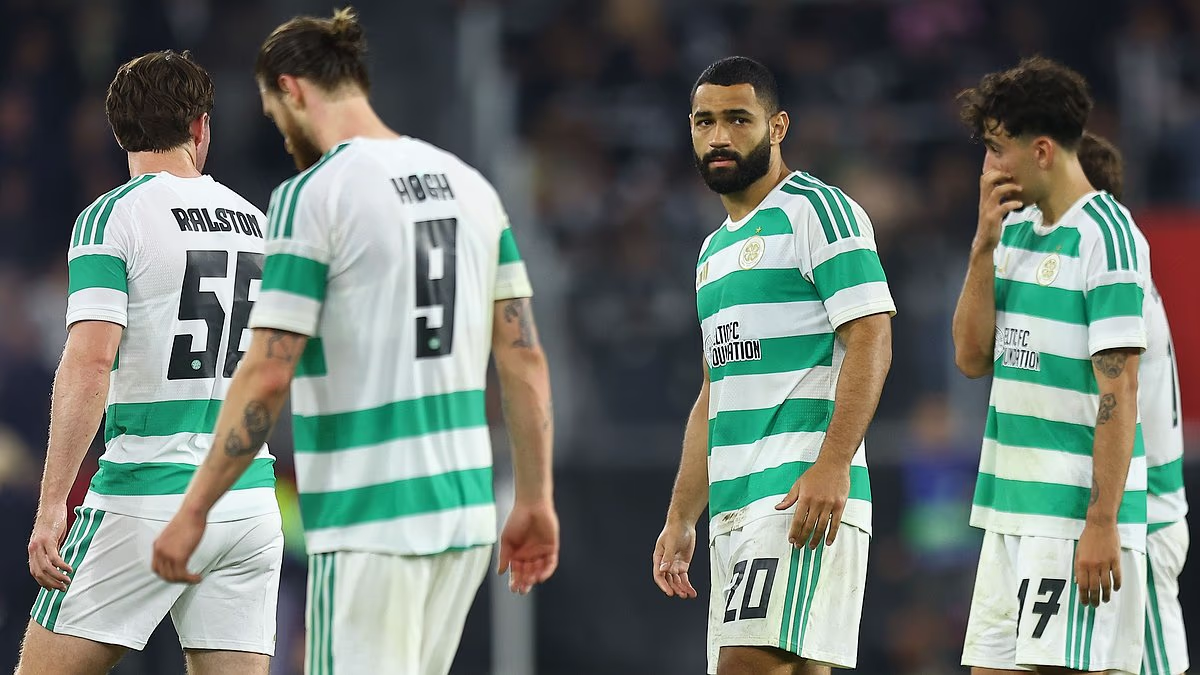
Celtic’s defeated players are left trying to process the scale of their collapse in Linz
On probability alone, even a well-prepared side might lose one of those ties. To lose them all points to something far more troubling than bad luck.
Whenever these defining fixtures arrive, Celtic’s hierarchy seem to be the last people to recognise what is required. The preparation falls short again and again. By now, the consequences are painfully familiar.
Back in the spring, following on from three diabolical transfer windows and eight league defeats which had seen the fanbase arrive at the point of insurrection, interim chairman Brian Wilson vowed that this time it would all be different.
‘It is going to be a big summer,’ he stated in an in-house TV interview. ‘Everyone, I hope and expect, has learned lessons from some things which influenced this season.’
Celtic have done more to this point than in previous windows, although it must be said that that was not exactly difficult.
Camilo Duran was signed on July 10 from Qarabag for £4.5million. Kasper Hogh arrived on July 28 from Bodo/Glimt for £11million.
Both players had scored five goals apiece for their previous clubs in last season’s Champions League and were in the door well in advance of the play-off with LASK. Taken in isolation, they felt like two steps in the right direction.
But the flow of players wasn’t one way. Daizen Maeda departed for Ipswich on July 25 for £10million. The loss of Maik Nawrocki to Lens and Luis Palma to Lech Poznan brought in more seven-figure fees.

Celtic manager Martin O’Neill saw his hopes of returning the big league after 22 years dashed
It took Celtic until August 12 to parade Haissem Hassan after paying Real Oviedo upwards of £6million and it was another day before Mika Baur’s £4.5million move from Paderborn was confirmed. The glacial pace at which the deals were done meant both players were undercooked when the Austrians came to town last week.
At least they were in the building. Celtic have spent the summer eyeing up Ermin Mahmic, Landon Emenalo, Niko Sigur and Gvidas Gineitis. In typical fashion, they’ve procrastinated.
Nothing, though, sums up the longstanding ineptitude of the club’s directors quite like Arne Engels’ situation.
The Belgian was the subject of some serious bids from Nottingham Forest in January. The dogs in the street knew that other offers were incoming.
When West Ham tabled £22million, Engels made it clear that he wanted to go in case his move was scuppered by injury, as had happened to Everton target Alistair Johnston.
You could hardly blame him. You can blame Celtic’s board for not having his replacement waiting in the wings. They banked another big cheque to take their spending into the black, crossed their fingers and hoped for the best. Again.
Ahead of last week’s first leg, O’Neill was asked if he could understand that many fans would be dismayed at a failure by the club to act before sanctioning the Engels sale.
‘Yeah, I will understand any arguments put forward about that,’ he said.
There’s clearly nothing to be gained now by the Celtic manager letting rip in public about how exposed Engels’ departure left him, but nor is there any mileage in him seeking to defend the indefensible.
He’s the fourth Celtic manager in seven years to fall short at this juncture in Europe and all have suffered through the failure of those above them to adequately support the football department.

The capitulation against LASK has widely been labelled Celtic’s worst ever result in Europe
A conservative estimate would put the cost of those repeated failures at north of £200million. No executives in any other line of work would survive that.
It’s hard to see how the reputations of Wilson, chief executive Michael Nicholson and finance director Chris McKay ever recover.
On the back of such a litany of failure, they’ll forever be associated by the worst result in Celtic’s European history. And, make no mistake, that’s precisely what Tuesday’s capitulation in Austria was.
Three goals up from the first leg and four ahead on aggregate after 21 minutes, O’Neill’s men melted before your eyes.
Physically and mentally weak, their embarrassment of a performance in the second half was a low point in 64 years of competing in Europe.
Quite why O’Neill, Shaun Maloney and Mark Fotheringham didn’t batten down the hatches at half-time with the side still 4-1 up on aggregate, only they could explain.
Rudderless, gutless and error-strewn, they were fortunate to get as far as extra-time. LASK managed 40 – yes 40 – shots on the night. They scored five times without reply and could have had double figures.
Without an imposing midfielder such as Engels to stop the flow and break the game up, the Austrians came in waves and ran Celtic ragged.
A combination of weariness and injuries forced off Kieran Tierney, Cameron Carter-Vickers, Colby Donovan, Baur, Hyun-jun Yang and Benjamin Nygren. The replacements – Liam Scales, Anthony Ralston, Dane Murray, Luke McCowan, Seb Tounekti and Reo Hatate – only added to the chaos.
Callum McGregor, who’d scored earlier, accused his team-mates of being ‘scared’ and it was impossible to argue with that withering assessment.
Towards the end of last season, in the midst of ongoing speculation linking him with a move to Saudi, the Celtic skipper stated that he required the club to match his level of ambition. A penny for his thoughts this morning.
No matter what Friday’s Europa League draw brings, Tuesday’s humiliation will hang over everyone connected with Celtic for a long time to come.
As well as the huge financial disparity in prize money, the club has now lost the carrot to dangle in front of prospective signings.
The atmosphere for the visit of Falkirk on Saturday will once again be hostile and divisive, the truce which came after a promising start to the season abruptly ended by one of the darkest nights in the club’s history.
The timing of it will be lost on no one. Come May, it will be 60 years since 11 men from the west of Scotland became sporting immortals when they lifted club football’s biggest prize.
The recent attempts to make inroads in the modern-day competition have become an insult to the legacy of the Lisbon Lions.


