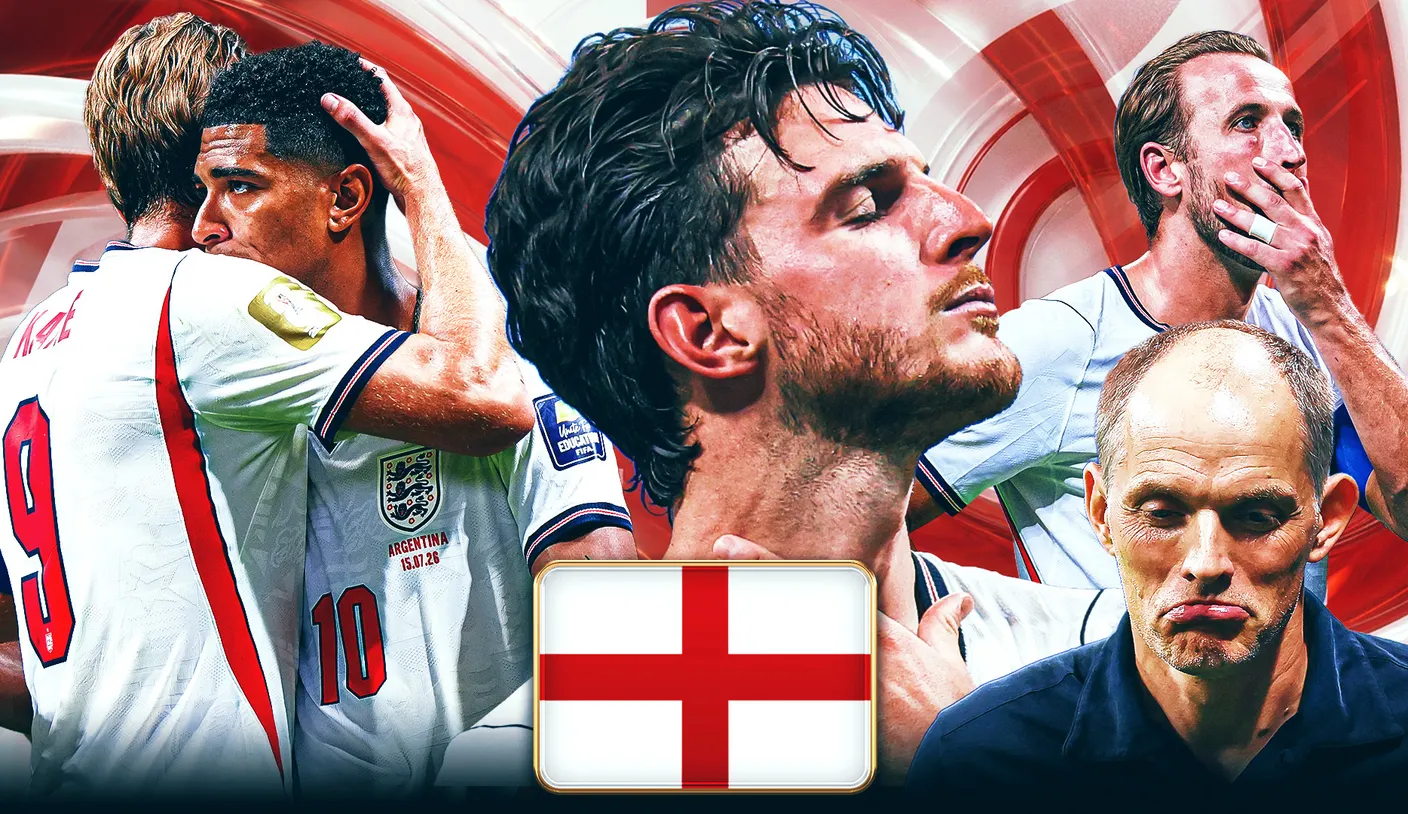

The postmortem began almost before the heartbreak had fully registered.
How did England let a World Cup semifinal slip away after taking the lead against Argentina with only minutes left to navigate? Why did Thomas Tuchel’s side seem to retreat once Anthony Gordon had put the Three Lions in front with 35 minutes of normal time still on the clock? And what is it about this team, this shirt and this stage that keeps England from ending a major-tournament drought now guaranteed to stretch to at least 62 years?
The blunt answer is also the hardest one for England to accept: this team still is not quite good enough.
England, the nation that gave soccer to the world, remains a serious footballing power. Jude Bellingham and Harry Kane are genuine global stars, the kind of players who would walk into almost any lineup. But measured against the very best international sides — France, Spain and, most immediately, Lionel Messi’s Argentina — the Three Lions continue to fall short. The reigning champions will meet Spain in Sunday’s World Cup final, a showdown between FIFA’s two highest-ranked men’s teams. England’s latest failure, painful as it is, fits a pattern that has endured for much of the past half-century rather than some cruel one-off twist of fate.

Ezri Konsa and Thomas Tuchel look dejected during the 2026 World Cup semifinal loss to Argentina. (Photo by Harry Langer/DeFodi Images/DeFodi via Getty Images)
Tuchel will absorb plenty of the blame for this particular collapse, and the backlash has already been fierce. In England, calls for the German manager’s dismissal began almost as soon as the final whistle confirmed another crushing World Cup exit, with critics focusing heavily on what they saw as an excessively cautious approach after halftime.
Yet that criticism can overlook an inconvenient truth: England was not protecting a lead against an ordinary opponent. It was facing the defending world champion, led by the greatest player the sport has ever seen. Argentina has collected more meaningful silverware in the last four years than England has managed across its entire modern history. For two decades, even stronger teams than this England side have failed to prevent Messi from bending matches to his will.
It was not that England lacked the desire to find a second goal.
“When we went ahead, the messaging was to go again and get another goal,” a devastated Kane said before leaving the field on Wednesday. For the life of them, they just couldn’t do it. Because it’s impossible to score when you can’t keep possession of the ball.
And that’s what still separates England from the game’s true elites.
For all of England’s fight and physicality and pedigree, the three other semifinalists at this World Cup are all just far superior technically with the ball at their feet. Say what you want about Tuchel’s choice of substitutions, but it’s not like he had someone on his bench with the Velcro touch of someone like La Roja’s Rodri, who is damn near impossible to dispossess without fouling.
Tiny margins determine winners and losers at this stage of any major competition.
When Spain took the lead over France in Tuesday’s other semifinal, that match was effectively over. Including stoppage time, Les Bleus were behind on the scoreboard for more than 70 minutes of that contest, and yet, Spain still had the ball for the majority of the time.
England, in contrast, had just 36 percent of possession against Argentina in a game that was deadlocked for more than an hour. Meantime, La Albiceleste passed the ball around with ease even inside their own box, using keeper Emiliano Martínez as an outlet even when the English were pressing with abandon.
Lionel Messi and Harry Kane duel during the 2026 World Cup semifinal match between England and Argentina. (Photo by Rico Brouwer/Soccrates/Getty Images)
“In the culture, basically, of the Argentinian team — of South American teams — ball possession plays a crucial role,” Tuchel said during Wednesday’s post-game press conference. “Ball possession, taught from a young age. It’s in their DNA, and it demands a lot of natural self-confidence to always want the ball, to always be in the gaps, to always define yourself through the ball possession.”
“That’s then a crucial thing,” he continued, “to show the courage to take the ball away from these teams in the crucial moments when you’re under pressure. You need to get every little decision right. You need to get the angle, the body positions right. You need to get your decision-making right in little two-against-ones, three-against-twos, to really overcome the first line of pressure, to not be intimidated, to not be physically bullied. Because Argentina has in their culture this mix between being very physical and also strong on the ball.”
England only has the first part of that formula. Unless or until its culture catches up, the World Cup or European Championship trophy is never, ever “coming home.”
Soccer, at its core, rewards the team that takes better care of the rock. That’s how a tiny country like Croatia, with a population of fewer than four million people — about the size of greater Minneapolis — has reached as many World Cup semifinals since gaining its independence in 1991 as England, with almost 60 million inhabitants, has over the same period.
It’s why England was unable to beat Belgium, a nation four times smaller, in the third-place game in 2018. It’s why the Three Lions will be the clear underdog against France on Saturday in Miami in this World Cup’s bronze-medal match.
Player for player, man for man, England still lags behind the very best when it comes to the most basic skill there is. And until it admits that, things will never change.
Harry Kane and his England teammates after losing the 2026 World Cup semifinal match to Argentina. (Photo by Michael Regan – FIFA/FIFA via Getty Images)
In the lead up to the 2022 World Cup, I nearly fell out of my chair when an English journalist I won’t name wrote that “England’s young players are the envy of the world,” as if France and Spain aren’t producing higher-quality talent on an industrial scale every year.
Maybe the whole country needs to get out more.
Because while the import-dominated Premier League is the best domestic circuit by a landslide, while the place the sport occupies in mainstream culture in Britain is second to none, while the Three Lions are good — maybe even very good — they’ve consistently proven an inability to hold a candle to any of the perennial title contenders.
And that’s why England is going home without the trophy once again.
England vs Argentina Extended Highlights 🌎🏆 2026 FIFA World Cup™ | Semifinals
]


