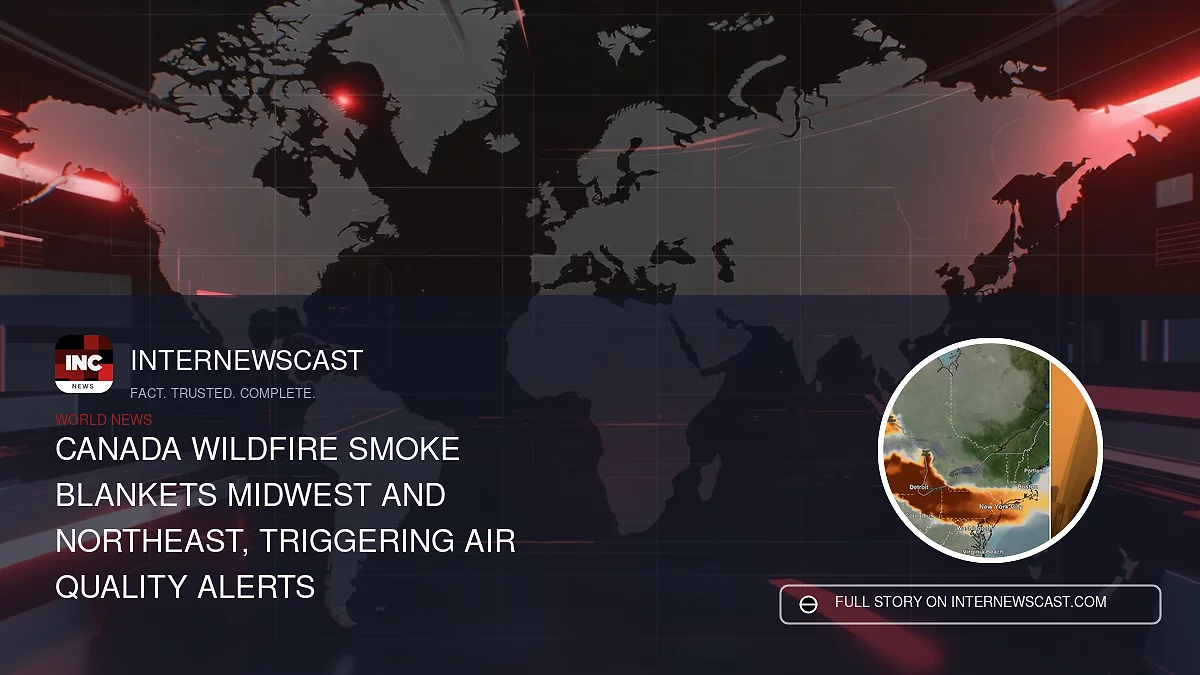


A sprawling plume of wildfire smoke loaded with fine, lung-irritating particles is drifting south from Canada into the United States, threatening to degrade air quality across a wide stretch of the northern tier this week. The smoke, produced by large fires burning in northern Ontario, is being steered by fast-moving upper-level winds across the Upper Midwest and toward the Northeast. Forecasters say Minnesota, Wisconsin and Michigan are likely to experience the thickest smoke on Wednesday before the plume advances into Pennsylvania, New York and New England by Thursday. Dan DePodwin, AccuWeather’s vice president of forecasting, told the Daily Mail that major cities including New York City and Philadelphia could begin noticing air quality impacts Wednesday into Thursday. “Northern Michigan, maybe Western New York, those types of spots at this point seem most favorable to experience at least a time of poor air quality. And then places farther east, like Boston, some of the major cities in the northeast,” DePodwin said. Health officials are warning that wildfire smoke carries fine particulate matter known as PM2.5, a mix of microscopic pollutants small enough to move deep into the lungs and potentially enter human tissue, raising the risk of breathing problems.
Smoke exposure increases health risks

The US Environmental Protection Agency has linked exposure to PM2.5 with a range of serious health effects, including worsening asthma, reduced lung function, irregular heartbeat, heart attacks and premature death among people with heart or lung disease. DePodwin urged residents to pay close attention to visibility and the smell of smoke. “If the visibility starts to really be reduced and you can really smell the smoke, that’s a situation that becomes unhealthy,” he said. “You want to be spending indoor time, especially if you’re a sensitive group, or even wearing a mask outside is something that can be done in those situations if you have to be outside and avoiding strenuous activity.”
Wildfire smoke spreads across the Midwest

Beyond the Great Lakes and Northeast, smoke impacts are also expected in parts of New Jersey, Maine, Vermont, New Hampshire, Rhode Island, Maryland, Delaware, Ohio, Indiana and Illinois, with the Chicago area among the locations that could see hazy skies or reduced air quality. Traces of smoke had already started crossing the border earlier in the week, but forecasters expect conditions to intensify quickly. The National Weather Service office in New York wrote Tuesday: “Smell smoke this morning? It’s coming from a wildfire outbreak in Ontario.
Wildfire smoke may worsen air quality

“While it should not impact air quality much today, smoke at the surface could increase Wednesday into Thursday, potentially reducing visibilities and air quality.” Canada is currently battling more than 800 active wildfires, with major activity reported in the Northwest Territories, Saskatchewan, Manitoba, Ontario and Quebec. DePodwin said roughly two million acres have burned in Canada so far this year, a figure that already exceeds the total acreage consumed in some full wildfire seasons. While climate change may be contributing to the broader rise in Canadian wildfire activity in recent years, he said the country’s approach to fire and land management is also a factor in why smoke is able to spread so widely into the US.
Minimal fire suppression in rural Canada

“Because a lot of Canada is very rural, in many parts of the country, they don’t actively fight fires, because there is very little to no population nearby,” DePodwin explained. “So, the fires burn until they go out themselves, or they do minimal fire suppression. So that is part of it, that is occurring here.” Although air quality in the US is expected to worsen this week, he said the episode is unlikely to match the dramatic conditions seen in 2023, when smoke turned skies across several states an eerie orange.
Air quality worsens near Canadian wildfires

During that historic Canadian wildfire season, about 40 million acres of forest burned. “It would be difficult to repeat 2023 again. However, that same poor air quality, where it becomes unhealthy or very unhealthy, that type of air quality, we’re seeing that in Canada near the fires where they’re burning now,” DePodwin said. “You could have that type of poor air quality in at least parts of the northeastern Great Lakes here through the middle of the week, probably through about Thursday, we could see pockets of that,” he added. Wildfires often release smoke in bursts, with output rising and falling over time, which makes local air quality difficult to predict hour by hour. “Some of the tools we use suggest that there could be poor air quality in a lot of places like Buffalo, maybe New York City, Albany, maybe even down to Philadelphia on Wednesday and Thursday,” DePodwin said.
Unpredictable smoke clouds threaten cities

“I think a safe bet at this point would be to say that it’s probably prudent to plan for a day or two of at least some reduction of air quality, and it’s not out of the question that it becomes unhealthy.” The severity, he said, will depend largely on how close the smoke gets to the ground. As of Wednesday, much of it remained elevated in the atmosphere, producing hazy or milky sunshine and enhancing the colors of sunrises and sunsets without greatly affecting ground-level air quality. Conditions become more concerning when smoke mixes downward toward the surface. The incoming plume is arriving as the Northeast is already coping with extreme heat and humidity tied to a large heat dome affecting 25 states. While hot, muggy weather does not necessarily make smoke more toxic, DePodwin said any location where smoke reaches the surface will feel even more uncomfortable. “A very hot day and a very humid day are already not very comfortable. If you then add near-surface smoke that reduces air quality and reduces visibility and smells not great, that’s going to even feel grittier and just not pleasant. It’s going to make you feel even more unpleasant, obviously.”


