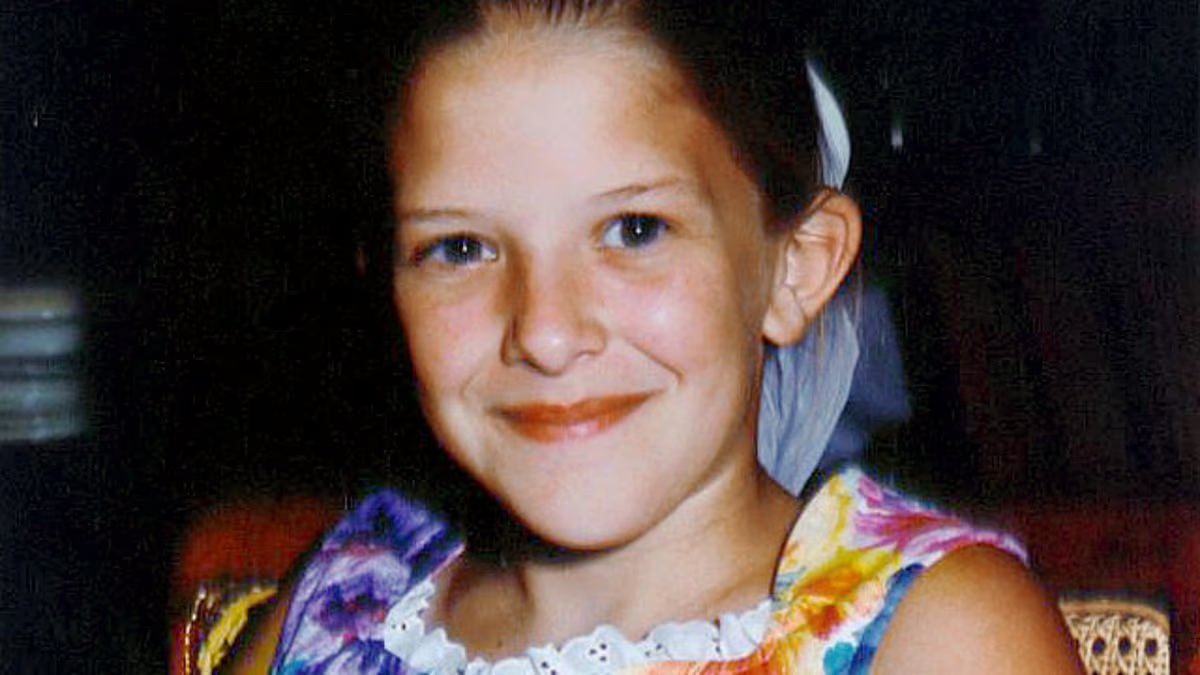

As a powerful hurricane churned across Mississippi in the summer of 1992, 13-year-old Leigh Occhi was allowed to stay home by herself for the first time.
Within an hour, the teenager had vanished.
When her mother came back, she walked into a terrifying scene: fresh blood, still wet, streaked across the walls and carpet, with more pooled outside Leigh’s bedroom.
The house was silent, with no sign of the daughter who should have been there.
Investigators later found Leigh’s nightgown in a laundry basket, marked with blood. A bloodstained bra was discovered with it.
In the bathroom, evidence suggested someone had attempted to clean up after whatever had happened inside the home.
The missing girl case soon produced a strange and unsettling series of clues: Leigh’s glasses appeared inside an envelope, a skull was mistakenly believed to be hers, and a church leader was convicted of [sexual assault] just months after her disappearance.
Leigh’s mother, Vickie Felton, also faced intense scrutiny, failing three polygraph tests as police investigated the disappearance of the blonde-haired teen. Felton has never been charged and has never been named a suspect.
It marked the beginning of a mystery that would haunt Tupelo for decades – one that came to a legal end in 2024 when her mother filed an amended petition seeking to have Leigh declared dead.
‘I just decided that I wanted to do it,’ Felton told the Northeast Mississippi Daily Journal at the time. ‘I felt it was time to do it.’
The case was jolted back to life last year when FBI agents descended on the area around the former Occhi family home, appearing to search near a drainage ditch with shovels and K-9 units.
But the reason for the dramatic return quickly became a mystery of its own. Authorities have refused to say what investigators were looking for – or whether they found anything.
Now, 34 years after Leigh vanished, the questions that began on that stormy morning remain as unsettling as ever.
Is Leigh alive? Is she dead? Will anyone ever be charged? And will her remains ever be found?
The blood has long since dried. The clues have gone cold. But one question remains:


Pictured: Leigh Occhi

What happened to the young girl who disappeared in the middle of a hurricane?
Torrential rain hammered Mississippi on the morning of August 27, 1992, as Hurricane Andrew tore through the Southeast, leaving 23 people dead in its wake.
Inside the Occhi home, however, life carried on as usual.
Leigh and her mother ate breakfast together. They talked about their plans to attend an open night at her school before grabbing dinner at Taco Bell that evening.
The school year had not yet begun when Felton left for work just before 8am that Thursday, leaving her daughter home alone for what would be the first – and last – time.
As the Category 5 storm closed in on Tupelo – the town where Elvis Presley was born – and the Gulf Coast remained under a hurricane alert, Felton grew concerned and called home less than an hour later.
She used a code the two shared – two rings followed by a hang-up, a signal that Leigh would know it was safe to answer. But this time, there was no response.
Felton had spent only minutes at the office before turning around and making the short, 1.5-mile drive back to 105 Honey Locust Drive.
When she pulled into the driveway, she noticed the garage door was open and its automatic light was still on, despite being wired to shut off after just five minutes.
‘That was very strange because the light doesn’t turn on unless someone triggers the door,’ Felton told CNN at the time.
Whatever unfolded inside the house appeared to have taken place only minutes before she arrived.
‘I came in the house and there was blood on the side of the wall,’ Felton told the outlet.
‘I started calling for Leigh and going through all the rooms. Then I went into her bedroom,’ she added. ‘Her favorite blanket was crumpled up on the floor and I was very scared.’
In the hallway, a small pool of blood lay on the floor just outside Leigh’s bedroom, with blood spattered across the wall beside it. After searching the bedrooms, backyard, pool and shed and finding no sign of her daughter, Felton called 911.
Tupelo police responded immediately, with Captain Bart Aguirre, one of the original investigators assigned to the case, heading straight to Leigh’s bedroom.
Inside, they found a laundry basket containing the nightgown Leigh had been wearing when her mother left for work. It was covered in blood.
‘There was some indication Leigh had sustained some kind of injury,’ Aguirre said at the time, according to The Associated Press. ‘You couldn’t tell how bad the injury was. You couldn’t tell where the injury was.’
Blood and hair clung to a door frame, suggesting Leigh had struck her head against it – possibly more than once. The blood was still wet, and investigators said the splatter pattern was consistent with head trauma to someone of Leigh’s height.
‘It looked like the blood had dripped down onto her nightgown, you would think the injury had to be above the neck possibly,’ Aguirre said.
A trail of blood stretched from the hallway through the living room and toward the back door. In the bathroom, fresh blood was still wet on the walls, carpet and countertop.
‘It’s pretty obvious to us that someone tried to clean up the scene or the countertop,’ Aguirre said, pointing to a ‘light pink haze’ left behind on the surface. The problem was, investigators could not find whatever had been used to scrub it away.
‘We couldn’t find the rag or towel that had been used. We couldn’t find it anywhere,’ Aguirre said.
The countertop later tested positive for blood, authorities said, suggesting whoever cleaned the surface had taken the rag or towel – and potentially a crucial piece of evidence – with them.
A brand-new outfit – including a bra and underwear Leigh had received for her birthday just a week earlier – was nowhere to be found.
Her glasses and the sleeping bag she always kept in her room were also missing.
The missing clothing raised another disturbing possibility: she may have changed clothes, or someone may have undressed and redressed her.
Investigators also found no signs of forced entry. Her parents were adamant their daughter would never have opened the door to a stranger.
A team of bloodhounds and searchers canvassed the neighborhood, starting in the yard before expanding into nearby ditches and fields. But the remnants of the hurricane made tracking any scent nearly impossible.
‘We covered a half-mile radius from the house that morning with the dogs and could not come up with anything,’ Aguirre said, according to CNN.
‘It was raining and it was storming and blowing pretty good. Had our dogs not had that bad weather to work in, they probably could have gotten on good scent.’
Jordan Morse, Leigh’s middle school boyfriend, attended a nearby school that was already in session and called her as soon as his day ended, as he did every afternoon, according to the AP.
‘I rushed off the bus to call her like I always did to call her soon as I got home from school and her mom picked up the phone,’ Morse told the outlet.
‘I asked where Leigh was and Vickie said she was missing. I don’t know what missing is. I’m 12 years old. What do you mean missing?’ he added. ‘She said, “We don’t know where she is. We can’t find her.”‘

The investigation
Police began their investigation close to home, turning first to the people who knew Leigh best: her mother, father and stepfather.
At the time, her father, Donald Occhi, was serving in the military and stationed in Virginia. Her stepfather, Barney Yarborough, was separated from Felton and had recently moved out of the family’s ranch-style home.
There had been rumors that Yarborough abused Leigh, including reports that she came to school with bruises and a black eye. The allegations, however, were never substantiated.
Police quickly ruled Yarborough out as a suspect after he ‘passed’ a polygraph test and had a confirmed alibi. He died in 1996. Leigh’s father, Occhi, who died in his sleep in 2024, was also ruled out early in the investigation.
Occhi said he did not learn Leigh was missing until the following day, when Felton told him their daughter had run away – without mentioning the blood or gruesome scene inside the house.
He said he returned to Tupelo in mid-September and spent about a month searching for Leigh before his leave ended, according to AP.
‘People called me and contacted me all the time. It was mostly stuff about like she was a great little girl. Or look at her mother, look at her mother,’ Occhi told the outlet. ‘I already was doing that. I don’t know if her mother was involved.’
Investigators repeatedly questioned Felton after Leigh vanished and asked her to take a lie detector test within hours. She failed the first, then took two more in the weeks that followed.
Retired detective Ronny Thomas said she showed signs of deception in all three polygraphs – two of which were administered by the FBI.
Felton later addressed the failed tests in a statement to CNN. ‘I couldn’t tell you why,’ she said. ‘They measure changes in your body and when your daughter has gone missing and they strap you up to things, I can’t imagine anyone’s body not reacting.’
She acknowledged detectives would not be doing their job if they didn’t press her for answers.
‘But, unfortunately, they wasted a lot of time with it,’ she said.
Meanwhile, searches of the surrounding woods turned up nothing. DNA testing was still in its infancy in 1992, leaving detectives with blood typing as their main forensic tool – and every sample recovered from the scene matched Leigh’s blood type.
Teams scoured Tupelo in the weeks that followed, including an open pasture, looking for any sign she might still be alive.
They searched places where an injured, frightened or disoriented girl could have hidden or become lost.
‘Over the course of the first few weeks, that started to change into a concern they were looking for a body, not a live girl anymore,’ Rick Hammond, the Daily Journal crime reporter in 1992, told the AP.


Chilling clues
Eight days after she vanished, a college student thought she spotted Leigh in a truck at a McDonald’s drive-thru in Booneville. But investigators soon determined the sighting was another dead end – the girl was someone else.
Five days later, 13 days after Leigh went missing, an envelope addressed to her stepfather arrived at the family home. Both his name and the street name were misspelled.
It carried six stamps – twice the postage needed – and had been mailed from Booneville, roughly 30 miles north of Tupelo.
When he opened it, he found Leigh’s glasses inside.
Police hoped the delivery would provide a breakthrough and lead them to Leigh or her abductor. But the stamps had been moistened with water, not saliva, and forensic testing turned up nothing from the envelope.
Aguirre said he came to believe the glasses may have been planted as a distraction to send investigators down the wrong path.
There was no ransom demand, note or other message with them.
‘It was just those glasses,’ he said, according to the AP. ‘You would think if it was an actual kidnapping, you would have expected a little more to come along with that.’
He later told CNN that the envelope was the last real lead the case would ever produce.
Just over a year later, a farmer discovered a human skull in a ditch near a soybean field in Monroe County. Two days later, dental records led the coroner to positively identify the remains as Leigh.
The identification was almost immediately retracted: the skull actually belonged to 27-year-old Pollyanna Sue Keith, who had disappeared from Shannon in March 1993.


Pictured: Oscar McKinley “Mike” Kearns
Theories
As other clues went cold, the failed polygraph tests and Felton’s reportedly aloof demeanor fueled speculation that she may have played a role in her daughter’s disappearance.
In a 2017 interview with true crime blogger Anthony Wayne, Occhi revealed that he met Felton while she was studying Korean and interrogation techniques in California. He said she had been trained as an interrogator.
‘I had my concerns,’ he said over the handling of Leigh’s case. ‘I don’t think they had dealt with someone with Vickie’s intelligence before.’
‘She was a trained interrogator. She knew how to act regarding questioning. She had interrogated Koreans while in the army. She failed three polygraphs. I mean, how many did she have to fail?’
Occhi described Leigh’s relationship with her mother as ‘strained at best.’ And when asked whether Felton had a temper, his answer was blunt: ‘Yes, a very bad temper.’
He also found it strange that the abductor would take the time to put Leigh’s bloodied clothes in the hamper, describing it as the behavior of a ‘neat freak.’
‘I told them Vickie was a neat freak,’ he said during the interview.
His theory never changed: he believed someone attacked his daughter inside the house in the early hours of the morning and that she never left Tupelo.
‘There wouldn’t be enough time for someone to come to the house when Vickie left, kill Leigh and attempt a clean up and leave before Vickie came back home at 845,’ Occhi said, explaining his reasoning.
‘This is all while a hurricane is going on,’ he added. ‘Who comes into a house, kills someone, then attempts to clean up the scene? Why clean it up?’
Meanwhile, Felton has steadfastly denied any involvement in her daughter’s disappearance. That same year, on the 25th anniversary, she told the Daily Journal: ‘That has been discussed over and over before, and I won’t go through it again.’
Instead, she has spent decades pointing the finger at someone else entirely: a man named Oscar ‘Mike’ McKinley Kearns.
Kearns taught Sunday school and Vacation Bible School at Holy Trinity Lutheran Church in Tupelo, where Leigh and Vickie attended. He and Leigh shared a love of horses, although accounts differ over how close they actually were.
Less than nine months after Leigh disappeared, Kearns drove to Memphis and kidnapped a 15-year-old girl he had met through his church, luring her under the pretense of giving her a ride to school.
He drove her into the woods, held her at knifepoint and [sexually assaulted] her. The girl later told police she had known Kearns her entire life and had never noticed a single warning sign.
The victim told police he grabbed her by the neck and threatened her with a knife – similar to how investigators believe Leigh’s attacker may have controlled her. His blood type also matched the blood recovered from Leigh’s home.
Kearns pleaded guilty to [sexual assault] and was sentenced to 24 years, with 16 suspended. He was released in October 1997 after serving less than half of his eight-year sentence.
Just 18 months later, he was back in trouble. In 1999, he pleaded guilty to kidnapping a Union County couple and raping the wife, a crime that would keep him behind bars until 2019.
Investigators repeatedly tried to question Kearns about Leigh, but he refused every time. He once agreed to a polygraph, only to back out on his attorney’s advice.
He never answered questions about Leigh’s disappearance, and ultimately died in 2021 – two years after his final release.
The Daily Mail has reached out the Tulepo Police Department and the FBI for comment.


