

CHAPEL HILL, N.C. (AP) — A contrast:
At the National Speech and Debate Tournament, two high school students step onto the stage. The first student articulates the viewpoints he has been tasked to defend — the notion that people should possess the right to secede from their government — and justifies why this stance is valid. Following him, another student, who has been assigned the counterargument, proceeds to systematically dismantle her rival’s perspective.
A year later and 800 miles away, two teams of high school students gather at the University of North Carolina for the National High School Ethics Bowl finals. A moderator poses a thought-provoking question regarding the boundaries of discourse — when a public figure passes away, how should we balance the value and potential harm of critical commentary about their life?
No positions have been pre-assigned to the teams. One team presents their ideas, and the opposing team poses inquiries that encourage everyone to delve deeper into the issue. No one engages in attacks.
Many a young debater may learn the rhetorical skills to become a successful lawyer or politician, subduing an opponent through wit and wordplay. But are they learning skills that will make them better citizens of an increasingly complex and contentious republic?
In an age when many Americans are wondering whether it is still possible to have a principled, respectful disagreement over important issues, proponents of Ethics Bowl say it points the way.
Discussion replaces contentiousness
Ethics Bowl may resemble debate. After all, it’s two teams discussing a controversial or difficult topic. But they are very different.
In Ethics Bowl, teams aren’t assigned a specific position on an issue that they have to defend regardless of their beliefs. Instead, members are given cases to discuss and make their own decisions about what they consider the best position. Teams can, and often do, come to similar conclusions. It is — and this is important — OK for them to agree. Scoring is based on how deeply they explore the issues, including other viewpoints.
Robert Ladenson, who developed the Ethics Bowl as a college philosophy classroom exercise back in 1993 and went on to lead the Intercollegiate Ethics Bowl for decades, explains what he considers an ethical understanding of an issue in an oral history for the University of Illinois in 2023.
It means “having some capacity to view, from the inside, the ethical outlooks of people who disagree with you. That means not simply being aware of what they’ve said or what they’ve written, or being able to develop a nifty debaters’ responses to the viewpoints they hold — but really looking inside the other view and trying to understand it from the other person’s way of looking at the world.”
It’s a reach for understanding and common ground
That plays out at Ethics Bowl. Take the case “See Spot Clone,” about whether it is ever ethical to clone a beloved pet.
Harpeth Hall from Nashville starts the discussion with six minutes to present their thoughts. There are millions of homeless pets, so the ethical choice is to adopt, they believe. Cloning is self-serving for the human. The pet cannot consent to being cloned. Also, cloning may involve unknown health issues for the cloned pet, as in the renowned case of Dolly the sheep. The team also believes that death is a part of life, and it is important for people to confront death.
Now it is the turn of team B, Miami’s Archimedean Upper Conservatory — not to attack and refute, but to ask questions that expand the discussion. What about pet breeders? Where do they fit on the ethical continuum? Also, what’s so wrong with cloning a pet for your own happiness? Are all selfish pursuits bad?
Team A responds that breeding is better than cloning but worse than adopting a stray. They point out that a cloned pet will not have the same personality, and that could bring the owner pain instead of comfort.
Next the judges ask questions. What if there were no possible health problems for the cloned animal? What if the animal is not cloned to comfort an owner but for a more noble purpose? Would it be ethical to clone a skilled search-and-rescue dog?
Cloning is still a threat to the “natural cycle of life,” Team A contends. And there is no guarantee that the temperament and personality that make an excellent service animal would be retained in a clone.
Once the round is complete, the moderator introduces a new case.
Easy answers are avoided
In a society awash in shortcuts and simple solutions, simply setting the ground rules for contentious conversations can be a high hill to climb. At the Ethics Bowl, though, it’s part of the point: The process of conversation is as important as the outcome. And subtlety matters.
A good Ethics Bowl case is one where “two well-meaning individuals can take in all of the same facts and information and come to diametrically opposite, value-driven answers,” says Alex Richardson, who directed the National Bowl for five years.
The cases students grapple with include real-life scenarios pulled from the headlines, like the less-than-respectful response to the murder of United Healthcare CEO Brian Thompson. There are also more philosophical issues, like whether humans should pursue immortality. And there are dilemmas that teenagers deal with every day, like whether not posting on Instagram about a hate crime in your community makes you complicit.
That last case was a difficult one for the team from Harpeth Hall, they say, but it helped them clarify some of their thoughts around social media.
“We came to the conclusion that no one is obligated to share information,” says Katherine Thomas. “But then there was a difference like when you’re talking about Taylor Swift, when she actually could register 500,000 people to vote but she decides not to. Is she actually complicit in that? She has the actual power to make change, where I don’t, really, with my 200 followers.”
Another case considered whether to confront an uncle who makes sexist remarks at the dinner table. Discussing the issue with her Harpeth Hall teammates helped Thalia Vidalakis think through when it might be good to speak up and when “it’s good to just be there for your family and recognize that there’s going to be differences.”
It unfolds in a low-key way
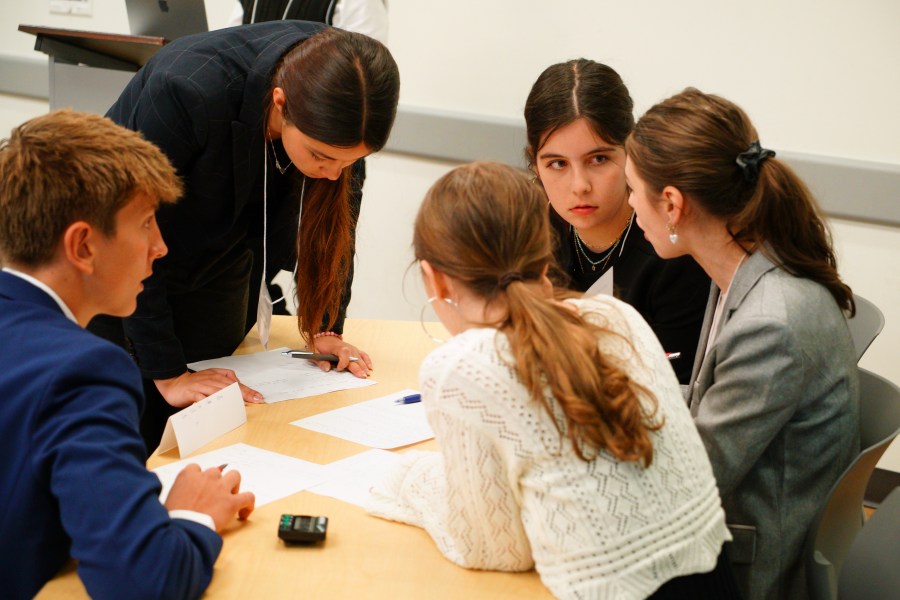
A group of teenagers sits at a table with sticker-covered water bottles and the occasional Red Bull. They are allowed only pens and blank paper, no previous notes, but their backpacks litter the room. Their opponents sit at a neighboring table. In between is a moderator. Facing them are three judges pulled from the UNC philosophy department, Ethics Bowl leaders from other states, even the community at large. There is no dress code, so the teens come in whatever they consider nice clothes.
The teams have been discussing a group of cases for weeks, but they don’t know which they’ll be asked about. Once the question is read, they are given a few minutes to discuss. That’s when one or two of the teammates generally scurry around the table to huddle. Intense whispering and furious scribbling ensue.
It’s clearly a contest. There is a winning team and a trophy. But students say it is not competitive in a traditional sense.
“We’re all sad that it has to end. But I agree that it’s not about beating people,” says Lizzie Lyman, whose first-year team from Midtown High School in Atlanta lost in the semifinals of the national championship. “When it becomes about winning and beating the other team, it gets hostile and … just unsavory. When it’s about constructively answering a question and just having a really interesting, engaging conversation, that’s where you get to have all these amazing conversations.”
Competitiveness isn’t only beside the point. It can even be counterproductive in achieving the desired goal. That’s how Mae Bradford of the winning team BASIS Flagstaff from Arizona sees it. Her assessment: “Something that’s rare and unique about Ethics Bowl is that those who don’t focus on winning and instead focus on truth and respect and getting to the moral heart of the issue will win.”
Changing minds, one kid at a time
Part of the point of the Ethics Bowl is to create well-rounded students who ingest other viewpoints and engage without arguing. A 2022 survey of participants in nationals found that 100% believed that their critical thinking skills had improved. A large majority said their ethical or political beliefs had changed.
There is clearly a thirst for a different kind of competition. The National High School Ethics Bowl is only 12 years old, and this year saw 550 teams competing in regional bowls around the country.
Sona Zarkou, also on the BASIS Flagstaff team, sees herself as a case study in Ethics Bowl benefits. When she practiced debate, she says, she was “kind of a jerk” — “very quick to attack and very rude” about opposing views. In Ethics Bowl she sees herself “turn the discussion to something a lot more respectful, a lot more truth-oriented.”
Rhiannon Boyd, a judge at this year’s competition as well as a high school teacher and coach and the organizer of the Virginia High School Ethics Bowl, has seen the positive changes as well. Two of her students last year were on opposite ends of the political spectrum. Their disagreement was great. Could they be on the same team together? In the end, both joined and made it all the way to nationals.
Their differing opinions remain. But now, Boyd says, they are “really good friends.”
“They can see each other’s strengths because they were sitting side by side at nationals in a huddle trying to build off of each other’s ideas,” she says. “They could see that leveraging those differences was actually the thing that made them strong.”
Ethics Bowl: Lesson learned. ___
AP National Writer Allen G. Breed contributed to this report.