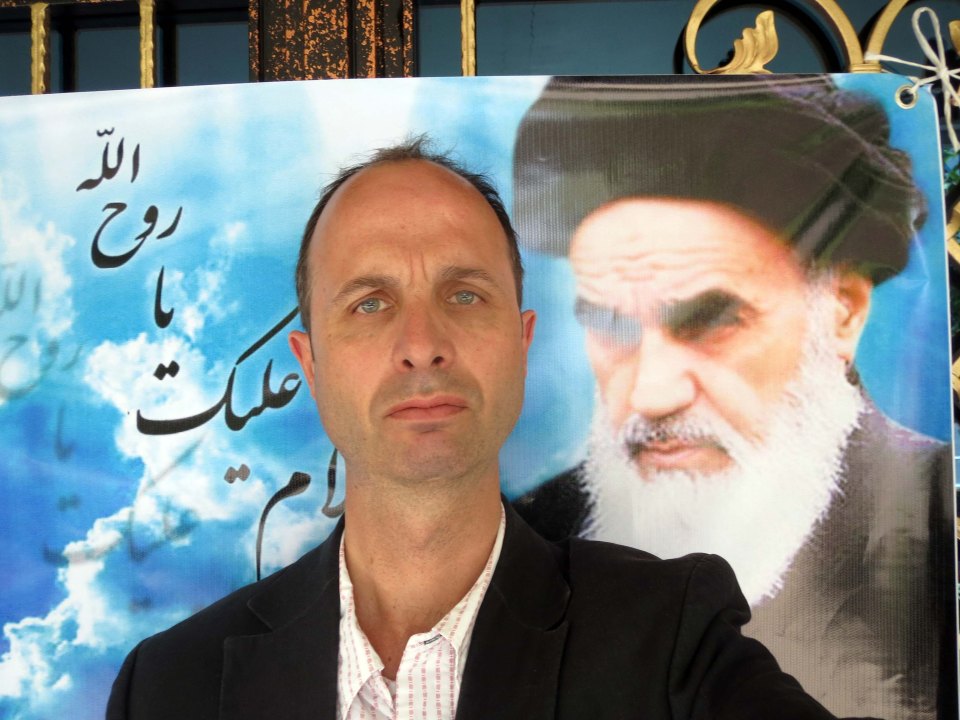
EMERGING from a carpet shop in Iran’s beautiful and ancient city of Esfahan, I was engulfed by a group of jostling young men.
Like a desert mirage, as quickly as they had arrived they were gone.


Patting myself down, a zip on my trouser pocket was undone.
My passport was gone.
And this so-called Axis of Evil nation had no British Embassy to get a replacement.
Hands trembling uncontrollably, my adrenalin-induced sweat of fear smelt like cat’s urine.
There can be few more hazardous places on Earth for a journalist without papers — and an entry stamp — than the Islamic Republic of Iran.
Years later Barry Rosen — a US embassy worker held hostage there in 1979 — told me how his interrogation played out.
With a rifle pressed to his temple, Barry was told he had ten seconds to admit he was a spy.
As the daunting countdown started, the New Yorker faced a tough decision: either risk being seen as betraying his country or risk leaving his children without a father.
“On the count of five I relented,” Barry told me.
“I signed the false confession, distraught and completely ashamed.”
Barry would eventually return to his loved ones in the US after 444 days in captivity.
Britons are high-value hostages for the regime.
Nazanin Zaghari-Ratcliffe was detained in Iran for six years on trumped-up charges of plotting to topple the Iranian government.
She was finally released when Britain paid a £400million outstanding debt to Iran.
Eventually, I managed to find a way out — I’ll explain how later — but not before staying with an exceptionally generous Iranian who accommodated me in his home and calmed my anxieties with some potent homemade brew.
Nowadays, as Iran’s oppressive government becomes a target for Israel and the US, I find myself reflecting on the warm and hospitable individuals I encountered while exploring this historic region.
These folk loathe rule by the hardline ayatollahs and long for a time less than 50 years ago when women wore miniskirts in capital Tehran, the hair bouncing on their shoulders.
I had arrived in Iran — successor state of the Persian Empire — in 2012 with the idea of travelling from Tehran to Persepolis, a millennia-old desert ruin once the centrepiece of its civilisation.
On the way I’d talk to ordinary people to try and understand what made this land tick.
Did they really think Britain was the cursed Little Satan?
‘GREAT SATAN’
On landing in Tehran — a high-rise city of 9.8million shrouded by mountains — fleets of white taxis honked their way through the city’s awful traffic.
In the pollution-choked centre, I was struck by the number of women walking around with white plasters on their noses.
Tehran has been called the nose job capital of the world.
Women here also face a daily battle over what they can wear in public, with checks made by the dreaded Basij militia network.
Yet many were wearing their head scarves pulled back to reveal dyed blonde hair, while their overcoats were colourful and figure-hugging.
Since the 1979 Iranian revolution, when the Shah — or king — Mohammad Reza Pahlavi was toppled and replaced by hardline cleric Ayatollah Ruhollah Khomeini, Islamic dress has been strictly enforced.
Alcohol was banned, protests stifled and unmarried couples prevented from meeting in public.
Today, the internet is censored and the regime attempts to scramble satellite TV signals.
Near the Taleghani Metro station is the old American embassy — known here as “the nest of spies” — its walls daubed with murals and slogans decrying the so-called Great Satan.
Months after the revolution, students stormed the embassy compound and took 66 Americans hostage.


A disastrous and aborted US rescue mission the following year — when eight servicemen were killed in a helicopter crash — badly damaged US president Jimmy Carter’s reputation.
The lingering stigma of that failure was perhaps a factor in why Donald Trump took his time before deciding to unleash American firepower on Iran.
In Palestine Square — in the heart of Tehran — beats a Doomsday Clock predicting Israel’s end by the year 2040. The regime put it there in 2017.
It helps explain why Israel launched a pre-emptive strike against Iran’s nuclear sites, senior nuclear scientists and top brass last week.
Nearby, I visited the British embassy compound, its gateway overlooked by lion and unicorn statues.
Around six months before my visit, diplomats had fled as a frenzied mob of Iran- ian “students” storm- ed the building and ransacked offices.
It would remain shuttered for nearly four years.
The rioters — who were chanting “Death To England” — were in fact state-sponsored Basij thugs.
It is the same sinister paramilitary force that is responsible for the policing of morals in this hardline Shi’ite Muslim state, including the wearing of the hijab or headscarf.
Yet these repressive goons are far from representative of the beating heart of this oil-rich nation.

A short stroll away in the teeming Grand Bazaar, women shoppers, in the all- covering black cloak-like chador, were out looking for bargains.
But surprisingly, Union Jack-patterned knickers and bra combos were on sale on at least three stalls.
American stars and stripes underwear was also available in several shops.
One black-clad shopper in her thirties told me: “The underwear is very popular.
“We have nothing against your country.”
The message that the lingerie worn under the chadors sent out was clear: Knickers to the hardliners.
Indeed, as a metaphor for things being very different under the surface in Iran, it couldn’t be bettered.
Another stall sold Manchester United bath towels in a nation where the Premier League is avidly followed.
“We don’t hate Britain,” a 26-year-old Red Devils-mad taxi driver told me.
“Far from it.
“We admire your freedom.”
After a few days in Tehran I took a shared taxi on the five-hour, 280-mile journey to Iran’s third largest city Esfahan.
It’s home to an exquisite square overlooked by the imposing aquamarine dome of Shah Mosque, regarded as one of the masterpieces of Persian architecture.
The city’s outskirts are also home to one of the largest uranium enrichment facilities in the country.
‘EVERYBODY BREWS THEIR OWN NOW’
Terrified that Iran was close to producing a nuclear weapon to make good on its doomsday prophecy, the site was pummeled by more than two dozen US Tomahawk cruise missiles on Sunday morning.
I had checked into a largely empty hotel in the city centre which had no safe for valuables.
That evening I went out shopping for a Persian rug.
Warily passing some soldiers in the street, I was dismayed to see them beckon me over.
Yet they simply wanted a selfie alongside a rare Western traveller.
Emerging with my new carpet, I was heading for an electronics store bearing a fake Apple logo when I was surrounded by pickpockets.
Now passportless, I was petrified about being stopped by police and asked to produce my documents.
I then remembered meeting some Iranian migrants in Calais who had told me they used to work as smugglers, trekking over the mountains from Iran to Turkey with some contraband alcohol in backpacks.
Finding an internet cafe to research the journey, a man started using the computer next to me to watch porn.
The idea of attempting to walk alone over rugged mountains seemed more hazardous than another internet suggestion — go to another country’s embassy and throw myself at their mercy.
Travelling back to Tehran I attempted to check into a hotel but the receptionist insisted I needed to show my passport.
When I explained my predicament, he told me: “I’ll phone the police and they’ll sort this out.”

I told him I needed to collect my luggage then scarpered.
Knowing no one in the country, a contact then put me in touch with someone who could put me up.
The grey-haired father lived alone in a ramshackle flat and said I was welcome to the sofa.
“I was jailed for protesting against the Shah when he ruled,” he told me.
“Now I wish I hadn’t bothered.
“This regime is far worse.
“We have far less freedom now.”
Deciding the Dutch would be most amenable to a stricken Brit, I tried their embassy but it was closed for holidays.
So I went to the Danes instead.
They took my details and I was told to return the following day.
Presented with a paper Danish temporary passport 24 hours later, I profusely thanked the embassy staff for making me an honorary viking.
Taking a cab to the airport, I checked my bag on the flight then queued up at immigration dreaming of a glass of red on the plane.
A bearded border guard disdainfully looked at my Danish passport, sniffing as he tossed it away: “No good, no ministry stamp.”
It was back to my new friend’s sofa to watch subtitled TV, including shows with Jamie Oliver and James May.
The former prisoner — raising a glass of home-distilled spirits — revealed: “Twice every year the police go upon the roof and smash up all our satellite dishes.
“But we simply go out and buy some more.

“There’s a saying here that the regime closed down thousands of brewers during the revolution but created a million more.
“Everybody brews their own now.”
After two days queuing at the relevant Iranian ministry — and praying that they wouldn’t google my identity — I finally got my stamp.
My plane banked over the vast mausoleum built to house Khomeini’s remains as it headed west.
One after another, most of the women on the flight removed their head scarves, then their restrictive chadors.
Settling with a glass of wine, I hoped one day to return to this fascinating land under better circumstances.
Now, with the ayatollahs’ regime perhaps at threat of being toppled, I may one day make it to Persepolis.
Unlock even more award-winning articles as The Sun launches brand new membership programme – Sun Club.


