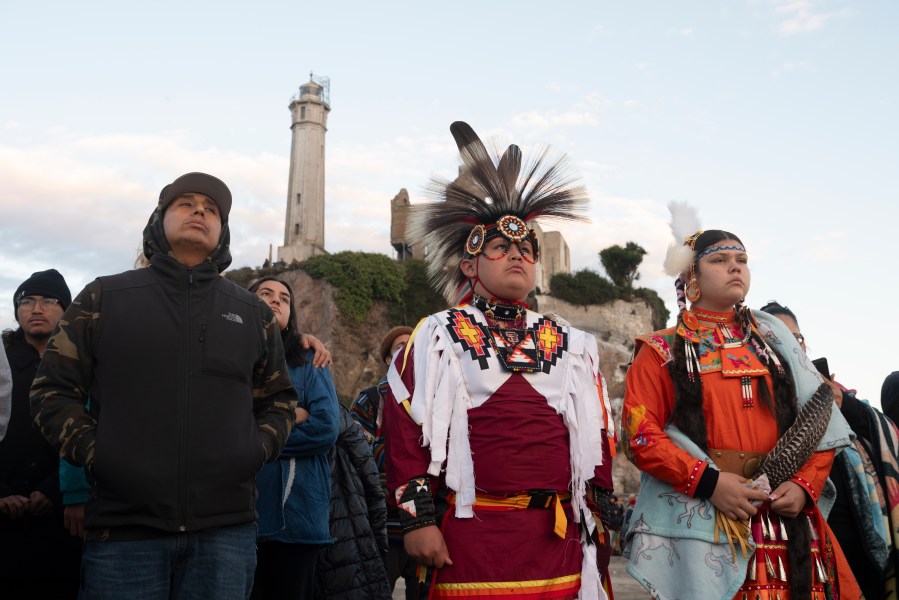


From Seattle to Baltimore, numerous Americans observed Indigenous Peoples Day on Monday, celebrating it as a testament to endurance despite centuries of hardship. Tribal nations and communities participated in powwows, markets, and musical performances, among other joyful events, to honor their culture and history.
Over the decades, various states and cities have used the second Monday in October to honor Native Americans alongside the Italian explorer Christopher Columbus, for whom the federal holiday was established in 1937. President Joe Biden has signed a declaration acknowledging both observances.
Last week, President Donald Trump reversed this acknowledgment, following through on a promise made in April. He pledged “to reclaim [Columbus’s] extraordinary legacy of faith, courage, perseverance, and virtue from the left-wing radicals who have tried to tarnish his name and dishonor his memory.”
Trump’s tribute to the explorer, whose placement of the Spanish flag in the Caribbean in 1492 heralded “the ultimate triumph of Western civilization” — along with its ensuing periods of disease, slavery, and conquest that devastated Indigenous cultures — has sparked criticism and disapproval from Native Americans.
However, some advocates argue that Trump’s stance is not unique among previous presidents and remain resolute in their efforts to build consensus for tribal objectives.
Indigenous Peoples Day is about inclusion, not exclusion
This marks the inaugural year that Indigenous Peoples Day has been officially recognized in Montana, following a lengthy campaign in a state home to 12 federally acknowledged tribes.
What changed? Democratic State Sen. Shane Morigeau, a citizen of the Confederated Salish and Kootenai Tribes who sponsored the legislation, framed it not as a holiday that would eliminate Columbus Day, but as a day of “inclusivity, healing and bringing people together.”
“It’s just not an us-versus-them type of day. It’s a day that brings everyone together,” Morigeau said. “And if you don’t want to go check that out and you want to go do something else and celebrate the other day, you can do that too and our feelings won’t be hurt.”
What matters is that both Native and non-Native people can go to an event or do some self-reflection or even “go down to the river and go fishing for the day,” Morigeau said.
After the protests over the Dakota Access Pipeline in 2016 and the racial injustice protests in 2020, more people and institutions questioned the narrative of Columbus as only an intrepid sailor and explorer, arguing for a more complete understanding of his historical impact. Trump’s proclamation lambastes this as the villainizing of a “true American hero.”
“Outrageously, in recent years, Christopher Columbus has been a prime target of a vicious and merciless campaign to erase our history, slander our heroes, and attack our heritage,” Trump’s proclamation reads. “Left-wing radicals toppled his statues, vandalized his monuments, tarnished his character, and sought to exile him from our public spaces.”
Chase Iron Eyes, director of the Lakota People’s Law Project, said it’s Trump who is making this a culture war, when the day should be about learning all aspects of history around Columbus.
“If Trump wants to celebrate the good things about Christopher Columbus then let him. Let him do that. But also tell the truth about him and let us also celebrate Indigenous peoples’ accomplishments,” said Iron Eyes, who is of the Lakota Sioux Nation. “We don’t teach that in America’s schools.”
Soldiers at Wounded Knee keeping medals
The National Congress of American Indians found it profoundly troubling when Defense Secretary Pete Hegseth announced last month that the soldiers who killed more than 250 men, women and children in the 1890 Wounded Knee Massacre would retain their military honors after a review launched under the Biden administration.
Hegseth called it part of his effort to root out “woke” thinking.
Iron Eyes, who lives on Pine Ridge, called it hurtful.
“We have kids who pay attention,” Iron Eyes said. “When Pete Hegseth is doubling down on wanting to honor people who slaughtered noncombatants and women and children and elderly, the kids are paying attention.”
This has only reinvigorated the Lakota People’s Law Project’s campaign to persuade Congress to rescind the Wounded Knee military medals, he said.
“We’ve made hard-fought sacrifices to get to a place where we’re saying to each other, ‘Hey, let’s tell the truth about each other,'” Iron Eyes said. “Natives aren’t savage. They’re not impediments to progress. They’re not antithetical to civilization.”
Increased funding for Tribal Colleges and Universities
In September, Trump’s Education Department redirected nearly $500 million in federal funding from schools serving large contingents of Hispanic students, promising the money instead for historically Black colleges and tribal colleges. This could double federal funding to roughly $108 million across the United States for tribal colleges and universities, or TCUs.
“That’s what Indian Country wants, to continue to invest in our tribal citizens and Native people and to be contributors to not only our tribal economies, but to the U.S. economy as a whole,” said Larry Wright Jr., executive director of the National Congress of American Indians.
There are 35 accredited TCUS with over 90 campuses across 15 states, most of which are in Indian Country, according to the American Indian Higher Education Consortium.
The consortium lauded the funds as “progress toward fulfilling federal trust and treaty obligations” while also noting that it could raise more obstacles for students at non-TCU schools. Many Native Americans are enrolled at the universities that are losing federal funding.
Tribal appropriations were initially included in the Trump administration’s efforts to claw back federal spending that it sees as promoting diversity, equity and inclusion. Wright gives credit that the administration heard NCAI officials out and understood “Indian Country is not DEI” — and that there are treaties and trust responsibilities that must be met. He said they’ve had productive conversations with the administration and lawmakers on both sides of the aisle.
“To have that kind of alignment with this administration is a good thing in spite of all the other rhetoric. Truly more so than anything else, I think, from a micro aspect, Indian Country really is dependent on bipartisan efforts to to make sure our issues aren’t overlooked and forgotten,” Wright said.