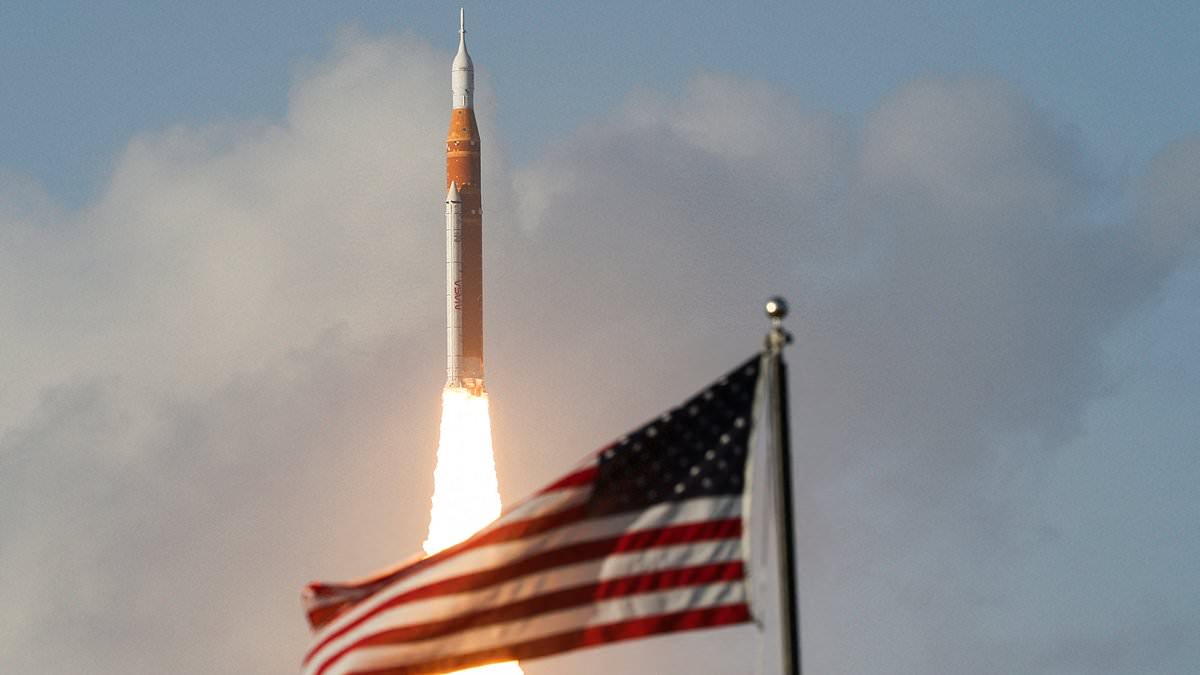

Marking a historic milestone, Artemis II successfully lifted off from Florida’s Kennedy Space Center, propelling four astronauts on a groundbreaking ten-day mission to the moon. This mission marks humanity’s return to lunar exploration, a feat last accomplished in 1972.
The launch took place precisely at 6:35 PM ET on Wednesday. Despite initial concerns over two system glitches that threatened to delay the mission, the NASA spacecraft ultimately soared into space as planned.
Among the crew embarking on this extraordinary journey are NASA astronauts Reid Wiseman, Victor Glover, and Christina Koch, joined by Canadian astronaut Jeremy Hansen. Their mission is to venture deeper into space than anyone has before.
By April 6, the team is expected to travel approximately 250,000 miles from Earth, surpassing the previous distance record set by Apollo 13 in 1970. This endeavor will take them further into the cosmos than any human has previously ventured.
Just four minutes after the launch, Artemis II successfully crossed into space, with no issues reported, offering the crew a clear path to their lunar destination.
Mission commander Reid Wiseman captured the moment’s excitement, exclaiming, “We have a beautiful moonrise. We’re headed right at it!” as the crew set their sights on the majestic lunar horizon.
NASA Administrator Jared Isaacman reported after the successful launch that Artemis II suffered a temporary communications problem and was still dealing with a ‘controller issue’ with the toilet on board the Orion capsule.
However, all major systems were still functioning and the crew was busy preparing for the next stages of their orbital burn over Earth before the space agency declares the spacecraft ready for its trip to the moon.

Artemis II successfully launched from the Kennedy Space Center Wednesday evening

From left to right: Canadian astronaut Jeremy Hansen, NASA astronauts Victor Glover, Reid Wiseman and Christina Koch
Just after 6pm, Wiseman declared ‘Full send,’ as he and his crewmates sat atop NASA’s towering rocket, confirming they were ready for launch.
From mission control, Artemis II launch director Charlie Blackwell-Thompson delivered an emotional message to the crew, telling them they carried ‘the heart of this Artemis team, the daring spirit of the American people and our partners across the globe, and the hopes and dreams of this generation.’
‘Good luck. Godspeed, Artemis II. Let’s go,’ she said, following the final launch checks.
Artemis II lifted off into orbit using the SLS (Space Launch System) rocket, with the Orion spacecraft sitting on top.
The twin solid rocket boosters ignited first, delivering more than 75 percent of the thrust needed to lift the 5.75-million-pound rocket off the pad, according to NASA.
Their combined power, along with the four RS-25 engines already at full thrust, generated an incredible 8.8 million pounds of force at liftoff.
As the rocket rose, the umbilicals – which provided power, fuel and data connections during prelaunch – disconnected and retracted into protective housings. This ensured the vehicle was free from ground systems and fully autonomous for flight.
The main engine cutoff of the SLS core stage completed and separated from the craft eight minutes into the flight, marking the end of the first major propulsion phase of the Artemis II mission.

Artemis II overcame a pair of minor technical gliches to launch on time and 6.35pm ET
From there, the space capsule began to deploy its set of four solar wings approximately 20 minutes into the historic flight.
The four solar panels will provide continuous electrical power to the spacecraft throughout its ten-day journey, supporting the crew’s life‑support systems, avionics, communications and onboard operations.
NASA officials noted that the four astronauts would be spending most of the night performing systems checks to make sure the launch went off as planned and there were no critical issues before the spacecraft moves into high-Earth orbit.
On day two, and if all systems are go to leave Earth orbit, the Orion spacecraft will perform the critical translunar injection burn, a powerful engine firing designed to send the spacecraft out of orbit and on course toward the moon.
It will take three to four days for the Artemis II crew to reach the moon, with the Orion spacecraft projected to enter what NASA calls the moon’s sphere of influence on day five.
This is the point at which lunar gravity overtakes Earth’s pull and begins guiding the spacecraft toward its destination.
Day six is likely to be historic for NASA and the rest of humanity, as Artemis II conducts its lunar flyby and travels to the dark side of the moon.
The spacecraft will not only reach a point farther from Earth than any previous crewed mission, but NASA confirmed that the astronauts will be able to see a lunar eclipse – when the moon blocks out the sun.

Artemis II will be the first manned mission to reach the moon since Apollo 17 in 1972

Crowds gathered near the Florida space center to watch the rocket launch in person on April 1
After looping around the moon, the Orion craft will begin its return journey, leaving the moon’s gravitational influence and heading back toward Earth.
It will take another four days to return, which the astronauts will fill by conducting key safety demonstrations, including testing procedures designed to shield the crew from dangerous solar radiation from solar flares. The crew will also practice manually steering the spacecraft.
The mission will conclude on day ten with a fiery return through Earth’s atmosphere, where the Orion capsule is expected to endure temperatures nearing 3,000 degrees Fahrenheit.
Parachutes will deploy to slow the spacecraft before it splashes down in the Pacific Ocean, bringing the landmark mission to an end.
However, Isaacman said shortly after launch that Wednesday’s history-making event was only the first step in NASA’s much larger goals, including building a permanent base on the moon just two years from now.
‘Artemis II is the opening act. This is the test mission,’ Isaacman said.
‘It’s gonna set up for the subsequent missions. You’re gonna see a moon rocket launch in 2027, when we do our testing with the lander. We’re gonna go for the landing on Artemis IV in 2028, and in parallel, we’re gonna build the moon base!’
Artemis III, NASA’s next space mission, is set to launch in 2027.
The mission to low Earth orbit will test integrated operations between the Orion spacecraft and one or both commercial landers from Elon Musk’s SpaceX and Jeff Bezos’ Blue Origin, respectively.

Artemis II entered space just four minutes into its historic journey to the moon as crowds of fans watched across Florida

Countless Americans around the US also stopped in busy cities to view the launch on TV
President Donald Trump congratulated NASA and the astronauts aboard Artemis II as he began his presidential address Wednesday night.
‘Let me begin by congratulating the team at NASA and our brave astronauts on the successful launch of Artemis II,’ he said.
‘It was quite something,’ he added, deeming the mission ‘amazing.’
‘They are on the way and God bless them. These are brave people. God bless these four astronauts.’
Trump was among the countless Americans who gathered to watch the historic launch, many stopping in crowded streets to watch Artemis II lift off on TV monitors throughout the country.

Artemis II will travel approximately 250,000 miles from Earth, the farthest any human has ever gone in history

Major sporting events, including the game at Dodger Stadium in Los Angeles televised the Artemis II launch for fans

William Shatner, known for playing TV space pioneer Captain Kirk, praised the NASA launch and the inclusion of a Canadian astronaut on the four-member crew
Members of the Canadian Space Agency also cheered as they watched the Artemis II launch.
Astronaut Jeremy Hansen became the first Canadian to go to the moon. It was also the 50-year-old from Ontario’s first time going to space.
Fellow Canadian, TV icon and former Blue Origin astronaut William Shatner even praised the launch during an interview with CNN.
The 95-year-old actor, famed for playing Captain Kirk on Star Trek, said: ‘We’re very proud of what Canadians have contributed to this, exploration of space exploration, of mankind’s reach.’
‘The possibility of going to Mars and discovering more about the mystery of the universe, all that so many nations have contributed and led by America and its unquestionable excellence in technological advancement.’


