
ORLANDO, Fla. – For many years, sports fans had a straightforward path to their favorite games. The NFL was reliably found on a select few channels like NBC and CBS, later joined by FOX, while local broadcasts were the go-to for MLB and NBA games. Olympic coverage rotated through broadcast networks every four years, and ESPN served as the all-encompassing hub for other sports.
Yet, as we look ahead to 2026, it’s clear that the times have changed dramatically.
Today, the experience of watching sports involves more than just turning on the TV. Fans now navigate a complex landscape of subscriptions, apps, and streaming platforms, each holding various rights to different events. The traditional stalwarts like ABC, NBC, CBS, FOX, and ESPN are now joined by tech giants and new players such as Apple TV, Amazon, HBO Max, Netflix, Paramount+, Peacock, and YouTube. Even Tubi made waves last year by simulcasting Super Bowl LIX.
The competition for sports rights has become a central focus for the streaming industry, driving growth while also representing a costly venture.
This transformation has been gradual but profound. Just as cable once disrupted the broadcast industry, streaming is now challenging cable, reshaping how fans consume sports content.
This shift, however, didn’t happen overnight. Just as cable has upended the broadcast industry, streaming is now giving cable a taste of its own medicine.
The good old days
Streaming is the new “it”, but for some owners, “it” is losing a lot of money.
Alongside prestige dramas and big-budget originals, streamers have added a new draw: live sports. But that golden ticket doesn’t come cheap.
Streamers see sporting events as a gateway to welcome new subscribers, keep existing ones from canceling, and give their platforms a reason to exist beyond movies, series, and reruns. Leagues and rights holders, in turn, have used this demand to push fees even higher.
The result: fragmentation the likes of which we’ve never seen before.
Back in the day (I’m not saying I was there for this… I’m also not saying I wasn’t), things were different. Through the 1960s, ‘70s, and most of the ‘80s, there were just three networks: ABC, NBC, and CBS. ESPN launched in 1979 as cable began expanding beyond rural markets, and FOX didn’t arrive until 1987.
Sports rights were just as concentrated. The NFL rotated between CBS (NFC) and NBC (AFC) until FOX shook things up in 1993 by taking the NFC package. Five years later, CBS returned the favor, reclaiming the AFC from NBC in 1998.
MLB regular-season games were relegated to local channels during the week, with weekend afternoon games on national TV, along with the playoffs and the World Series. Same for basketball. Hockey was also a local affair and was tough to find come playoff and Stanley Cup time. College sports? Everywhere.
Regional sports networks started populating cable lineups in the late 1970s with PRISM in 1976, followed by SportsChannel networks in the early 1980s. The modern RSN era: that can be traced back to Comcast SportsNet Philly in 1997.
Then there was NASCAR. NASCAR’s first live televised race wasn’t until 1971 – the first live Daytona 500 was in 1979, and the first season of live “flag to flag” coverage of all races wasn’t until 1997.
And the Olympics? NBC has had a lock on broadcasting both the Summer and Winter Olympic Games in the states since 2008, with its agreement running through 2036 (including the 2028 Olympics in Los Angeles).
,
“Sports” is expensive
In 1980, ABC paid about $15.5 million for the Winter Games while NBC paid about $70 million for the Summer Games. NBC’s latest Olympic rights extension (signed in 2025) cost some $3 billion, and one extension in 2014 cost $7.75 billion. Overall, NBC has spent about $19.13 billion for Olympic broadcast rights since 2008.
If all that sounds like a lot, you’re probably going to need to sit down when I give you some 2026 numbers for two major sports leagues. Let’s start with the NFL.
For the NFL in 2026, regular season, playoffs, and the Super Bowl are split among six (possibly seven) different rights holders:
-
Disney/ABC: $2.7 billion (Monday Night Games)
-
Paramount (CBS): $2.1 billion
-
FOX Corp (FOX): $2.25 billion
-
Comcast (NBC & Peacock): $2.0 billion
-
Amazon (Prime Video): $1.0 billion (Thursday night games)
-
Netflix: $150 million (Christmas Day games)
-
YouTube: Possibly getting 2026 premium games*
*Of note: YouTube got a taste of streaming the NFL in 2025 with a free Week 1 Brazil game, and in 2026, it’s negotiating for up to four more games, but no deal or price tag has been confirmed.
Total estimated cost (excluding the four games that YouTube might or might not get): $10.2 billion. To put that into context: that’s a little more than half of what NBC has paid for years of Olympics rights. And don’t forget the premium packages of YouTube’s NFL Sunday Ticket for every out-of-market Sunday game, and NFL’s RedZone (now part of ESPN’s growing NFL portfolio) for live highlights.
This fragmentation didn’t happen overnight. Although ESPN first jumped on NCAA men’s basketball coverage in March of 1980, one of the biggest instances came when FOX and NBC split NASCAR coverage – an agreement dating back to 2015.
Speaking of NASCAR, coverage of that sport has a number of partners as well in a deal put together in 2024 (specific amounts for each partner were not made public, but the whole right package is worth about $7.7 billion for 2025-2031 or around $1.1 billion a year). For 2026:
-
FOX Corp. (FOX Sports): First 14 Races
-
Comcast (NBC/USA Sports/Peacock): Final 14 Races
-
Amazon (Prime Video): 5 Midseason Races
Those are two major sports leagues – without getting too much into the weeds, here’s a snapshot of some others, their costs, and their partnerships:
-
Major League Baseball: Six national partners (+MLB TV and regional sports networks)
-
National Basketball Association: Three national partners
-
National Hockey League: Two National Partners
-
PGA Tour: Three National Partners
Individually, each of these deals makes sense, but together, leagues and distributors have created a system where no single platform can deliver a complete sports experience.
So, what does this mean for you, the sports fan?
In a nutshell, if you want to keep up with your major sports teams, be ready to pay up.
Just when you’ve come to grips with $100-a-month cable bills, streaming subscriptions are piling on – each ready to take a chunk out of your monthly budget.
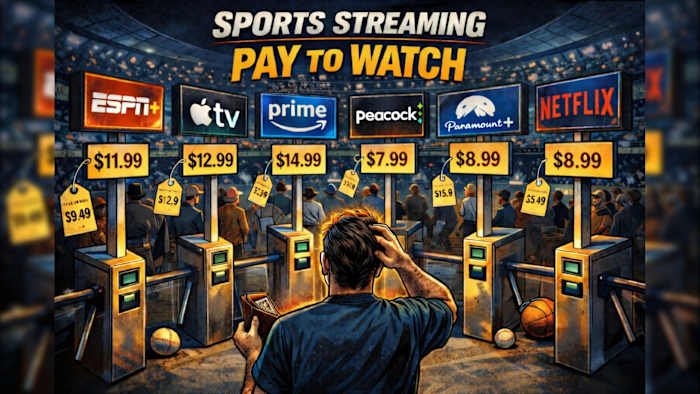
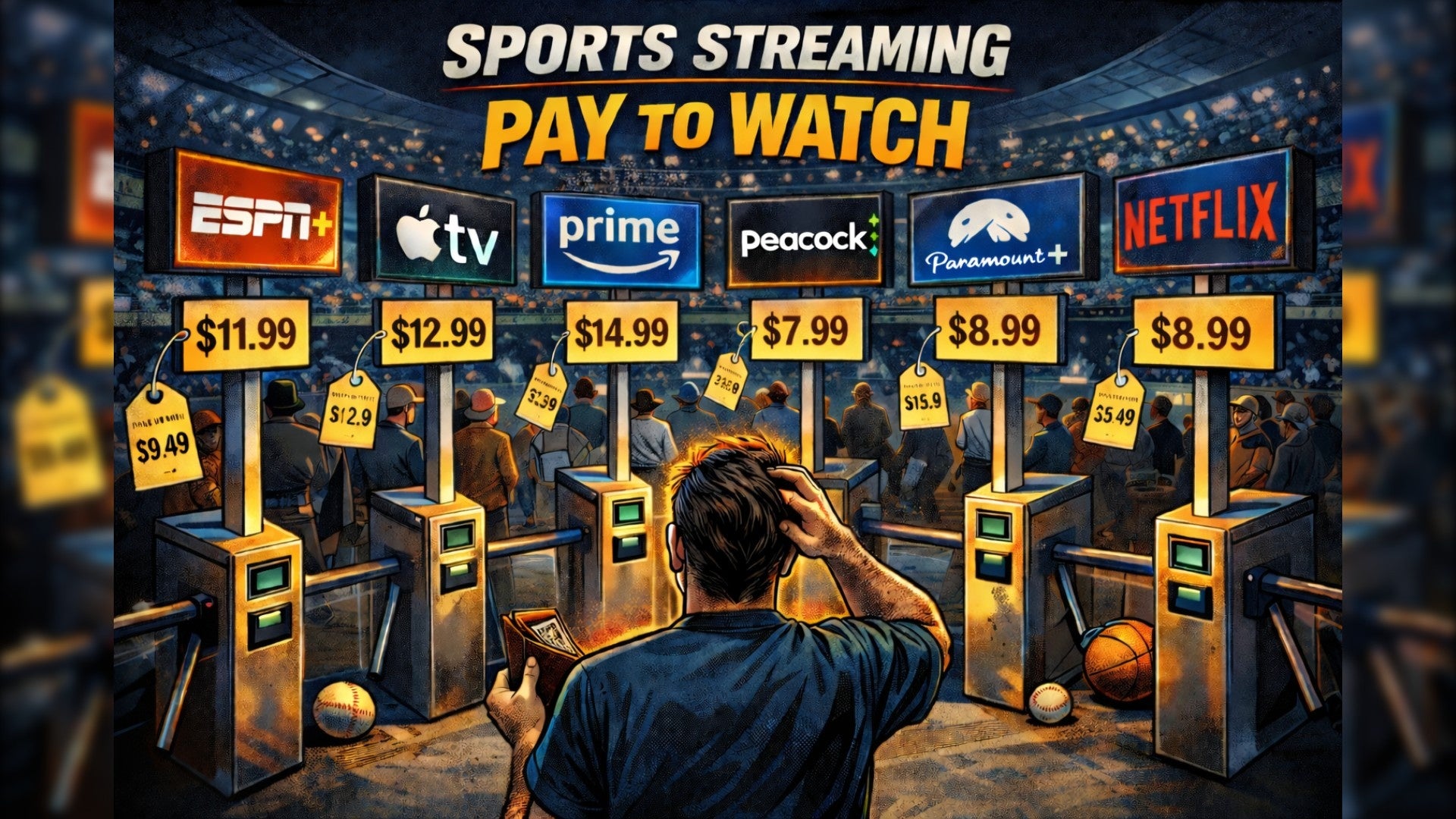
As an example: most NFL teams are broadcast in their local markets each Sunday or Monday (with occasional Thursday and Saturday games). But with new packages, those Thursday night games are now on Amazon Prime – $14.99 a month or $139 a year. Sunday and Monday night games: NBC/Peacock (Sunday) and ESPN (Monday). Christmas games – those are on Netflix ($8.99–$26.99 a month). YouTube’s Sunday Ticket is $192–$240 for new subscribers or $378–$480 for returning ones. Add in the NFL Network and RedZone (NFL+ Premium) for another $14.99 a month.
A 2026 FOX Sports article estimated the diehard NFL fan is in for almost $600 to $800 for full coverage of the 2025 NFL season.
In fact, if you are a true sports fanatic, to watch the NFL, MLB, and NBA in 2026, on top of your network coverage (which, if you’re paying for cable, satellite, or a live TV streaming service, could hover around $100 a month), you need a minimum of 8-10 different subscriptions across traditional cable/satellite/live TV streaming.
Here’s what things look like:
-
All sports:
-
YouTube TV ($82.99/month)
-
Alternative: Disney+, Hulu, ESPN Unlimited Bundle ($35.99-$44.99/month)
-
-
NFL
-
NFL Sunday Ticket ($192-$480/season)
-
Amazon Prime ($14.99/month – Thursday Night Football)
-
Peacock ($7.99-$16.99/month – Sunday Night Football)
-
Netflix ($8.99-$26.99/month – Christmas Games)
-
ESPN+ ($11.99-$12.99/month)
-
NFL+ Premium (includes RedZone and NFL Network) – ($14.99/month)
-
-
MLB
-
NBA
-
NBA League Pass ($110/season)
-
Local RSN (like MLB, it’s a mess)
-
Oh, and if you’re an F1 fan, pony up for Apple TV ($12.99 per month or $99.99 annually) along with Netflix for Formula 1: Drive to Survive.
The new sports fan reality
Don’t expect things to get better anytime soon. Streamers bid aggressively because live sports equals sticky subscribers who stick around for a full season, won’t cancel after a series binge, and sample a streamer’s other choices.
The soaring cost of sports broadcast rights has pushed networks and streamers into uneasy partnerships – these fractured deals have now left fans chasing games across a maze of channels and apps.
Skinny bundles promise relief – YouTube TV has a new $64.99 sports tier while Disney offers up the aforementioned Disney+, Hulu, ESPN Unlimited Bundle. RSNs are collapsing (FanDuel Network is sunsetting,commercial-free and Bally’s went bankrupt). MLB will run production and distribution for some baseball teams, while a few others are returning to their roots for a smattering of games on local stations. Both the NBA and NHL are looking at the possibility of a national streaming hub with fragmented local deals.
So, moving forward – how do you keep your sanity (and your dollars)?
Pick two to three teams (not leagues), accept you’ll miss games, and live with highlights. Try YouTube and pay about $15 a month to go commercial-free (no commercials completely changes the way you experience the platform). Occasionally hit a sports bar to get a football, baseball, basketball, or motor-racing fix.
Sports remain cultural glue, but accessing it shouldn’t require a spreadsheet and second mortgage.
Copyright 2026 by WKMG ClickOrlando – All rights reserved.