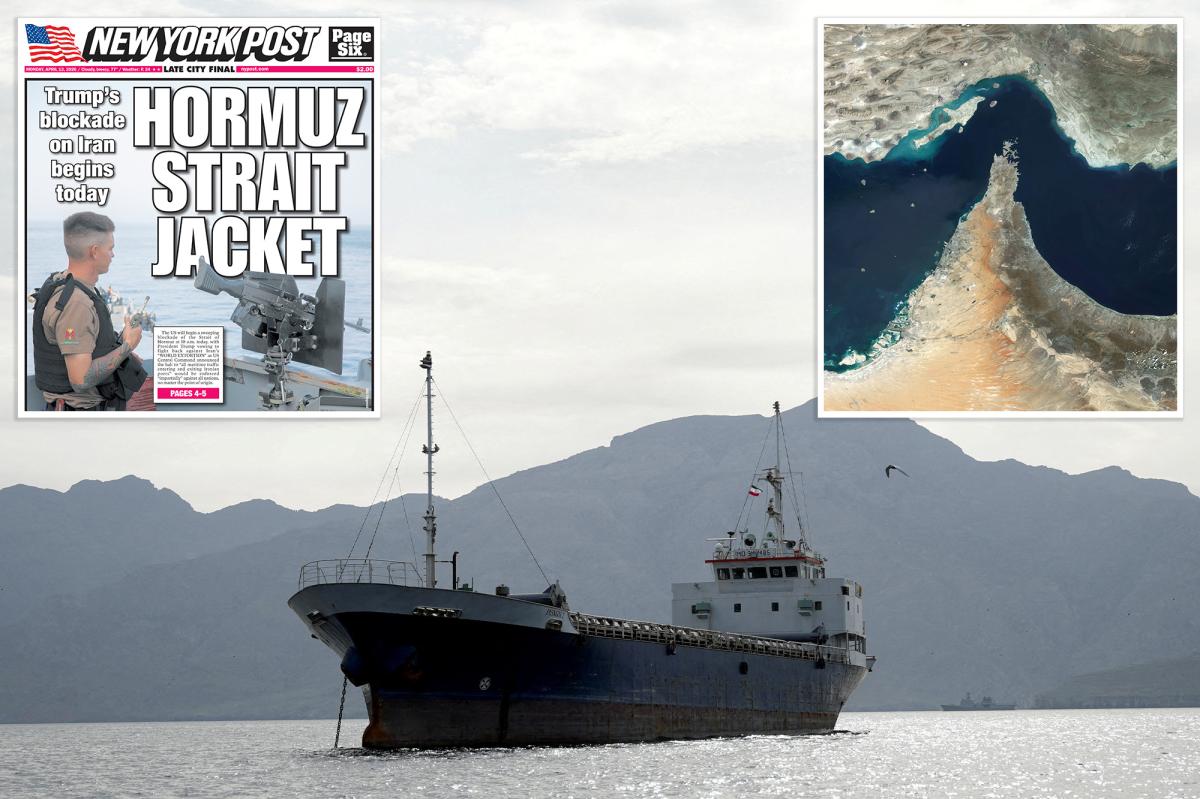


The U.S. has initiated a blockade of the Strait of Hormuz, effectively halting all maritime traffic to and from Iran’s ports. This significant move, fraught with challenges and potential dangers, is aimed at further crippling Iran’s already fragile economy, according to experts.
President Donald Trump has committed to maintaining this blockade as part of the broader U.S. and Israeli efforts to counter Iran’s regime, which they accuse of supporting terrorist activities.
“Starting immediately, the United States Navy, recognized as the best in the world, will enforce a blockade on any vessels attempting to enter or leave the Strait of Hormuz,” Trump announced via social media.
He also mentioned, “Eventually, we will arrive at a situation where entry and exit will be permitted for all.”
Whom does the blockade target?
The blockade was implemented promptly at 10 a.m. Eastern Time on Monday, obstructing ships from accessing Iranian ports while allowing a brief window for neutral vessels already within the ports to depart.
This strategy primarily targets Tehran’s so-called “shadow fleet,” which has been discreetly transporting Iranian oil through the strait since the conflict began last month.
The blockade will not “impede freedom of navigation” for vessels transiting the strait to and from other ports, CENTCOM said.
“The blockade will be enforced impartially against vessels of all nations entering or departing Iranian ports and coastal areas, including all Iranian ports on the Arabian Gulf and Gulf of Oman,” the military said.
How will the US enforce it?
US officials have remained mum on how exactly the American Navy will enforce the blockade, but the military has several options.
In times of war, nations can exercise their international right to “visit and search” — or stop and inspect ships and grant or halt their passage, said James Kraska, a professor of international maritime law at the US Naval War College, to the New York Times.
To do that, the US will have to identify, track, contact and potentially board vessels suspected of entering or leaving Iranian ports in one of the most crowded waterways in the world, said Andreas Krieg, a senior lecturer at King’s College London’s School of Security Studies, to NBC News.
“This would look less like a clean historical blockade and more like a messy, high-risk interdiction regime,” Krieg said.
Along with using its own ships, the US could possibly launch air operations to board vessels that try to break the blockade or employ electronic weapons to disrupt the trespassers’ navigation systems.
But it’s a “high-risk” operation, Krieg noted.
For one, Iran laid mines in the strait that need to be cleared as US ships traverse it.
Then there is the issue of how Iran’s volatile regime could try to retaliate — and how the US and Israel might respond.
How many ships are passing through the Strait of Hormuz?
The Strait of Hormuz serves as a critical trade route that oversees the flow of 20% of the world’s oil supply, with around 130 to 150 ships traveling through the passage every day before the war began, according to maritime trackers.
After war broke out Feb. 28, only a handful of ships were allowed to cross the strait, with traffic peaking at only about seven ships a day in late March.
The vast majority of the ships that were traveling through the strait during the war were owned by Iran or a member of its shadow fleet, according to the Lloyd’s List Intelligence maritime tracker.
Only 14 vessels went through the strait on both Saturday and Sunday as the peace talks collapsed and Trump issued the blockade order, according to Kpler, a maritime data firm.
Two Iranian-linked ships got through the Strait of Hormuz early Monday before the blockade went into effect, Kpler noted.
What are the impacts of the US blockade?
The blockade could escalate the war with Iran, as the Islamic republic has repeatedly warned of retaliation against the US and Gulf nations if its naval traffic is impaired.
Retired Pakistani Lt. Gen. Muhammad Saeed told The Post that the blockade could provoke Iran into attacking the US vessels enforcing the waters in the Gulf.
“It could push Iranians towards some kinetic actions. … What they would be aiming at is causing loss to life of whosoever militarily is present there,” he said.
A halt of Iran’s naval traffic would also hurt the Islamic republic’s already struggling economy, as it had been allowed to export its oil to limit the pressure on energy prices around the world over the closure of the Strait of Hormuz.
Robin Brooks, a senior fellow at the Brookings Institution, wrote on X that the blockade effectively “collapses Iran’s business model.”
But the tactic could serve as a double-edged sword, as a complete shut down of the Strait of Hormuz will likely exacerbate global oil prices, with crude jumping back up above $100 a barrel on Monday.
-Additional reporting by Caitlin Doornbos