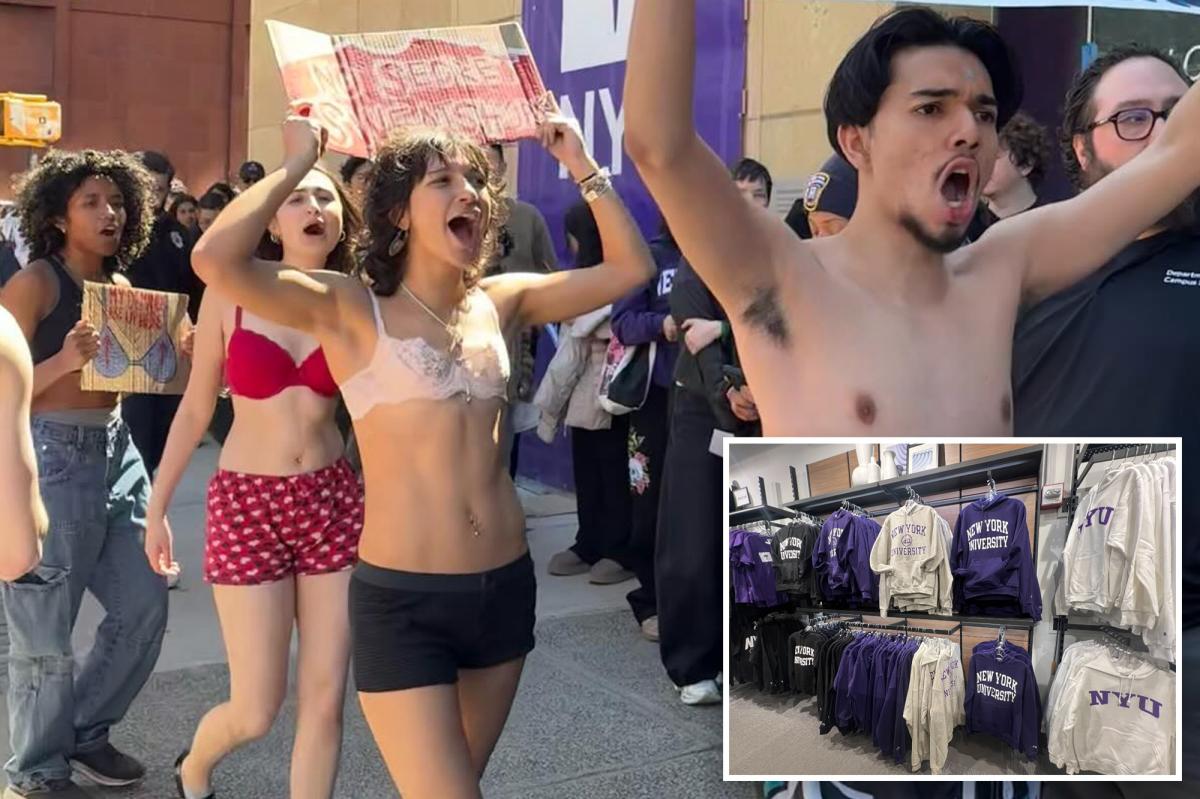


A group of progressive students at New York University made headlines when they stripped down to their underwear in a unique protest against the high costs of the university’s branded merchandise, aiming to highlight issues concerning workers’ rights.
During a campus visit for prospective students and their families, about 20 students put on an unexpected performance outside the Kimmel Center. Their goal was to demand transparency from the university regarding the origins of its pricey merchandise, such as $106 sweatshirts and $80 pullovers.
Chanting slogans like “Students, workers, stand together, solidarity forever,” the group paraded through the Village on April 11. This event, coinciding with the university’s Weekend on the Square, attracted both current students and visitors eager to experience campus life.
Protesters held signs with messages like “STOP SECRET SWEATSHOPS” and “DISCLOSE THE CLOTHES,” as they sought to raise awareness about the alleged exploitative labor conditions associated with the production of university merchandise. The demonstration was organized by Students of International Labor Solidarity (SILS), who criticized the university for benefiting from such practices.
“As students, we leverage our influence to support garment workers who produce the apparel sold in our bookstore,” explained SILS member Saesha Jindal, a sophomore focusing on social and cultural analysis, in an interview with The Post.
The NYU bookstore stocks well-known brands like Champion, Lululemon, and Nike, with products manufactured in countries such as Pakistan, India, Jordan, Vietnam, Canada, and the United States.
NYU is obligated to disclose its clothing supply chains but has only shared the final factories it uses, claimed Jindal, 19, and fellow SILS member Jamie Hesseltine.
NYU’s chapter of SILS was founded about a year and a half ago, and the group started demanding disclosure in October, Jindal said.
“They refuse to take any actionable steps to make that happen,” Hesseltine said of the school’s administration, whom SILS met with several times prior to the protest.
They suspect the university has something to hide about where it sources its pricey clothing.
“It’s an active decision to cover up labor violations,” claimed Hesseltine, 20, who is also a sophomore social and cultural analysis major.
All NYU merch is made under a “code of conduct that is intended to uphold fair labor standards, prohibit sweatshop conditions, and ensure compliance with applicable labor laws,” NYU Senior Director of Executive Communications Joseph Tirella said in a statement.
Licensees must meet those standards to maintain their relationship with the school, and that NYU actively works with partners to “monitor and enforce these expectations,” he said.
The demonstration, which was part of SILS’ larger “Follow the Thread” transparency campaign for disclosure, garnered “mixed reactions” from visiting families, Hesseltine said.
He explained many people seemed to support their fight for garment workers, while others were “dismayed” and baffled by the optics.
The effectiveness of SILS’ efforts is debatable, one critic said.
“These kinds of protests certainly grab attention. Shaming universities to cut ties may feel morally satisfying, but it can be short-sighted,” said Neetu Arnold, a policy analyst focused on K-12 and higher education at the Manhattan Institute.
“At its worst, this activism becomes political theater, generating attention without clearly expanding real opportunities for the workers activists claim to help.”