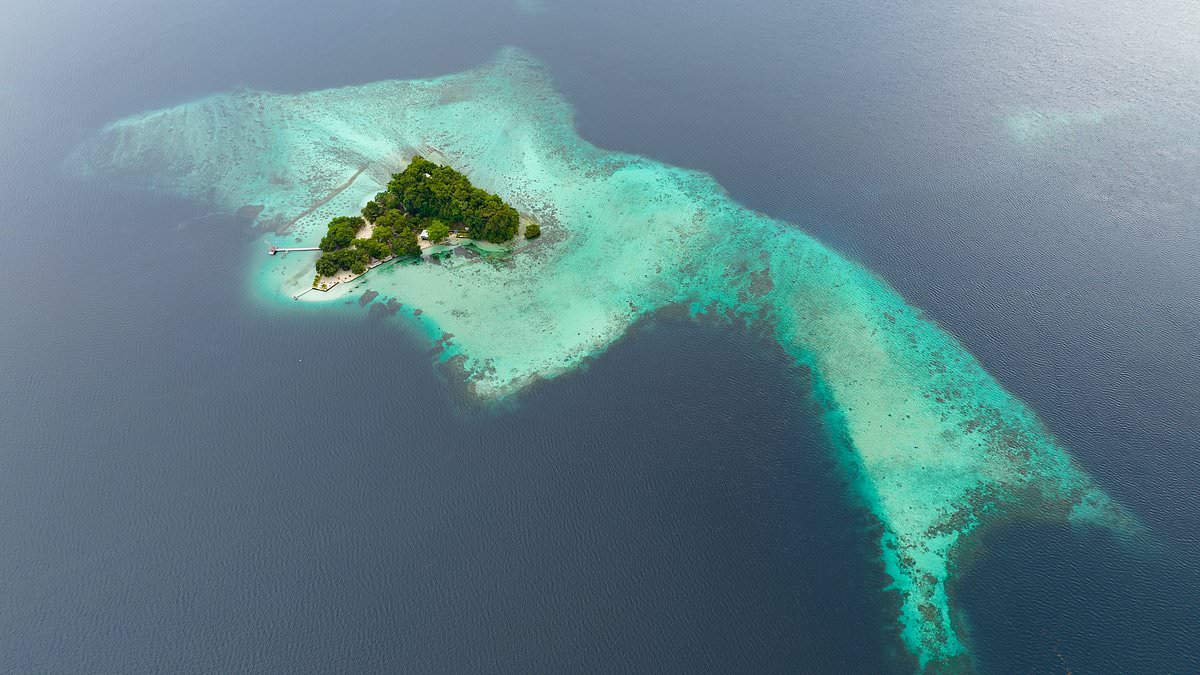

Over the next eight decades, some of the planet’s most beloved vacation spots are at risk of being submerged by rising sea levels, potentially disappearing from maps altogether.
By the year 2100, experts anticipate that climate change will cause global sea levels to climb by an average of 17 to 33 inches (approximately 32 to 84 cm), as reported by the Intergovernmental Panel.
While large urban centers such as New Orleans and Tokyo may grapple with severe flooding, low-lying island nations like the Maldives, Fiji, and the Seychelles face the dire possibility of vanishing completely.
Additionally, cities like Venice, New York, Amsterdam, and Hong Kong could experience up to six feet of sea level rise in the coming years, potentially transforming tourism landscapes and displacing countless residents.
For those considering visiting these places before they’re potentially lost, it might be time to think twice. A well-meaning trip could inadvertently hasten their decline.
Specialists caution against the “see it before it’s gone” mentality, noting that increased travel and visitor numbers can pose risks to local communities, tourists, and the environment alike.
Izzy Nicholls, founder of The Gap Decaders, says: ‘The most obvious issue is emissions. Extra long-haul flights taken specifically for last-chance trips add to warming and sea-level rise, and tourism as a whole has a sizeable carbon footprint.
‘Many fragile islands also have limited water supply, transport space and emergency response capacity. When visitor numbers surge, the impacts show up fast, from water shortages and sewage stress to damaged paths and crowded streets that reduce quality of life for residents.’
Andre Robles, owner of Voyagers Travel Amazon, added: ‘Dragging people to see a destination on the premise that it might not exist in the same way in the future can drive the conversation away from environmental stewardship to an obsession with consumption.
‘This ends up meaning more crowding and more strain on infrastructure and more pressure placed on a community already subjected to environmental changes.’
As specialists and environmentalists urge travellers to remain ravel conscious and self-aware, we take a look at the nations most at risk of disappearing by 2100.
1. The Maldives

The Maldives has an average elevation of just 1.5 metres, meaning around 80 percent of its 1,100 islands could be at risk of being swallowed by rising seas in the next 30 years
The Maldives, a chain of islands south of India, covers only about 298 square kilometers.
After periods of Portuguese, Dutch, and British rule, it became independent in 1965 – and has since become one of the most exclusive holiday and honeymoon destinations in the world.
What makes the country especially vulnerable to rising sea levels is its height – or lack of it.
With an average elevation of just 1.5 metres and a highest point of 2.3 metres, it is the lowest-lying nation in the world.
Over 500,000 people live here, many concentrated in the capital, Malé, where more than 200,000 residents occupy a small, low-lying area.
And if sea levels continue to rise as expected, around 80 per cent of the Maldives’ 1,100 islands could be uninhabitable by 2050.
2. Kiribati

Kiribati sits at just three metres high, making it most at risk of disappearing in the next 100 years
The Republic of Kiribati stretches across three million square kilometres of the Pacific Ocean, northeast of Australia, and is known as one of the first places on Earth to enter a new day and year.
Despite its size on the map, its land sits dangerously low at just three metres high.
Sea levels here are rising at roughly 1.2 centimetres per year – four times faster than the global average, according to Active Sustainability.
This combination of low elevation and rapid sea level rise puts Kiribati among the countries most at risk of disappearing in the coming decades.
3. The Bahamas
The Bahamas faces a growing threat from rising seas, particularly on New Providence, its most populated island.
The island, home to the capital Nassau, reaches only about five metres at its highest point.
A map generated by the University of California suggests that large parts of it could be submerged within 75 years, with new inland lagoons forming as water pushes further inland.
The situation is made worse by the islands’ limestone geology, which allows seawater to seep up through the ground – meaning flooding can occur from below as well as from the coast, according to BBC Wildlife Magazine.
4. Fiji

Extreme climate events, paired with rising sea levels, continue to pose a serious risk to the residents of Fiji
Fiji, a tropical paradise known for its white-sand beaches and volcanic landscapes, covers around 1.3 million square kilometres in the South Pacific.
While rising sea levels remain a concern, extreme weather events are an equally serious threat.
Heavy rainfall in 2009 led to severe flooding, killing 19 people, displacing thousands, and causing major damage to infrastructure.
Key industries like tourism and sugar production were also badly affected, highlighting how climate events can impact the economy as well as residents’ lives.
5. Samoa
Samoa, with a land area of under 3,000 square kilometres, became independent from New Zealand in 1962, and has managed to stay largely unspoiled by excessive tourism.
However, one of its main environmental challenges is the loss of coral reefs due to rising ocean temperatures, according to Active Sustainability.
These reefs act as natural protection against powerful waves – should they disappear, coastlines will be left exposed, leading to increased erosion and flooding.
6. The Seychelles

The Seychelles is a key holiday destination for those seeking sun, sea and a touch of luxury – but it may no longer exist in the next 100 years if sea levels continue to rise
The Seychelles, another luxury holiday spot, is made up of 115 islands in the Indian Ocean – many of which are low-lying and vulnerable.
Rising sea levels threaten not just the land itself but also the way people live.
Most of the 130,000-strong population and key infrastructure are located along the coast.
This means even the smallest increases in sea level or stronger storm surges can have serious consequences, with the possibility that much of the country could be underwater within the next 50 to 100 years.
7. Tuvalu
The independent island nation of Tuvalu is one of the clearest examples of how unpredictable the impacts of climate change can be.
Sea levels there have risen by about 21 centimeters over the past 30 years – nearly twice the global average.
The UN estimates that up to 95 per cent of the country – which has a low average height above sea level – could be submerged by 2100.
Despite contributing very little to global emissions, Tuvalu faces an uncertain future, with limited resources to respond to the threat.
8. The Marshall Islands
The Marshall Islands covers just 181 square kilometres – though much of its land is being lost year by year.
Here, the effects of rising sea levels are already visible in areas such as the capital, Majuro, where land that was once above water has been lost to the sea.
Rather than a distant possibility, the gradual disappearance of land is already happening in real time.
9. Solomon Islands

Entire islands have all but disappeared across the Solomon Islands due to rising seas
The Solomon Islands, which stretches nearly 30,000 square kilometres, is a little pocket of paradise in Oceania that is home to over 800,000 people.
However, over recent years, scientists have raised concerns about their long-term survival.
Rising sea levels have already caused noticeable erosion – and, in some cases, entire small islands have disappeared, with sinking countries now a serious threat.
10. Vanuatu
The Republic of Vanuatu is widely considered one of the most disaster-prone countries in the world.
Alongside rising sea levels, the country – situated in Melanesia – regularly experiences powerful cyclones.
One such storm, which saw Cyclone Pam batter the island in March 2015, caused widespread destruction, damaging the 90 per cent of the buildings in the capital.
With both sea-level rise and extreme weather intensifying, the risks facing Vanuatu continue to grow.
11. Venice

Venice has experienced several flooding incidents in the last 20 years – forcing tourists to equip themselves with wellies, umbrellas and protective clothing
Venice, like Amsterdam, draws millions of tourists every year who flock to explore its extensive canal system.
But the famed ‘Floating City’ isn’t just buckling under the weight of overtourism – it’s slowly sinking in the very waters that surround it.
The tourist hotspot has experienced 18 severe flooding events in the last two decades due to rising sea levels, with researchers at the National Institute of Geophysics and Volcanology revealing the city is sinking by about 1 to 2 millimetres per year.
Protecting Venice may require large-scale and costly solutions – like using large flood barriers to isolate parts of the land from the lagoon, or, as recently suggested, dismantling infrastructure and relocating them further inland.
But, in the worst-case scenario, some parts of the city could simply become uninhabitable – the flooded remains only able to be viewed by submarine.
To relieve some of the pressure Venice faces, Laura Evans-Fisk, head of digital & engagement at eurochange, suggests a trip to an alternative Italian spot that offers a similar experience.
She said: ‘Whilst Venice is a fantastic place to experience Italy’s true culture and history, there are plenty of other, much less visited destinations in the country that offer similar qualities.
‘Matera, in the Basilicata region, is one of the world’s oldest continuously inhabited cities. You might recognise it from the James Bond film, No Time To Die, which was filmed on its beautiful streets.
‘Trieste is another Italian port city worth visiting, which holds many similarities to Venice and is just 1.5 hours away by train. ‘Close to the Slovenian and Croatian borders, its culture is a unique blend of Italian and Slovenian influences.
‘The beautiful Canal Grande runs right through the city, dotted with restaurants and bars on the water’s edge, making it a great alternative to Venice.’
12. Palau

Across Palau, shorelines are disappearing, with much of the nation being vulnerable to rising sea levels and erosion
Palau, a nation in the western Pacific, consists of more than 300 islands and is known for its rich natural environment and cultural heritage.
However, much of its population and infrastructure is concentrated along the coast, making much of the nation highly vulnerable to rising sea levels, storm surges, and erosion.
Signs of damage are already visible, with shorelines steadily receding and vegetation struggling to hold its ground.
Nearby roads are also become increasingly vulnerable to flooding and wave action, according to NAP Global Network.
13. Torres Strait Islands
The Torres Strait Islands lie between northern Australia and Papua New Guinea and are home to several small communities.
Sea levels in this region have been steadily rising over recent decades, with flooding having already damaged homes, crops, and coastal defenses.
In addition, saltwater intrusion is affecting local wildlife, reducing access to traditional food sources, with one man testifying that a notable rise in seawater had killed crabs, fish and other seafood locals would feed on.
In a 2025 landmark case, the Australian Federal Court heard evidence that sea levels in the Torres Strait rose by 6cm per decade between 1993 and 2019, threatening the traditional way of life of local residents.
14. Bangladesh

Up to 20 million people could end up displaced in Bangladesh if sea levels rise by up to 1.5 metres within the next century
By the end of the century, Bangladesh could lose up 17 per cent of its territory due to rising tides – potentially resulting in the displacement of around 20 million people.
Sea levels along the coast may rise by up to 1.5 metres by 2100 – with extreme weather potentially driving that increase even higher.
Those living in rural areas are already having to grapple with the option of changing their way of life or finding a place elsewhere to settle due to unpredictable conditions.
At the same time, saltwater intrusion and more frequent storms are making farming harder and driving migration.
Joyce Chen, economist at The Ohio State University, told the BBC: ‘The climate is becoming more volatile so we are seeing a higher frequency of migration.
‘Where in the past we see migration due to annual flooding, or river bank erosion, now we see saltwater intrusion more commonly which affects the environment long term.
‘It makes it harder to grow crops because the land is permanently altered by the saline water.’
15. The Netherlands

In the Netherlands, around 60 per cent of the population lives in areas at risk of flooding
Even developed lands aren’t safe.
The Netherlands – famous for its winding canals and overlapping bridges – has long managed the challenge of living with water, with more than a quarter of its land below sea level.
Around 60 per cent of its population lives in areas at risk of flooding, making the country highly vulnerable to sea level rise driven by climate change, as reported by National Delta Programme.
Future projections from the KNMI Climate Scenarios suggest sea levels could rise by over one metre by 2100 if the climate warms by even 2 degrees.
As a result, the country must continue investing heavily in advanced flood defenses and water management systems.
16. Miami
Miami, a popular beach hotspot in the state of Florida, faces an entirely different kind of flooding risk.
Although it’s surrounded by water, the city is built on porous limestone – allowing water to rise not just from the ocean, but from beneath the ground as well.
Due to its low elevation of roughly 6 feet, the city faces a severe, long-term threat from rising sea levels, with ongoing urban flooding already causing damage to upland properties and infrastructure.
In the coming decades, flooding is expected to become more frequent due to higher king tides, storm surges, and extreme weather – with hurricanes being a key concern.
In 2012, Hurricane Sandy brought waves of up to 10 feet high to Miami’s shores, causing extensive destruction.
Although it’s not set to be completely underwater within the next century, there is a risk the city can become partially submerged, as reported by Rising Above Miami Beach.
17. Nauru
Nauru is a tiny island nation in Micronesia, covering just over 20 square kilometres.
Its low average height makes it particularly exposed to rising sea levels, while 80 per cent of its land already devastated by decades of phosphate mining.
If global warming continues at its current pace, ocean levels are expected to increase further here, putting the long-term survival of the island and its population in serious doubt.


