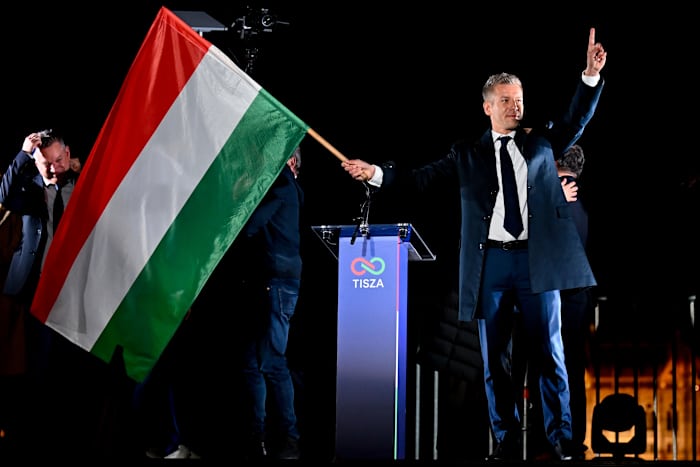

BUDAPEST – As Péter Magyar prepares to officially assume his role as Hungary’s new prime minister this Saturday, a large crowd is anticipated to gather in the square outside the imposing neo-Gothic parliament building. They will be there to celebrate the conclusion of Viktor Orbán’s 16-year tenure.
Magyar’s center-right Tisza party emerged victorious in a sweeping win against Orbán’s nationalist-populist Fidesz party, securing more votes and parliamentary seats than any party has seen in Hungary’s history since the fall of Communism.
This landslide victory provides Tisza with a powerful mandate to reverse several of Orbán’s policies that critics have labeled as far-right authoritarian. The party also aims to address the economic framework that has reportedly led to significant wealth accumulation among Orbán’s allies and relatives.
Before diving into the responsibilities of governance, Magyar has invited the nation to join an all-day “regime-change” festival on Saturday, celebrating both his inauguration and the conclusion of the Orbán era.
“We are about to step through the gateway of regime change with a grand celebration. Join us, and bring your family and friends!” Magyar announced in a social media update this past Sunday.
Magyar’s priorities
Magyar, a 45-year-old lawyer who formed Tisza in 2024 after spending years as an insider within Orbán’s party, has vowed to do away with official corruption which he argues has robbed Hungarians of economic opportunity.
One of his top priorities is unlocking about 17 billion euros ($20 billion) of European Union funds for Hungary that were frozen during Orbán’s time in office over rule-of-law and corruption concerns. That money is sorely needed to help jump-start Hungary’s struggling economy, which has stagnated for the last four years.
Magyar has also promised to repair his country’s ties with its EU partners that Orbán had pushed to the breaking point, and to restore Hungary’s place among Western democracies that had come under question as Orbán drifted ever closer to Russia.
In a sign of that commitment, Tisza officials say they will once again fly the EU flag on the parliament building’s facade, beginning on Saturday, after Orbán’s government removed it in 2014.
Despite wide jubilation over the end of Orbán’s reign, many of the nearly 3.4 million Hungarians that voted for Tisza expect Magyar to hold Fidesz officials and their business allies accountable for the perceived misconduct of the outgoing administration.
Magyar plans to form the National Asset Recovery and Protection Office, an authority tasked with investigating and seeking to recover public funds misused during Orbán’s tenure. He’s also vowed to suspend the news services of Hungary’s public broadcaster — widely seen as a mouthpiece of Orbán’s party — until objectivity can be restored.
Tisza is also expected to conduct a major overhaul of much of Hungary’s governmental structure, and to create separate ministries for health, environmental protection and education that did not exist under Orbán.
Magyar has said he will restore competence to Hungary’s government, and has nominated numerous officials to cabinet positions who are internationally recognized in their fields.
The incoming leader has tipped diplomat and foreign policy expert Anita Orbán, who is not related to the outgoing prime minister, for minister of foreign affairs, former Shell executive István Kapitány for minister of economy and energy, and economist András Kármán for minister of finance.
‘Farewell to the system’
Magyar is set to take his oath of office around 3 p.m. local time on Saturday, after which he will address the crowd outside. In an invitation to the event, he promised artistic performances and surprise guests.
The liberal mayor of Hungary’s capital Budapest, Gergely Karácsony, has also announced a “system-closing” party along the Danube River, an event he said is meant to show gratitude to Hungarians who have spent years speaking out against Orbán’s system.
“Teachers fired, civilians and journalists humiliated, small churches torn apart,” Karácsony wrote in a social media post. “We can finally leave this era behind us — but first, let us remember the everyday heroes and express our gratitude with a farewell to the system.”


