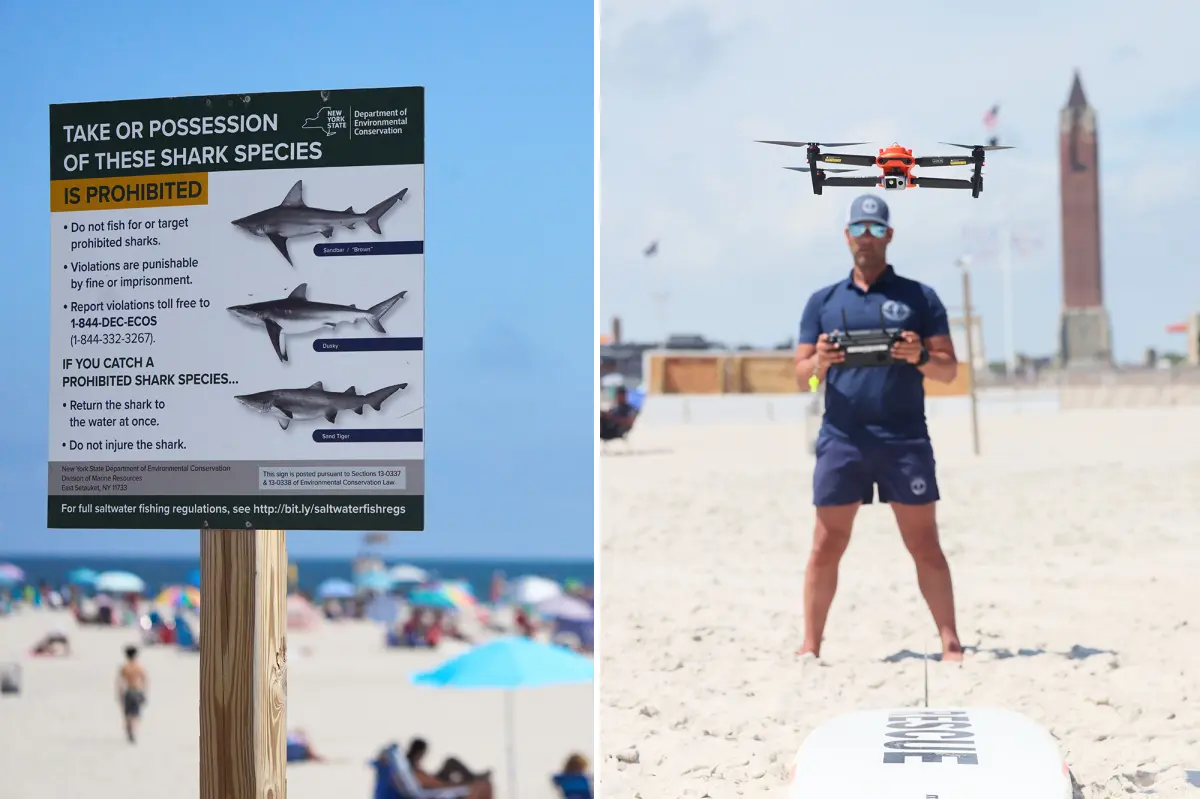

As Fourth of July crowds head for the sand, officials are working to keep some unwanted visitors away from the celebration.
Sharks are again appearing off New York’s beaches as part of their seasonal return, and drones are being used to help spot the predators before they get too close to swimmers.
The aerial surveillance technology has been patrolling stretches of coastline from Rockaway Beach to Montauk, giving lifeguards and beach officials a better view of shark activity near shore.
Cary Epstein, a Jones Beach lifeguard supervisor who operates drones, said the equipment is being used to boost public safety and help prevent rare but serious encounters. While the chances of an incident remain extremely low, he noted, they are not impossible.
Epstein also urged beachgoers to remember that swimming in the ocean always carries some level of risk. Shark attacks are uncommon, he said, but people are entering the animals’ natural habitat.
Reported shark bites have fallen sharply since the unsettling summers of 2022 and 2023, when 13 encounters were reported along the South Shore, including five over one especially alarming three-week stretch.
Last summer, that number dropped to just one reported incident. Epstein said the victim’s injuries were so minor that investigators had to determine whether cuts resembling those from “stepping on a sharp shell” were actually caused by a juvenile tiger shark.
The decline may be linked to New York’s expanded shark-monitoring efforts. This year, Gov. Kathy Hochul increased Long Island’s fleet to 46 drones and 67 certified drone operators.
Epstein and his crew send the tiny aircraft to the skies a minimum of three times per day.
Since spotting an actual shark in the murky waters is like “looking for a needle in a haystack,” operators are instead trying to locate large, swirling pods of bunker fish, a favorite shark delicacy, which are a clear indicator the predators may be nearby.
Once the swarms of bait fish are spotted, lifeguards will move bathers away from the potential feeding frenzy and keep the area clear until it has moved.
“The reality is the sharks are not swimming to the beaches because they know it’s July 4th weekend and they’re looking for a human snack … If there’s a big pod of bunker and it’s close to the swimming area and if you happen to be in the wrong place at the wrong time and a shark is having a buffet — you could accidentally get in the way,” explained Epstein.
There have not been any shark sightings at state-run beaches so far this summer, but experts expect that to change around next week.
The big fish typically show up on the stretch of shores from the Rockaways to Montauk around July 4, which is when the waters warm up for the cold-blooded hunters and their scaly prey.
Despite the good track record over the past few years, it’s nearly impossible for experts to promise any status quo for the ancient fish.
“It’s unpredictable what’s going to happen this season,” said Frank Quevedo, an environmental scientist and executive director of the South Fork Natural History Museum.
“That’s what makes scientific research so interesting and intriguing and exciting — there’s still so many answers that we don’t know about.”
Weather, water temperatures and, most importantly, food availability determine where sharks spend their summers — and the warming planet is driving the species closer to New York. Successful conservation efforts also mean that there are more of the beasts.
But Quevedo warns bathers not to be intimidated, emphasizing that shark “encounters” are typically accidental.
“They’re definitely not attacks. They’re experimental bites, if anything … Don’t forget, the only way a shark can catch its prey is by opening its mouth and trying to catch it with its teeth,” the scientist explained.
“We can’t blame the sharks for doing that. The sharks are just looking to feed on and survive. If we’re in that habitat where we’re in their way, we may have an incident with a shark.”