
The Supreme Court delivered a major campaign finance ruling on Tuesday, striking down limits on how much political parties can spend in coordination with certain candidates and reshaping the flow of millions of dollars in election cash.
In a 6-3 decision split along ideological lines, the justices lifted restrictions on coordinated party spending, a move that comes just months before the midterm elections.
The ruling marks a significant victory for the Republican Party and is expected to influence tens of millions of dollars in campaign spending across the United States for years to come.
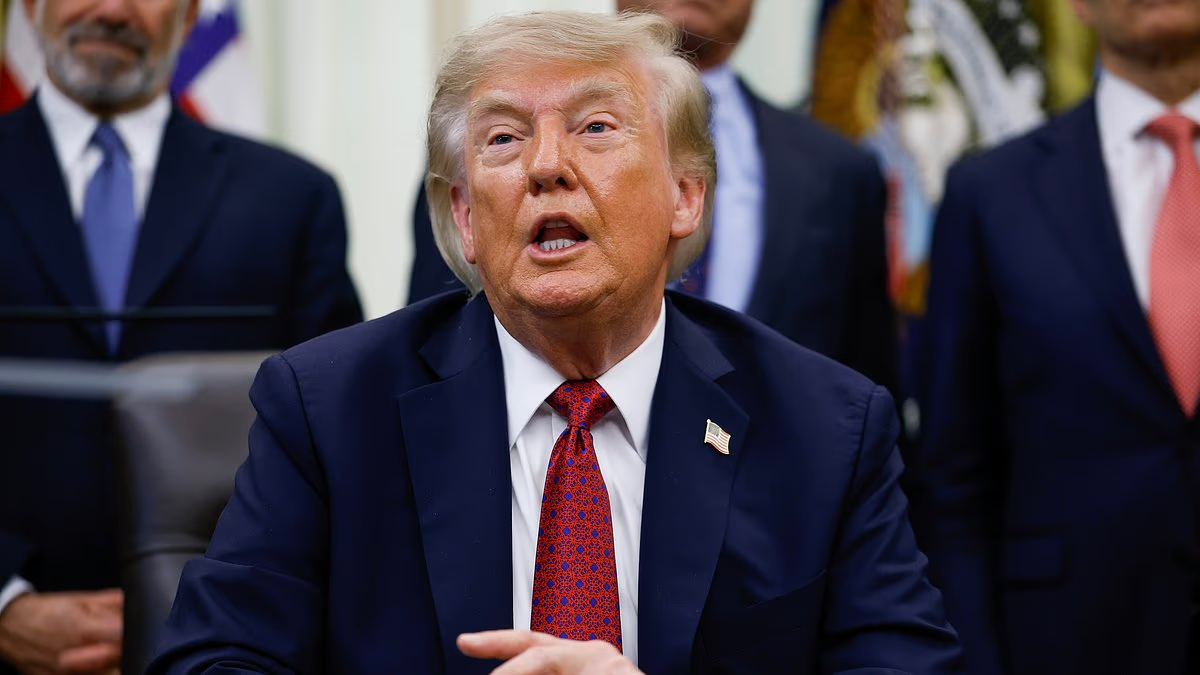
President Donald Trump praised the decision, celebrating the removal of the spending limits as a “big win for Republicans and the First Amendment.”
Republicans had argued that the limits unfairly constrained parties and candidates during elections, while Democrats cautioned that loosening the rules could give wealthy donors more room to exert influence over the political process.
Under the previous system, spending caps could reach as high as $4 million in Senate races and $127,000 in House contests, with the exact limits tied to the voting-age population in the districts involved.
Writing for the majority, Justice Brett Kavanaugh said the coordinated spending limits amounted to a “severe infringement” on political speech protected by the First Amendment.
“To uphold the political-party coordinated-expenditure limits here could therefore help consign political parties to continued second-tier status as compared to outside groups,” Kavanaugh wrote. “Weakened political parties distort the political system.”
‘More speech is generally better than less speech,’ he went on.
The high court heard arguments last year in the case, National Republican Senatorial Committee v Federal Election Commission.
The case centered on whether federal limits on campaign spending by political parties and coordinated expenditure limits run afoul of free speech protections under the First Amendment of the Constitution.

President Donald Trump cheered the ruling taking restrictions off political spending, calling it a ‘big win for Republicans and the First Amendment’

The Supreme Court building in Washington, DC. Justices ruled on a major campaign finance case Tuesday

President Donald Trump addresses the media in Paris
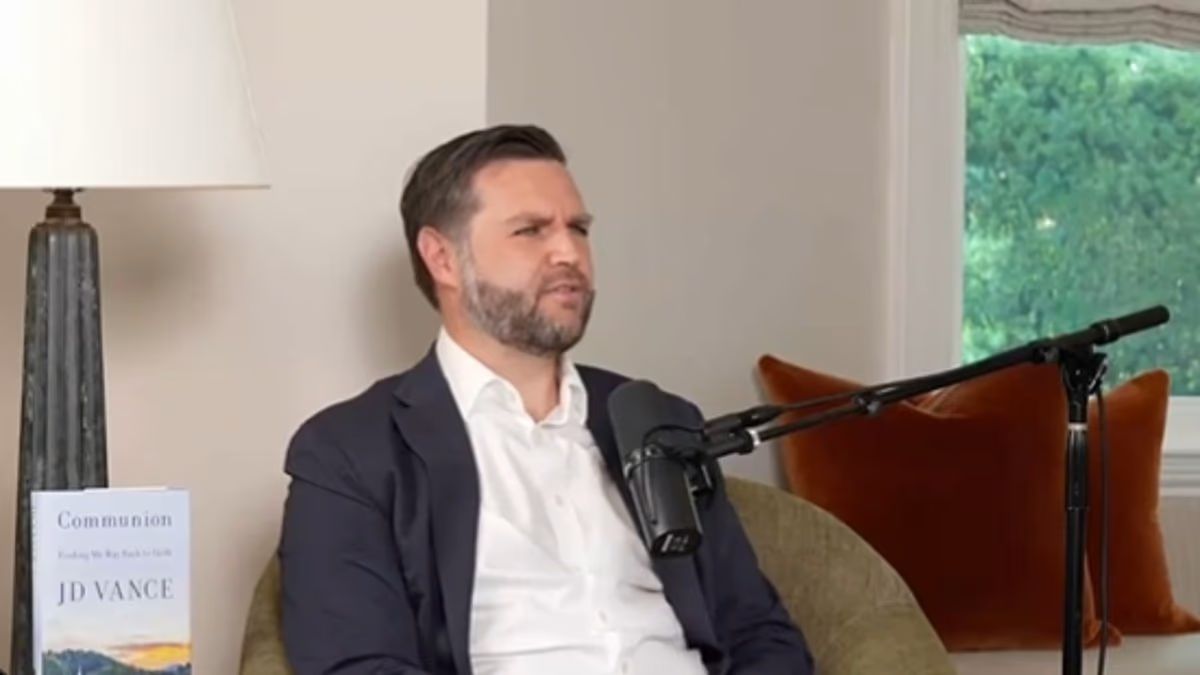
The case was appealed to the high court by the National Republican Senatorial Committee (NRSC), the National Republican Congressional Committee (NRCC), and on behalf of two Senate Republican candidates running for election at the time – among them, now-Vice President JD Vance.
The petitioners had argued in their Supreme Court appeal last year that the campaign spending limits at issue ‘severely restrict political party committees from doing what the First Amendment entitles them to do: fully associate with and advocate for their own candidates for federal office.’
The Republican National Committee welcomed the ‘massive victory’ on Tuesday.
Chairman Joe Gruters said that the RNC is ‘ready to expand’ how it provides resources to candidates heading into November’s midterm elections.
Meanwhile, the Democratic National Committee denounced the decision as a ‘win for billionaire donors and special interests.’
Republicans, generally, receive most of their fundraising from big donors compared to Democrats relying on small dollar donors.
It’s apparent in the large discrepancy between the RNC and DNC fundraising heading into the 2026 midterms. The RNC has $125 million on hand compared to the DNC’s $3.5 million.
The high court’s decision will have widespread implications on campaign spending in the US, further eroding the Federal Election Campaign Act of 1971.
A coalition of Democratic campaign groups vowed last year to combat the effort, which they described as the GOP’s bid to ‘sow chaos and fundamentally upend our campaign finance system, which would return us to the pre-Watergate era of campaign finance.’

Balloons drop at the Republican National Convention in 2024

Supreme Court justices pose for a group portrait in Washington, DC
The ruling comes as federal election spending has reached record highs. Presidential candidates in 2024 raised at least $2 billion, according to FEC figures, and spent roughly $1.8 billion in the campaign cycle.
During oral arguments, two of Trump’s nominees, Justice Neil Gorsuch and Justice Amy Coney Barrett, stayed completely silent or only asked one question, giving little indication as to how the high court might rule.