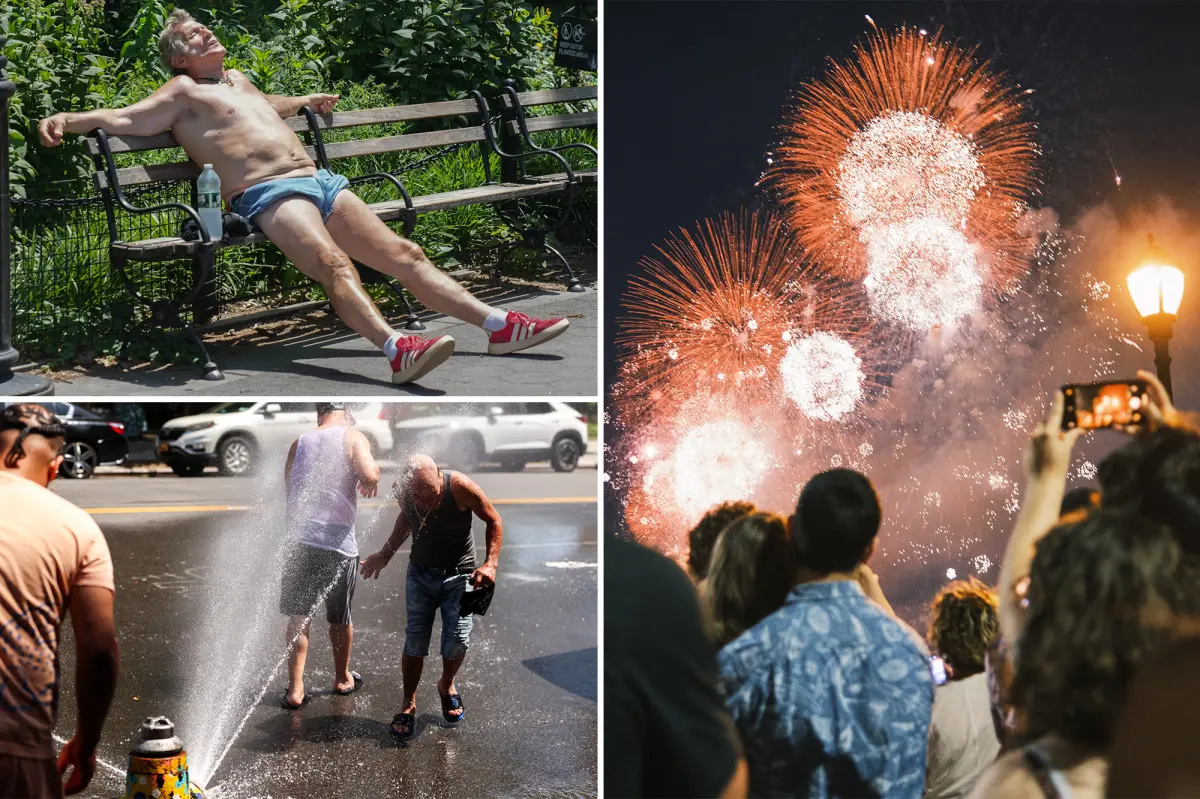

Cities across the United States are preparing some of their largest Fourth of July fireworks celebrations yet to mark America’s 250th birthday on Saturday, including a record-setting Macy’s display in New York City that will launch from two rivers.
However, a powerful heat dome could make conditions less than ideal for spectators in the Big Apple and other cities along the East Coast.
AccuWeather meteorologist Carl Erickson cautioned that humid, moisture-heavy air can interfere with fireworks by scattering and absorbing their light.
“It can make the fireworks look a little less crisp, less vibrant,” he told The Post.
Saturday night in New York is forecast to hover near 80 degrees with humidity around 75%, creating muggy conditions for what is expected to be a major spectacle.
Adding to the challenge, light winds in the forecast could allow smoke and pollution to linger overhead, forming a hazy veil between the fireworks and the crowds watching below.
There is a chance that storms predicted for New York and other northeastern cities could help clear out some of that haze while bringing temperatures down.
“But you still have that humidity,” Erickson noted.
Still, the industry is undaunted as pyrotechnics companies pull out all the stops for the semiquincentennial.
The display in Washington, DC, is expected to set a world record for the biggest ever — with 851,000 shells popping off Saturday night.
“This year every show across the nation [is] going to be bigger, badder, and more elaborate because it’s America’s 250th. This is a special time,” said Julie Heckman, director for the American Pyrotechnics Association.
Display operators spend weeks monitoring the weather and watch the skies minute-by-minute on the day of the show — ready to launch even in pouring rain, she said.
Barring strong wind or lightning, there will be fire in the skies — humidity be damned.
Whatever the weather, this is the year to come out for fireworks, Heckman said.
Big commercial displays took off in 1976 for the last major centennial celebration.
Fifty years later, display companies are bursting to show off the latest in pyrotechnics, like computer-powered choreography, drone integration, and, of course, bigger booms.
As for what they’ll actually look like, modern displays favor pastel colors like pinks, coral, and chartreuse.
“But this Fourth of July, it’s all gonna be red, white, and blue,” Heckman said.