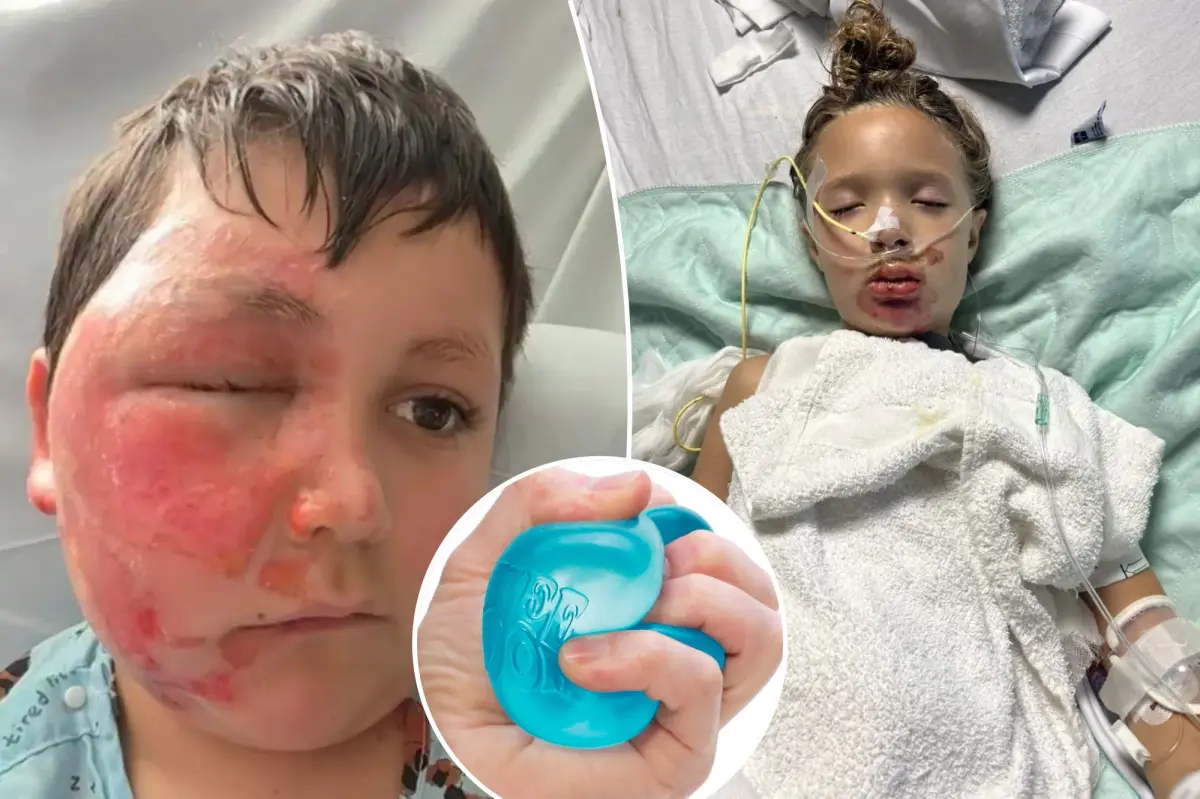

Brightly colored, squishy toys sold around the globe as harmless “sensory” products have become a major hit with children, who squeeze, stretch and mash them for fun.
But physicians are warning that the viral popularity of NeeDoh toys has been accompanied by a troubling rise in serious injuries. Some children and teenagers have been hospitalized with severe burns, with doctors describing intense pain and cases requiring treatments as serious as skin grafts or medically induced comas.
Doctors say the danger can arise when the toys are heated, frozen or placed in a microwave — sometimes as part of a social media challenge, and other times by accident.
NeeDoh products are often filled with a sticky, gel-like substance that can become thick and gluey when exposed to heat. One popular version, the Nice Cube, contains a natural sugar-based filling that expands quickly as it warms, building pressure inside the toy and potentially causing it to rupture.
The manufacturer’s warning is explicit: “Do NOT heat, freeze, or microwave, may cause personal injury.” Still, doctors say children are increasingly encountering online videos and trends that encourage the very behavior the label warns against.
According to Dr. Alicia Webb, a pediatric emergency medicine physician at Children’s of Alabama, the risk is not limited to the toy itself but also includes the social media environment that pushes young users to experiment with it.
“Parents need to be aware of this trend and all dangerous social media challenges because they can pose a serious risk to children, and the children participating are not yet mature enough to recognize the danger for themselves,” Webb told the Post.
Burns are already among the most frequent injuries seen in children, but doctors say these NeeDoh-related cases can be particularly serious because of how the heated filling sticks to skin and behaves once it escapes the toy.
“The hot NeeDoh toys can easily explode, causing burns to the face, eyes, mouth, body, and can even cause internal damage if the hot substance is swallowed,” explained Webb.
Dr. Michael Cooper, director of Burn at Northwell’s Staten Island University Hospital, added that children are especially vulnerable because their skin is thinner and more delicate than adult skin, allowing heat to penetrate more deeply in a shorter amount of time.
“Even a brief contact with a hot substance can cause significant tissue damage,” Cooper said
These warnings are not theoretical.
In Missouri, 7-year-old Scarlett Selby was placed in a medically-induced coma after a NeeDoh toy exploded in a microwave and coated her in molten, sticky substance. The goo clung so tightly to her skin and clothing that her father struggled to remove it without causing further injury.
“It all happened so quickly,” her father told Kennedy News while recounting the harrowing nightmare. “I heard her scream, and it was like a blood-curdling scream.”
She later required a skin graft after doctors treated burns near her mouth and airway.
Similar cases, Webb said, mirror what she is seeing in her own emergency department: “I personally have taken care of several children and teenagers who have been burned while participating in the current NeeDoh microwave trend.”
In the UK, Bella, 10, suffered severe facial burns after a friend attempted a TikTok-inspired freezing and microwaving challenge involving a NeeDoh-style toy, leaving blistering and missing skin.
“She has been referred to the burns unit and told she won’t be able to have her face in the sun for at least 2 summers,” revealed her mother in a Facebook post. “They aren’t sure if it will scar.”
In Chicago, 9-year-old Caleb Chabolla was left with second-degree burns after a microwaved Cube burst across his face, with doctors reportedly needing to remove damaged tissue caused by the hot, molten material. “The right side of his face was kind of melting off, basically,” his mother told ABC 7.
In another case in New Mexico, a 13-year-old girl suffered third-degree burns after a toy left inside a hot car for hours exploded when squeezed, releasing scalding gel onto her arms and legs.
“She jumps out of the car and she’s like screaming at the top of her lungs like, ‘Please momma, get it off,’” her mother told KRQE. “There was people all around. We were trying to get it off and they said don’t take it off because it will rip her skin off.”
For Webb, these horrific incidences underscore a consistent pattern: Children encountering the toys in altered states — heated, frozen or left in extreme conditions — and then handling them as if they were still safe.
She warned that these burns can cause lifelong complications, such as scarring, damage to eyesight and even permanent disfigurement. Treatment often requires specialized burn care, multiple procedures, and skin grafts, with some children left with lasting injuries even after recovery.
Cooper said the consequences can extend even further. Because children have a smaller body surface area, burns that may appear limited can lead to infection, dehydration, impaired mobility and reconstructive surgery.
“Burn injuries can also have long-term psychological and cosmetic effects that may last well beyond the initial recovery period,” he noted.
Webb says the most urgent issue is prevention, particularly through parental awareness and conversation. She also warned that exposure to these challenges does not require social media use, as trends often spread through peers at school and other offline encounters.
“Social media challenges may seem fun and harmless when many times they are actually quite dangerous,” she said.
“Talk to your children about the videos they are viewing online and remind them that these videos often don’t show the whole truth and may misrepresent any consequences that can occur.”
Cooper echoed that advice, urging parents to prohibit children from microwaving or heating NeeDoh toys or similar sensory products, avoid leaving them inside hot vehicles and routinely inspect them for cracks, leaks or signs of damage. He also recommended reminding children that products designed for play should only be used as intended.
If a child is burned, he advised immediately chilling the area under cool running water for about 20 minutes and seeking medical attention if the burn is significant, involves blistering, affects the face, hands, feet, or genitals, or covers a large area.
“A moment of curiosity or experimentation can lead to injuries that require months of treatment and recovery,” Cooper warned. “Awareness, supervision, and education remain our best tools for preventing these entirely avoidable burn injuries.”
The Post has reached out to Schylling, the a Massachusetts-based toy company that manufactures and owns NeeDoh, for comment.