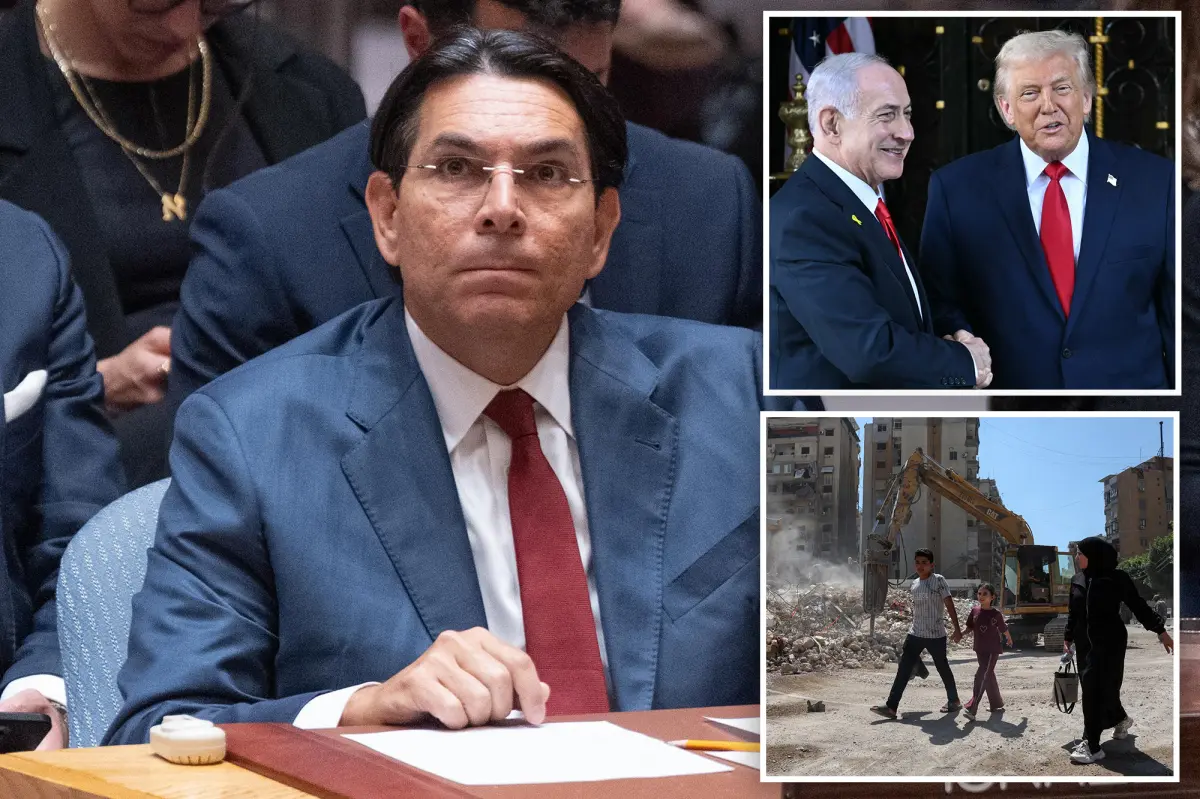

President Trump’s push to reorder Middle East diplomacy may yet produce one of his most unlikely foreign-policy victories: drawing Lebanon into the Abraham Accords after generations of enmity with Israel.
Danny Danon, Israel’s ambassador to the United Nations, told The Post that if Beirut can force Hezbollah out of southern Lebanon and restore state authority across its own territory, formal ties with Israel may no longer be unimaginable.
“I think it can be dramatic,” Danon said when asked how the region might change if Lebanon were free of Hezbollah’s grip. “We will be very happy to see normalization — even seeing them joining the Abraham Accords.”
If achieved, the move would represent one of the most significant enlargements of the Trump-brokered agreements since their 2020 signing, further widening Israel’s diplomatic acceptance among Arab nations and altering the region’s balance of partnerships.
That ambition fits into a wider Trump administration strategy aimed at helping Lebanon regain full sovereignty by ending Hezbollah’s armed dominance in the south, a US official told The Post this week.
“The Trump Administration is working to achieve a sovereign Lebanon that isn’t being threatened internally by Hezbollah, and Hezbollah cannot use southern Lebanon to pose a threat to neighbors,” the official said.
Secretary of State Marco Rubio and Vice President JD Vance have each held senior-level calls with Israeli Prime Minister Benjamin Netanyahu and Lebanese President Joseph Aoun as Washington works to move the agreement toward completion.
According to the US official, one major area of consensus in the talks was that Israel and Lebanon both viewed Tehran’s influence as a shared concern.
“Even when Lebanon and Israel were disagreeing on everything, they agreed they didn’t want Iran meddling in their affairs,” the official said.
But Danon cautioned that Lebanon still faces enormous obstacles before any such agreement could become reality.
“It will take time,” he said. “It’s much more complicated in Lebanon when you have the involvement of Hezbollah in parliament and in other parts of government.”
The US official echoed that assessment, stressing that Hezbollah remains deeply embedded throughout Lebanon’s political and security institutions, saying: “nobody is under any illusion that it’s going to be easy.”
Israel has already done much of the heavy lifting militarily by weakening both Hezbollah — notably with the infamous pager explosions of 2024 — and its Iranian backers, creating a rare opportunity for Lebanon’s government to reclaim control over territory long dominated by the terrorist group.
“We weakened Hezbollah dramatically. We weakened the sponsor of Hezbollah, Iran,” Danon said. “I think now it’s a good time for the Lebanese to take action.”
The ambassador said Israel has recently begun the first stages of withdrawing from portions of southern Lebanon under a new security arrangement, with the expectation that the US-backed Lebanese Armed Forces will move in to replace Israeli troops.
But the withdrawal will be deliberately gradual, with Washington warning that rushing the process could allow Hezbollah to quickly return.
Israel, Danon stressed, has no interest in occupying Lebanon permanently.
“We don’t have a desire to stay in Lebanon,” he said. “We want the Lebanese military to be there.”
The ambassador praised Lebanon’s new leadership for publicly committing to curb Hezbollah’s influence but said words alone won’t be enough.
“We’re now starting to test the gap between intention and capability,” Danon said. “They have to prove not only intentions but also capabilities.”
The Abraham Accords were brokered during the first Trump administration in 2020 to establish direct relations between Israel and several nations, including the UAE and Bahrain. The accords help set up normal diplomatic, trade, travel, and economic relations between Israel and countries that previously didn’t do business with the Jewish state due to conflict with Palestinians.
For the Trump administration, a stable Lebanon no longer controlled by Hezbollah would represent another major setback for Iran’s regional influence while potentially opening the door to expanding one of the president’s signature foreign policy achievements.
Danon acknowledged that scenario remains a long way off, warning that Iran still wields significant influence inside Lebanon.
“Iran…they feel that they own the country,” he said. “It’s not easy. It requires efforts and determination.”
Iran’s actions in the war targeting Gulf states have also driven up the possibility that other nations in the region could sign onto the Abraham Accords, Danon said.
“It strengthened the relationship we already had with countries like the UAE and Bahrain and other countries,” he said. “It’s one thing to speak about the Iranian threat, but once they are being attacked by ballistic missiles and drones, it’s much more realistic.”