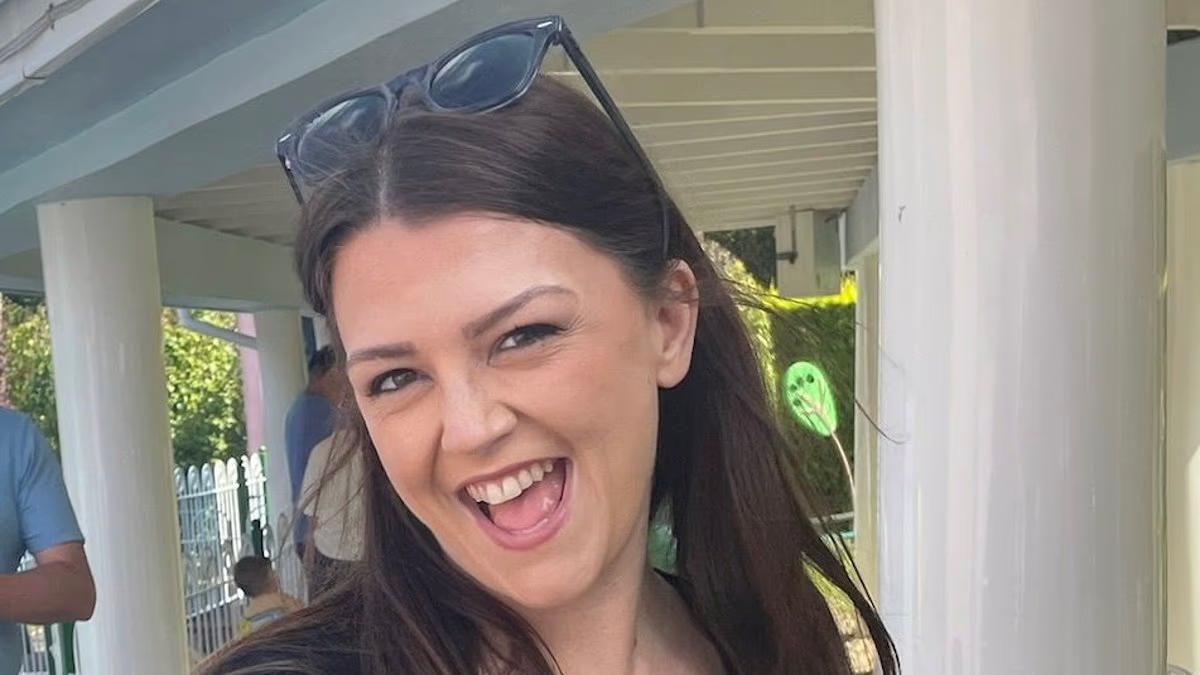

When Laura Jackson first started feeling unusually exhausted, she assumed it was simply the reality of life as a working mother with two very young children.
At 38, Laura was caring for a one-year-old and a three-year-old, both of whom, she says, regularly disrupted her sleep through the night.
But her tiredness took on a new significance last year, when she arrived for a routine blood donation.
Laura has the rare A-negative blood type and is a regular donor, making the appointment nothing out of the ordinary.
So it came as a shock when staff told her she could not give blood that day. A nurse explained that her iron levels were significantly lower than they should be.
Iron deficiency affects about one in ten women in Britain and is most often linked to heavy periods, which helps explain why it is more frequently seen in women under 50.
Iron is an essential nutrient that helps transport oxygen around the body. When levels fall too low, people may develop symptoms such as shortness of breath, heart palpitations and ongoing fatigue — the very problem Laura had been trying to explain away.
In many cases, iron deficiency can be treated straightforwardly, most commonly with daily iron supplement tablets.
However, after visiting her GP about the problem, he asked to run one more test on her – something called a faecal immunochemical test, or FIT. It was this test that saved Laura’s life.
The at-home stool test detects tiny, invisible traces of blood in the poo – a telltale sign of cancer.

When Laura Jackson first began to experience bouts of tiredness, she put it down to being a working mum with two babies

Laura was told she had stage three bowel cancer – a form of the deadly disease that has begun to spread throughout the body
And when the test came back, Laura’s GP told her the blood levels were off the charts.
Laura was immediately referred for hospital scans, which confirmed her GP’s worst fears.
She was told she had stage three bowel cancer – a form of the deadly disease that has begun to spread throughout the body.
Laura, from Southampton, says the news terrified her.
‘The first thing I thought was “am I going to die?”’ she says. ‘I thought “oh my gosh I’ve got two babies at home, I’ve got to be there for them”.
‘My husband was there with me trying to stay strong but he was crying as well.’
She also says she was shocked because she had few, if any, symptoms.
‘In that time the only thing I really felt was tiredness,’ she says. ‘I was a working mum, only 38 and had a one and three-year-old that were still up in the night.
‘Any tiredness I just disregarded.
‘I never thought, “oh this is cancer” or that it was anything serious.’
Laura is far from alone. Research shows that, in recent decades, the number of young people developing deadly bowel cancer has risen significantly.
Studies show that cases of early-age bowel cancer – where it occurs before the age of 50 – are rapidly rising in most parts of the world.
In Britain, those under 49 today are around 50 per cent more likely to develop bowel cancer than people of the same age in the early 1990s.
In March, Married at First Sight star Mel Schilling passed away from bowel cancer at the age of 54.

In March, Married at First Sight star Mel Schilling passed away from bowel cancer at the age of 54

British broadcaster, journalist and campaigner Dame Deborah James passed away in 2022 at the age of 40. She was diagnosed with bowel cancer at 35

Laura says the pain she experienced after surgery was ‘up there with childbirth’. She then had to go through 12 weeks of chemotherapy.
British broadcaster, journalist and campaigner Dame Deborah James passed away in 2022 at the age of 40. She was diagnosed with bowel cancer at 35.
Despite this, experts say that many patients are unaware that low iron levels are an early sign of bowel cancer.
Studies show the most accurate way to measure iron levels is a ferritin test – which assesses the amount of iron stored in the body, rather than the levels in the blood.
‘Often, low ferritin in women is assumed to be due to heavy periods,’ says Dr Philippa Kaye, a GP who was diagnosed with bowel cancer at the age of 39.
‘But it can also be a sign of bowel cancer – especially if you have regular periods or no periods at all.
‘If you are a woman with low ferritin levels, it’s always worth speaking to your GP about getting a FIT test.’
In July last year, Laura underwent surgery to have the tumour and part of her bowel removed.
She says the pain she experienced after surgery was ‘up there with childbirth’. She then had to go through 12 weeks of chemotherapy.
Today, she is cancer-free – though she will need to undergo regular scans for the next five years.
She says she now wants more people to take up the offer of a FIT test. The test is available to anyone who develops bowel cancer symptoms, which also include blood in the poo, changes in bowel habits, stomach pain and unexplained weight loss.
It is also offered on the NHS every two years to those aged between 50 and 74 to screen for the disease.
‘I want to raise awareness of the FIT test,’ says Laura. ‘It would have been left and would have spread if I’d not had it done.
‘My GP saved my life’.