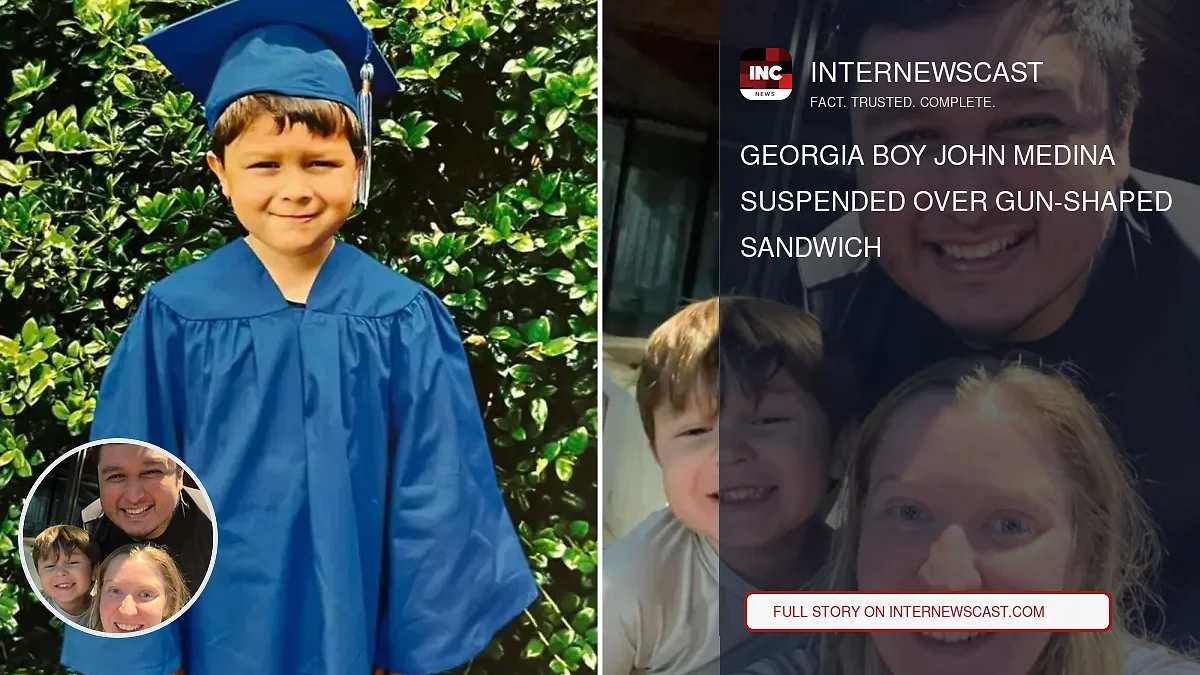

The parents of a Georgia first-grader with autism are raising concerns after their 6-year-old son was suspended for biting a sandwich into what school officials viewed as the shape of a gun and pointing it toward a classmate at lunch. They say the punishment reflects a rigid disciplinary approach that does not adequately consider his developmental disabilities.
John Medina, a student at Sarah Harp Elementary School in Fayette County, south of Atlanta, was suspended last March while he was in first grade.
John was diagnosed with level 1 autism at age 4 and was later diagnosed with ADHD. His parents say those conditions can affect his ability to read social cues and understand rules that may seem obvious to other children.
Speaking with Fox News Digital, Kristin and Juan “Ricky” Medina described their son as academically gifted but said the school’s strict discipline policies, combined with what they characterized as an initial lack of developmental support, have resulted in about 15 suspensions and more than two dozen disciplinary incidents since 2023.
The Medinas said they understand that some situations may require intervention. But they argue that other behavior, including hunting-themed drawings and finger-gun gestures, has been treated as grounds for discipline and heightened scrutiny despite being harmless in context.
Over time, they said, the repeated discipline has damaged John’s confidence. His parents noted that he already has difficulty making friends and often feels socially isolated.
According to his parents, John has begun calling himself a “bad kid,” a phrase they believe reflects how he feels he is perceived by classmates and within the school environment.
Kristin said she was stunned when she learned her son had been suspended over the sandwich episode. She also questioned what she described as the school’s “strike” system, saying minor behavior such as making a hand gesture or saying the word “gun” can build toward suspension.
“It was upsetting for me to hear that it was, that is what he was getting in trouble for,” Kristin said.
“I felt like they were cracking down more on small stuff, you know, stuff that maybe he didn’t need to be suspended for,” Ricky added.
While John has been involved in physical incidents, including pushing another student in PE and hitting a classmate with a branch, his parents said many official disciplinary actions stemmed from what they considered harmless hand gestures.
Other standard behaviors, like drawing a pilgrim shooting a turkey for Thanksgiving, also drew intense school scrutiny, they said.
They added that weapon-related topics are specifically not discussed in their home, but said they cannot control the outside influences John encounters.
They added that children can naturally develop an imaginative fascination with weapons, but John’s autism makes it more difficult for him to filter his speech in the way other children might.
They also stressed that, because of his autism, traditional punishments are ineffective and could inadvertently reinforce the idea that saying the word “gun” will allow him to leave school when he is having a bad day.
“Instead of singling him out, just make it a teachable moment for him. Teach, ‘Hey, we don’t do this in school because of this reason, it’s not appropriate,’” Kristin said.
However, the family said they initially faced pushback from the school over developmental accommodations.

Kristin said the school initially refused to grant John an Individualized Education Program (IEP), because he was too academically advanced and officials “didn’t see” his autism.
According to Kristin, it took about a year and a half, 10 to 12 suspensions and a second evaluation that resulted in an ADHD diagnosis before the school approved his IEP.
John’s parents said they worry that repeatedly focusing on what they consider harmless childhood behavior has reinforced a negative self-image and made him increasingly eager to leave school.
John is hesitant to attend school because he believes people are “going to laugh at him for making wrong choices,” his parents said.
“I just want to see John start to get his self-esteem built up, his confidence built up, friendships built up,” Kristin said. “I don’t want him to continue to feel singled out.”
The parents said John thankfully finished the previous school year strong, reading at a third-grade level and coming just four test points short of qualifying for the gifted and talented program.
The school also appeared to ease up on suspensions recently, particularly after the family hired Donna Reynolds, a special education advocate, to represent them during school meetings.
John is also currently on a behavioral plan that includes an aide during unstructured periods, including lunch, recess and PE. He also spends time in a smaller, calmer classroom setting, where his parents said he performs exceptionally well.
“What I want to see is that there’s less severe punishment like suspensions,” Ricky said. “And just continue to talk through things so you can have opportunities to learn from things and maybe focus on real serious concerns.”
Fox News Digital reached out to Fayette County Public Schools, the school district under which John’s school falls, about his situation.
The district declined to go into specific details, but encouraged a review of John’s “complete disciplinary history and the full context surrounding the situation rather than focusing on one isolated event.”