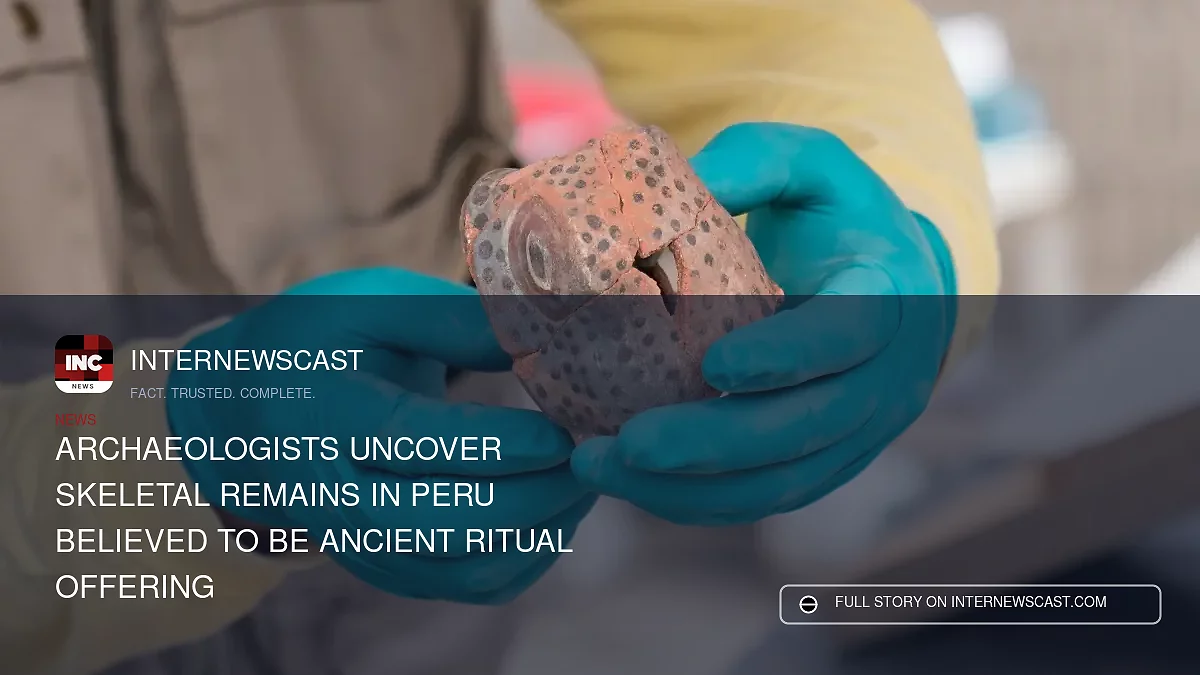

LIMA, Peru — Archaeologists in Peru have presented newly uncovered human skeletal remains found near the foot of Huaca Pucllana, the ancient adobe pyramid that rises from the heart of modern-day Lima.
Researchers believe the bones belonged to an adult man who may have been placed there as a ritual offering, possibly during a ceremony marking the closure of a canal connected to a ceremonial pool.
Gladys Paz, the archaeologist directing the excavation, said the discovery could offer valuable clues about “the rituals of the Lima culture” and help specialists piece together sacred practices carried out centuries ago.
According to Paz, the body had been laid inside the canal on its left side, with the skull oriented toward both the pyramid and the Pacific Ocean — a placement that may have held symbolic meaning.
The Lima culture developed along Peru’s dry central coastline between the first and seventh centuries, roughly 700 years before the Inca Empire emerged as a dominant power in the Andes.
Huaca Pucllana served as a major ceremonial and administrative hub for the Lima people, whose society had vanished long before Spanish conquistadors established the city of Lima in 1535.
Today, the pre-Inca pyramid stands in striking contrast to its urban surroundings, bordered by parks, tree-lined avenues and luxury apartment buildings in the Miraflores and San Isidro districts.
Now a popular Lima archaeological attraction, Huaca Pucllana welcomes visitors and features a restaurant known for Peruvian dishes such as ceviche, lomo saltado and roasted alpaca meat.
According to Peru’s government, there are more than 400 archaeological sites across metropolitan Lima.
Pieter Van Dalen, an archaeology professor at the National University of San Marcos who was not involved in the excavation, said that it’s common to find tombs, mummified remains, and other burial-related items along Peru’s coast.
Such discoveries have also been made while construction workers dig canals to install gas pipes.


