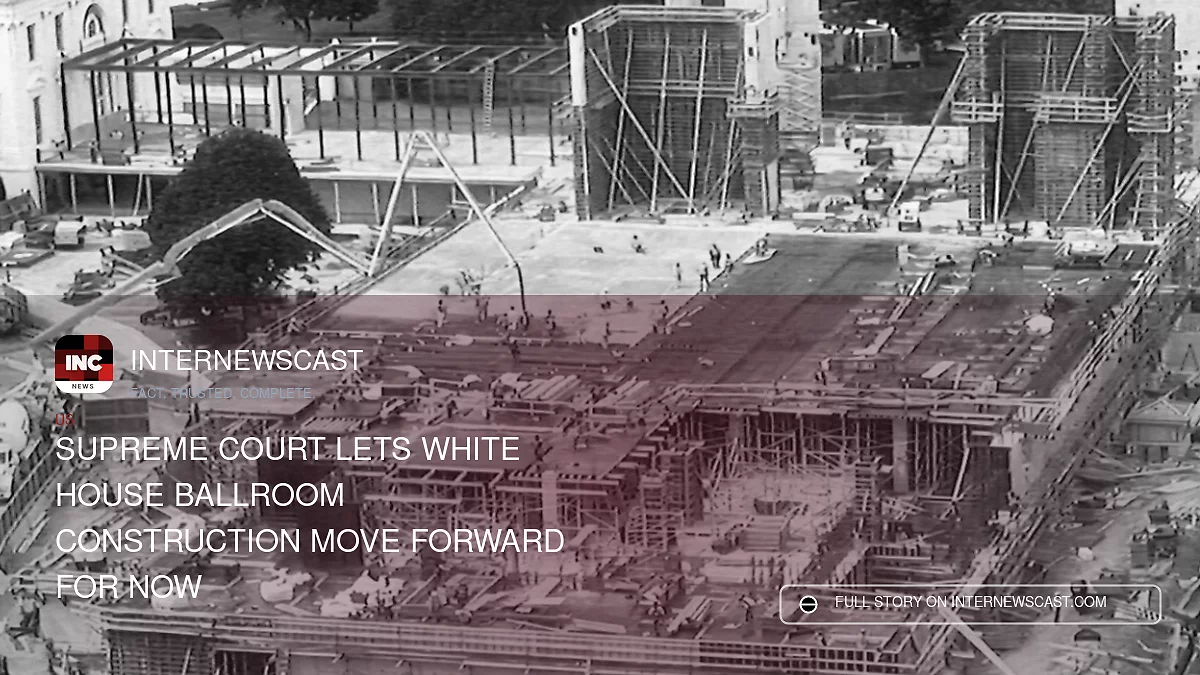

Washington — The Supreme Court on Friday cleared the way, at least temporarily, for construction to continue on the White House ballroom, putting on hold a lower court ruling that would have stopped above-ground work on the project.
Chief Justice John Roberts issued a stay that will remain in effect until the Supreme Court takes further action. The temporary order gives the justices more time to review the Justice Department’s request to freeze a district court injunction that was scheduled to take effect at midnight without intervention from the high court.
The Trump administration asked the high court last week to step in and permit work to proceed on the planned 90,000-square-foot ballroom.
President Trump reacted Friday on Truth Social, writing that he was “grateful for the Decision.” In another post Saturday, he said “tremendous work has been done on the magnificent BALLROOM/MILITARY COMPLEX being built on the grounds of the White House!”
“Presidents have wanted this for 150 years, and so has everyone else. It will give the White House, and all of D.C., Great National Security,” he wrote, alongside a photo of the construction site. “The Project is under budget, and ahead of schedule! The Ballroom will be paid for with ZERO Dollars of Taxpayer Money. Great American Patriots and Companies are footing the entire bill.”
Roberts’ order followed a ruling earlier this month from a divided federal appeals court, which concluded that Congress — not President Trump or the White House — holds “full constitutional control over federal property and the funding of its maintenance and development.” The court also pointed to an “absence of any express or implied authorization” allowing Mr. Trump to build the $400 million ballroom.
The U.S. Court of Appeals for the District of Columbia Circuit upheld the injunction issued earlier this year by the district court, which would have blocked construction on the White House ballroom. But the appeals court delayed the effect of its own ruling for 14 days, through Friday, giving the Justice Department time to ask the Supreme Court for relief.
In a filing with the court, Solicitor General D. John Sauer urged the justices to pause the lower court decision barring above-ground construction while litigation over the project continues. Other parts of the renovation, including an underground bunker, medical facilities and additional features, have been allowed by judges to move forward.
“This case involves an extraordinary and unlawful injunction that will halt the ongoing construction of the integrated military complex, including a totally secure ballroom space, at the East Wing of the White House, which is vitally required by national security,” Sauer wrote.
Mr. Trump has reiterated that concern, arguing that construction must continue because it is “vital” to his safety and the safety of future presidents, and American national security, especially in light of recent foiled assassination plots against him. In a Truth Social post earlier this month, Mr. Trump called the National Trust for Historic Preservation “TREASONISTS” and alleged without evidence that they “revealed Top Military Secrets!”
But Mr. Trump has often conflated the ongoing construction of a new presidential security bunker that is being built underneath the proposed ballroom and the construction of the ballroom itself. As the legal challenge has played out in lower courts, all below-ground construction on national security facilities has continued, and only above-ground work on the physical construction of the ballroom is at issue.
“The lower section does not work without the upper section and, likewise, the upper section does not work without the lower. It is all one highly integrated unit,” Mr. Trump wrote in the same Truth Social post criticizing the Trust. He later added in the same message that the lawsuit “is this kind of gross and flagrant abuse of our Courts that is exactly why Americans are losing faith in our System of Justice.”
The administration has warned the Supreme Court that work on the ballroom is too far along to stop. The White House official managing the project, Joshua Fisher, said in a declaration submitted to the justices that even if a court ordered the building to be taken down or altered, “there would be no way to do so.” And Sauer wrote in the filing with the high court that the “stop-work mandate” from the district court is “impossible.”
Lower court stays, which have allowed ongoing work on the ballroom, have pushed construction “beyond the point of return,” he said.
In response, the National Trust for Historic Preservation has accused the Trump administration of trying to “outrun judicial review.” While the case was before the D.C. Circuit, the White House “accelerated construction” with a 250-person crew working 20 hours a day, seven days a week, they wrote.
Mr. Trump has claimed to have raised most of the $400 million he says he needs to complete the project through donations from private donors and major corporations like Lockheed Martin, Amazon and Microsoft.
U.S. District Judge Richard Leon, the judge who is overseeing the legal challenge to the project, found that the Trump administration’s means of funding the project — in which donations were collected through a nonprofit organization, transferred first to the National Park Service and then to a fund used for typical White House maintenance and repairs — was unlawful.
Construction on the ballroom project began in October following demolition of the East Wing. The National Trust for Historic Preservation filed its lawsuit to halt ballroom construction in December, arguing the work is unlawful.
Leon issued his preliminary injunction that would block construction in March and clarified in April that work on the below-ground, national security facilities was not covered by his order.
The D.C. Circuit then ruled in favor of the Trust in a 2-1 decision, finding that the White House could not build the ballroom without authorization from Congress.


