When I served as transport minister in Tony Blair’s government, civil servants put me through an intensive rehearsal before I faced the formidable Gwyneth Dunwoody, then chairwoman of the House of Commons Transport Select Committee.
As part of that preparation, I was given a VHS tape to watch at home. It showed a Labour Treasury minister being questioned by MPs.
It was car-crash television: painful and embarrassing to watch, while also provoking sympathy for a minister who was plainly out of his depth and knew it. His response was to deliver one empty soundbite after another.
That was a different era. If ministers today need an example of what not to do when appearing before a committee of their peers, they have just been given a more contemporary lesson by Stephen Flynn, the SNP transport minister.
‘Car crash’ might not be the most fitting description. ‘Ferry collision’ could be closer.
The man John Swinney has entrusted with tackling Scotland’s transport problems was unaware of a potentially lethal incident aboard the ill-fated Glen Sannox last year. The ferry was carrying 82 passengers from Arran to the mainland when 700kg of highly flammable methane gas was accidentally released into the atmosphere.

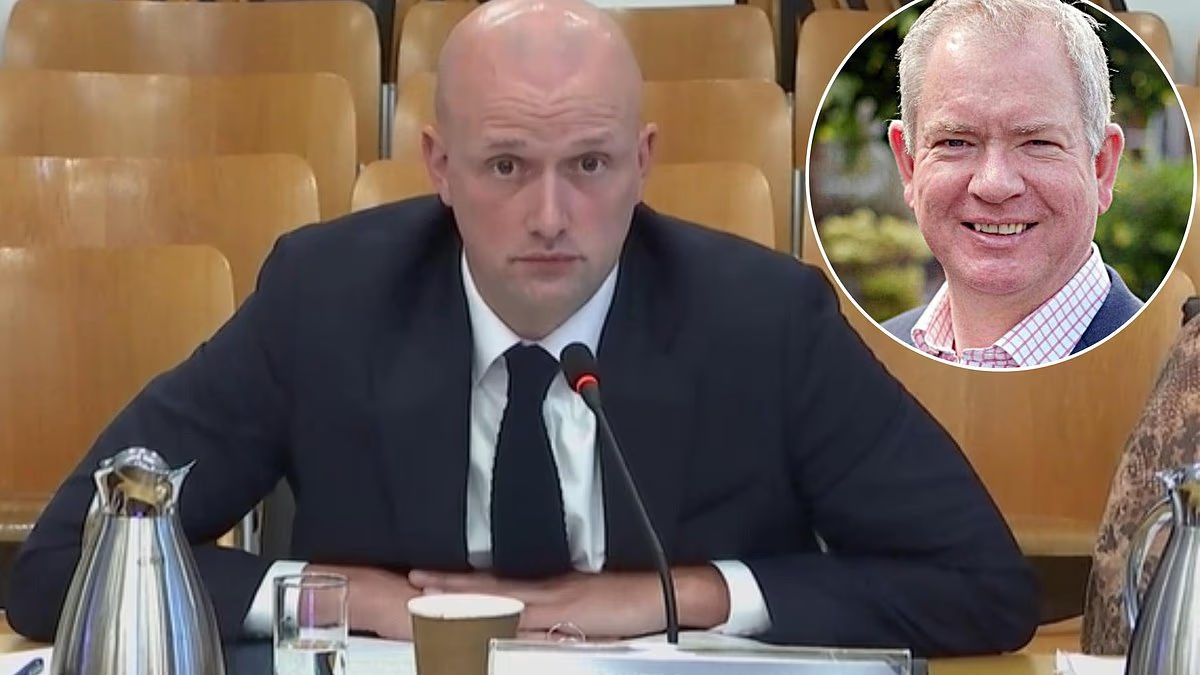
Transport Secretary Stephen Flynn was unaware of a potentially dangerous gas leak on the ferry, even though the incident had featured on that morning’s BBC news
Mr Flynn’s performance before Holyrood’s transport committee, chaired by Liberal Democrat MSP Willie Rennie, was difficult to watch. He appeared to be floundering for answers, like a dying guppy gasping for air as it struggled on the floor of a fishing vessel.
Mr Flynn, who entered Holyrood in May’s elections after nine years at Westminster, said he knew nothing about the incident described by Mr Rennie, despite the story having appeared on that morning’s BBC news bulletins.
‘You’re just finding out today when something happened last year?’ asked an incredulous Mr Rennie. ‘Were you not given a briefing over the summer that this incident had happened?’
‘Well, I wasn’t here last year,’ Mr Flynn replied, apparently hoping the explanation would buy him a few moments of breathing space. It did not.
‘But over the summer,’ the chairman pressed. ‘Were you not briefed over the summer?’
And then the pitiful floundering began. ‘It may well be the case that as part of the… the wide array of information that is shared with me in respect of ferry issues, that something that happened prior to my entering parliament and taking on a government position may have been conveyed to me as part of that, and I would not want to mislead the committee.
‘But the specific news story to… to which… to which you’re referring is one that I would have to go and familiarise myself with.
‘I wasn’t… I wasn’t listening or watching the BBC this morning.’
The civil service in Scotland is packed with highly paid press officers whose job is to monitor each day’s news bulletins and to alert their ministers whenever something relevant to their portfolio kicks off. The notion that the transport minister, especially one scheduled to answer questions in front of the transport committee that day, would not be alerted to such a damaging story, is risible.
And yet Mr Flynn clearly didn’t know about the incident. You could see it in his eyes. This was not a man holding his cards close to his chest; this was a man desperately trying to remember where he had placed the deck.
We may never know what recriminations followed his appearance, but we may safely assume that, as the nation chortled at such an entertaining display of ministerial incompetence, a frank exchange of views took place between Mr Flynn and his civil servants.
Mr Flynn could hardly have asked for a worse start to the journey he hopes will take him to Bute House itself. The Aberdeen Deeside and North Kincardine MSP has never hidden his ambition to lead his party and his country.
Westminster may have been a larger pool in which he was a relatively small fish, but it provided him with the platform to burnish his leadership credentials among SNP members and colleagues.
His period as the SNP’s Westminster leader confirmed his ability to produce effective one-liners in the Commons, but it couldn’t provide the one thing he craved more: a ministerial job that could serve as a stepping stone to the First Minister’s job.
He has that now, but it came at a price. Audrey Nicoll, a former detective sergeant who specialised in counter terrorism, and the previous SNP incumbent for the seat Mr Flynn now holds, was contacted by Mr Flynn before the last Holyrood elections and told that he planned to challenge her for the SNP nomination.
‘I was sitting in my kitchen proofreading my application to stand again at the next election,’ Nicoll says. ‘I’m not going to rehearse what Stephen said, but it was short and to the point.
‘He expressed his intention that he was planning to go for my seat in Holyrood.
‘Naively, I never saw it coming,’ she added. ‘I never had a clue. I was completely blindsided. I was confused and unsettled. I started to think, is this really where we are going to go as a party? That really concerned me. It still does.’
Ultimately, Ms Nicoll chose to stand down rather than fight what would almost certainly have descended into a bitter selection battle, and Mr Flynn emerged as the SNP’s candidate.
His ruthless pursuit of power can hardly be denied. In November 2022, he insisted he had no intention of challenging the then SNP Westminster leader, Ian Blackford. A month later, the position was his.
And now his sights are most definitely set on John Swinney’s job. But could the Transport Secretary finally have met his match in John Swinney? The First Minister is rumoured to have played a blinder by offering his ambitious rival one of the most politically challenging portfolios at Holyrood.
One SNP insider said: ‘Civil servants are tearing their hair out with Flynn. He’s not across his brief.
‘It’s an open question what Swinney was thinking when giving Flynn such a difficult portfolio. But the suspicion is he is trying to bury him.’ Few politicians have proved up to the job of improving – or even managing – Scotland’s transport mix.
One of Mr Flynn’s predecessors as Transport Minister, Humza Yousaf, did finally make it to Bute House (for a while anyway), but that was only after being stopped by police for driving without insurance and an entertainingly slapstick incident that saw him crash a scooter in a corridor inside Holyrood.
If even those incidents couldn’t stop Mr Yousaf from reaching Bute House, perhaps this week’s humiliating revelation that he is not on top of his brief will provide no obstacle for Mr Flynn either.
But perhaps it should.
- Tom Harris is a former Scottish Labour MP and Transport Minister.