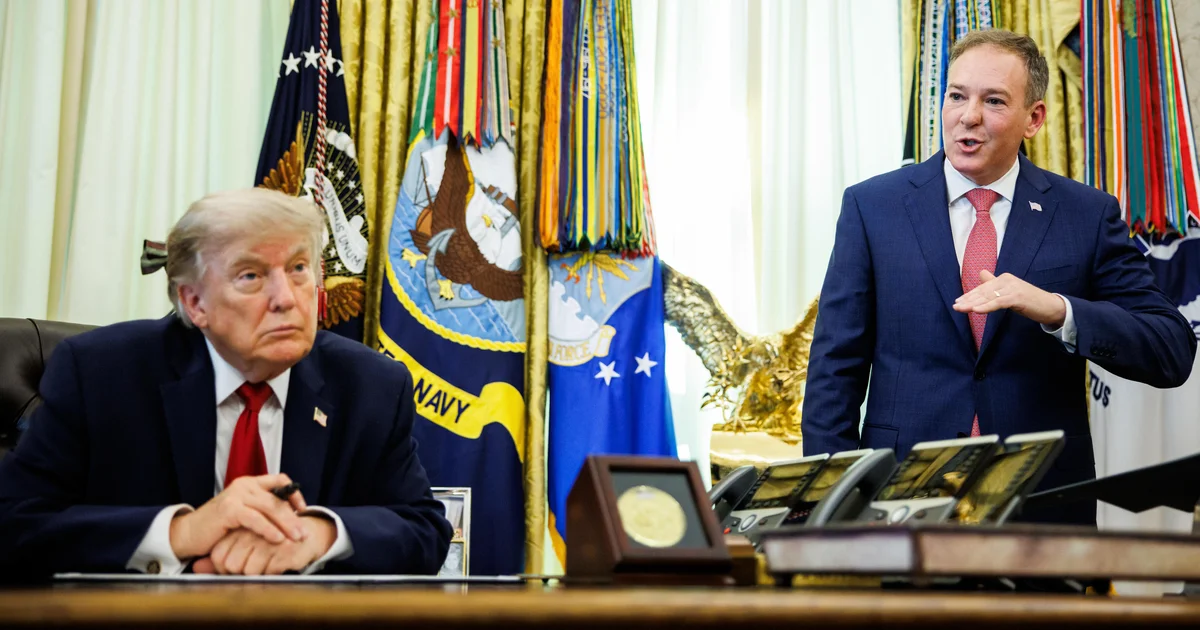

The Environmental Protection Agency on Monday scrapped regulations designed to curb planet-warming greenhouse gas emissions from coal- and natural-gas-fired power plants. EPA Administrator Lee Zeldin has argued that eliminating the standards will save the energy industry billions of dollars and help “unleash” American energy production.
The reversal marks a sharp departure from climate and pollution-control policies pursued by Democratic presidents Joe Biden and Barack Obama. Those efforts focused in part on reducing industrial pollution in low-income neighborhoods and communities with large Black and Hispanic populations.
In announcing the move, the EPA said it was eliminating most of the Biden administration’s 2024 Carbon Pollution Standards for power plants. The agency maintained that the greenhouse gas requirements exceeded the authority granted under the Clean Air Act.
The agency also projected that coal output for use by the electric power sector could grow more than tenfold under the policy shift.
The EPA said last year that it planned to determine that greenhouse gas emissions from fossil-fuel power plants “do not contribute significantly to dangerous air pollution.” But agency data from 2023 showed that power generation accounted for 31% of carbon emissions from fossil fuels, making it the second-largest contributing industry.
More than a dozen environmental and public-health organizations have filed lawsuits against Zeldin and the EPA, challenging the rollback of major measures adopted by U.S. administrations over nearly two decades to reduce pollution from fossil fuels.
Zeldin is announcing the change alongside Interior Secretary Doug Burgum and Energy Secretary Chris Wright at a G20 ministerial meeting on “energy abundance” in Houston. Holding the event in Texas highlights the oil-rich state’s central role in the energy economy, while also signaling a potential rebuke to European and other international partners who have continued advancing climate-focused policies the Trump administration is seeking to reverse.
At a United Nations address last year, Republican President Trump described climate change as “the greatest con job ever perpetrated on the world.” His administration also pulled the United States out of the 2015 Paris climate agreement for a second time. The accord sets voluntary targets for reducing planet-warming emissions.
Trump has repeatedly promoted America’s energy abundance, even as the war in Iran continues to unsettle global fuel markets. Gasoline prices have climbed above $4.31 per gallon, more than $1 higher than they were a year ago.
The New York Times first reported the administration’s plan to finalize the power plant rollback.
The administration says the changes will deliver on Trump’s promise to “unleash American energy” while giving electric utilities more flexibility to provide power to homes and businesses.
The power plant standards are part of nearly three dozen environmental rules Zeldin singled out in early 2025, during what he called the “most consequential day of deregulation in American history.”
When he proposed the changes last year, Zeldin said they would bring an end to what he characterized as the Biden and Obama administrations’ “war on so much of our U.S. domestic energy supply.”
Environmental advocates and public-health groups condemned the decision, warning that they would challenge the revised rules in court.
“Tearing down our national protections against climate pollution from power plants will have enormous costs for the health, safety and well-being of families across the country,” said Vickie Patton, general counsel of the Environmental Defense Fund. “Americans everywhere are already suffering from record-breaking heat, more dangerous floods and storms, and skyrocketing insurance costs.”
The EPA has a legal responsibility to protect the public from harmful pollution, Patton said, adding that “clean, affordable and reliable technologies are widely available to power our homes and businesses.”
Coal, gas and oil-fired power plants are responsible for about one-quarter of the nation’s total climate pollution, second only to the transportation sector. Pollution from power plants is one of the largest sources of climate-changing pollution in the world.
Even a partial dismantling of the rules would mean more pollutants such as smog, mercury and lead — and especially more tiny airborne particles that can lodge in lungs and cause health problems, the AP analysis found. It would also mean higher emissions of greenhouse gases, driving Earth’s warming to deadlier levels.
Biden, a Democrat, had made fighting climate change a hallmark of his presidency. Coal-fired power plants would have been forced to capture smokestack emissions or shut down under a strict EPA rule issued in 2024. Those rules are now being upended.
In its proposal last year, the Trump EPA argued that carbon dioxide and other greenhouse gases from fossil fuel-fired power plants “do not contribute significantly to dangerous pollution” or climate change and therefore do not meet a threshold under the Clean Air Act for regulatory action. Greenhouse gas emissions from coal and gas-fired plants “are a small and decreasing part of global emissions,″ the EPA said.
Zeldin, a Republican and former New York congressman, said Biden-era actions were designed to “suffocate our economy in order to protect the environment,” with the intent to regulate the coal industry “out of existence” and make it “disappear.”
The coal industry and groups representing coal-fired power plants have denounced the Biden rule as “overreach” by the EPA and urged its repeal. Lifting the rule will protect grid reliability and shield electricity consumers from higher costs at a time of surging demand from data centers, artificial intelligence and advanced manufacturing, according to America’s Power, a trade organization for the U.S. coal fleet.