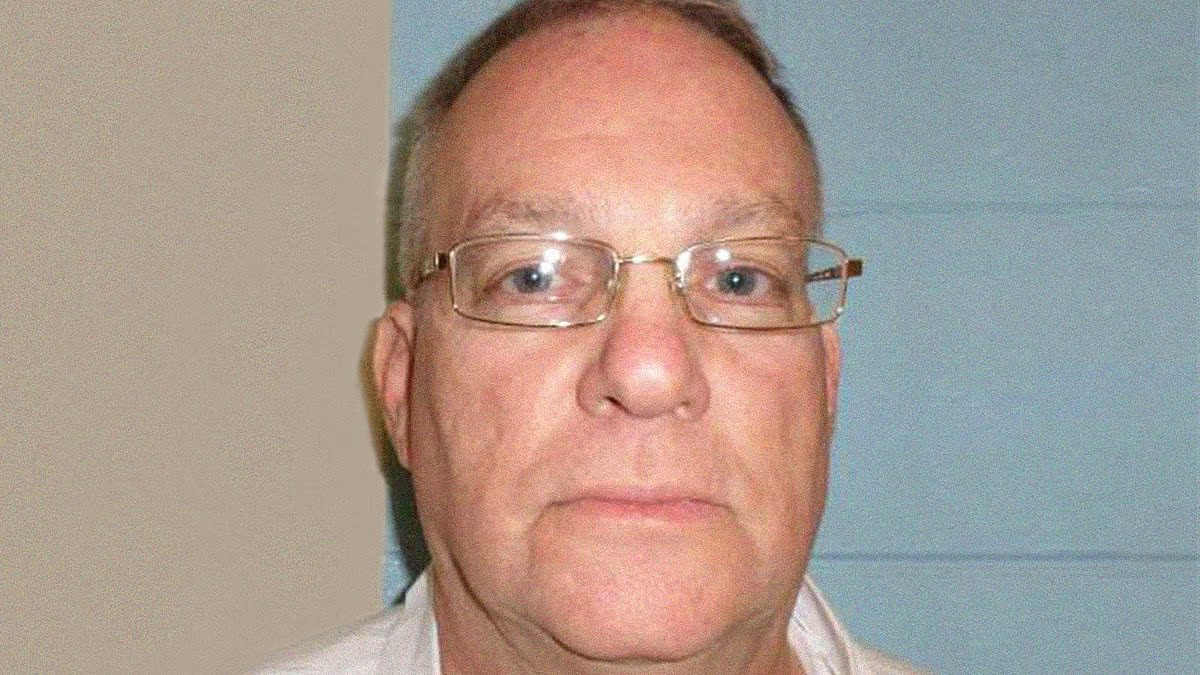
An Alabama man who spent more than four decades in prison for allegedly killing his wife has been granted a new trial.
Charles McCrory was convicted and sentenced to life in prison for the May 1985 killing of his wife, Julie Bonds McCrory. A federal judge has now ordered Alabama either to retry him for the murder or release him.
The prosecution’s case centered largely on two small marks on Julie’s arm. State prosecutors and their expert claimed the injuries were bite marks inflicted by Charles during a violent and rage-filled attack.
The practice of matching bite marks to a suspect’s teeth is now widely regarded as junk science. The dentist who testified against McCrory has also withdrawn his conclusion, saying he cannot even determine whether the marks were made by teeth.
In an order issued Monday, Chief U.S. District Judge Austin Huffaker Jr. wrote: “The bitemark evidence clearly prejudiced the outcome of McCrory’s trial, especially in light of the other evidence presented at trial.
“The non-bitemark evidence from which the jury could convict McCrory was thin.”
Huffaker’s ruling gives the Alabama Attorney General’s Office 180 days to start a new trial for McCrory or release him from prison.
McCrory worked for 26 years as a technology worker and volunteer paramedic. Despite the lack of DNA evidence, a confession or a clear motive, he remained the primary suspect in his wife’s death.

Julie and Charles McCrory were going through a divorce when Julie was found dead in her apartment in 1985

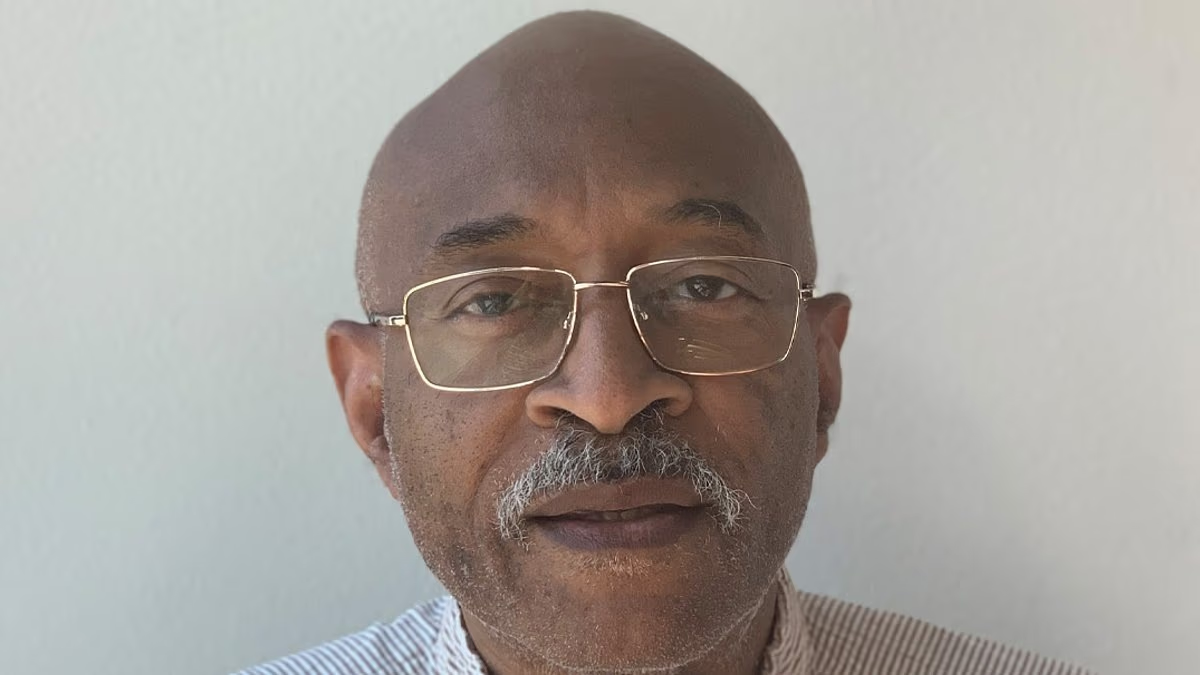
Charles McCrory spent nearly four decades in prison after receiving a life sentence for his wife’s killing

Investigators found two bite marks on Julie’s upper right arm, along with five “chop” wounds to her head, 11 puncture wounds to her chest, fractured jaw bones and bruises
No blood was found on McCrory’s clothing or inside his apartment.
Dr. Richard Souviron, a Florida forensic dentist who had previously matched a victim’s injuries to Ted Bundy’s teeth during Bundy’s 1979 trial, testified that the two marks on Julie’s arm matched her husband’s teeth.
The bite-mark testimony was the only physical evidence used against McCrory, Huffaker wrote, concluding that its admission “resulted in a fundamentally unfair trial.”
Huffaker also said the state court’s 2022 decision rejecting Charles’s request for a new trial was “both an unreasonable application of clearly established federal law and was based on an unreasonable determination of the facts.”
At the time, Charles lived in a small apartment down the street from Julie and their toddler son in Andalusia, Covington County. The couple were in the process of divorcing.
Charles said he and Julie attended couples therapy, spent time with their son and had sex before he returned to his apartment on the night of May 30, 1985.
The couple continued to spend time together, and Julie’s date book suggested that Charles might move back in, AL.com reported.

The bite-mark comparison method used to convict McCrory is now considered junk science

Charles and Julie McCrory’s son, Chad, still lives in Alabama. Our News Outlet contacted him for comment

Six years ago, the state court offered Charles McCrory to walk out of prison if he admitted killing his wife. He declined
Charles said he heard about the murder the next morning, when his paramedic radio signaled a call for help at his wife’s home.
Julie was found lying in the front doorway of her home – severely beaten with five ‘chop’ wounds to her head, 11 puncture wounds to her chest, fractured jaw bones, bruises and two small marks on her upper right arm.
The cause of the puncture marks was never confirmed.
At trial in October 1985, the case hinged on circumstantial evidence like McCrory’s behavior and disputed witness statements as to cars at the family home.
The two small marks that Souviron said were made by McCrory’s upper teeth were the only physical evidence.
McCrory was convicted and sent to prison for the rest of his life, despite the lack of evidence.
In recent years, the technique of bite mark evidence was questioned and considered ‘junk science’ by national groups saying that this type of analysis lacks data.
Souviron took back his testimony in a 2019 affidavit: ‘I no longer believe the individualized teeth marks comparison testimony I offered in his case was reliable or proper.’
He said he ‘would not’ give the same testimony today in Charles McCrory’s case, adding that he never actually examined Julie’s body and relied on photos instead.
Despite the dentist’s new statements, Alabama state courts denied a request from Charles’s team of lawyers for a new trial.
Prosecutors from the Alabama Attorney General’s Office argued in 2021 that jurors could have simply looked at pictures of Julie’s body and matched the markings themselves – to which the Alabama Criminal Court of Appeals agreed.
Huffaker commented on the suggestion: ‘This finding blinks reality in light of the evidence.
‘If an expert could not testify about bitemark identification because it is junk science, a jury should not have been allowed to consider it either.’
‘It makes little sense that a lay jury could permissibly form a conclusion that no forensic expert could.’
Charles McCrory’s lawyers cited 39 known wrongful convictions and indictments made on the basis of bite mark forensics – two of which were made on testimonies by Souviron.
Six years ago, the state offered McCrory to walk out of prison if he admitted to killing his wife – which he declined: ‘What am I going to do, make up a story?
‘I kind of chuckled… I’m not going to plead guilty to something I didn’t do,’ he told AL.com.
Our News Outlet contacted the Alabama Attorney General’s Office and McCrory for comment.